LEAP East 2026: Hong Kong Just Became the Test Bed for Stablecoin Settlement and Agent Payments
By Furlpay Team · July 8, 2026 · 7 min read
LEAP East 2026 opened this week at the Hong Kong Convention and Exhibition Centre — the first international edition of the Saudi-backed LEAP technology exhibition, running 8-10 July with hundreds of speakers and exhibitors across fintech, AI and Web3. The location is not incidental. Hong Kong has spent the past year building the most explicit regulatory on-ramp for stablecoin issuers anywhere in Asia, and the conference agenda — settlement infrastructure, tokenized deposits, agentic commerce — reads like a public roadmap for where regulated crypto payments go next.
The regulatory scaffolding is real now
Hong Kong's Policy Statement 2.0 on digital assets introduced the LEAP framework — legal streamlining, expanded tokenized products, advancing use cases, and people/partnership development — with a unified licensing regime covering exchanges, stablecoin issuers, dealers and custodians. In March 2026 that framework produced its first concrete output: the HKMA granted the first stablecoin issuer licenses to HSBC and to Anchorpoint Financial, a Standard Chartered-led venture that includes Animoca Brands. Bank-issued, reserve-audited stablecoins are no longer a consultation paper in Hong Kong; they are licensed products.
Japan reached the same milestone weeks earlier by a different route. The JFSA approved Ripple's RLUSD as the country's first "Type 4" electronic payment instrument, live via SBI VC Trade since late June (Ethereum-only, capped at roughly ¥1M per transaction), while SBI's yen-denominated JPYSC launched uncapped for institutional settlement. Two of Asia's three largest financial centers now have licensed stablecoins issued by or with major banks — a template the rest of APAC can copy.
From pilots to systems
The recurring theme on the LEAP East stage is the shift from experimental pilots to a systems phase: stablecoins as standard settlement infrastructure alongside ACH and SWIFT, not a parallel curiosity. That matches what we see on the merchant side. Cross-border settlement in USDC clears in seconds for cents, every payment carries an on-chain receipt, and treasury teams get reconciliation for free. The blocker was never the technology — it was the absence of licensed issuers and clear supervisory expectations. That blocker is now being removed jurisdiction by jurisdiction.
- Licensed issuance: HSBC and Anchorpoint in Hong Kong; RLUSD and JPYSC under the JFSA in Japan.
- Unified VASP licensing under the LEAP framework, covering custody and dealing, not just exchanges.
- Sandboxes for tokenized deposits, letting banks settle on-chain under regulatory supervision.
The second story: machines that pay
The other dominant track is autonomous commerce. With open protocols like x402 for pay-per-request APIs and AP2 for agent payment mandates, AI agents can now hold budgets and settle nanopayments — fractions of a cent for compute, data feeds and API calls — on low-latency L2 chains like Base and Arbitrum. The critical design pattern discussed across panels is the pre-authorized spending mandate: cryptographically bound limits (budget, merchant category, expiry) that let an agent transact without ever touching a master key.
This is precisely the architecture Furlpay ships today. @furlpay/agent-trust implements user-signed spend mandates — max total, max per booking, merchant allowlists, expiry, single-use — with RFC 9421 HTTP signatures, and x402-guard hardens the settlement path against the known free-riding attack classes. Our CLI's MCP server, now listed on the official MCP Registry, gives any AI agent 18 financial tools: balances, transfers, swaps, fractional stock orders, travel booking and yield deposits, all settling in USDC.
What we take home from it
| LEAP East 2026 trend | Furlpay alignment |
|---|---|
| APAC licensed-stablecoin corridors | USDC-native settlement on Arbitrum and Base, FX-aware routing |
| Tokenized-deposit sandboxes | Safe/ERC-4337 smart accounts via the Account Kit |
| Agentic micropayments (x402, AP2) | MCP server, agent-trust mandates, x402-guard |
| Verifiable settlement | On-chain receipt for every payment |
Our read: the compliance-aware corridor is the product. As JPYSC, RLUSD and Hong Kong's licensed issuers come online, the winners will be platforms that can route a payment through the right stablecoin, the right chain and the right disclosure regime automatically — for humans and for their agents. That routing layer is what we build. If you are working on APAC settlement or agent payments, talk to us or start with the developer docs.
Hong Kong spent two years writing the rulebook. LEAP East is the moment the industry showed up to play by it.

Founder & CEO, FurlPay · Software Engineer at Skyhigh Security · NeurIPS 2026 author · Google DeepMind contributor · ex-Quantiphi
Ashutosh is a Software Engineer at Skyhigh Security (previously Quantiphi), working across ML systems and cloud infrastructure. He is a contributor to Google DeepMind and a NeurIPS 2026 author. He is building Furlpay: stablecoin payments, travel booking, and investing in one client — settled on Arbitrum. Pay in USDC, book 2.2M+ stays and flights, and let AI agents pay per-request via x402. Phishing-resistant. Compliance-aware. Zero gas.
Don't miss the next one
Stay ahead of the curve
Get product updates, engineering deep-dives, and security bulletins. No spam — just the signal.
More in Legal & Compliance
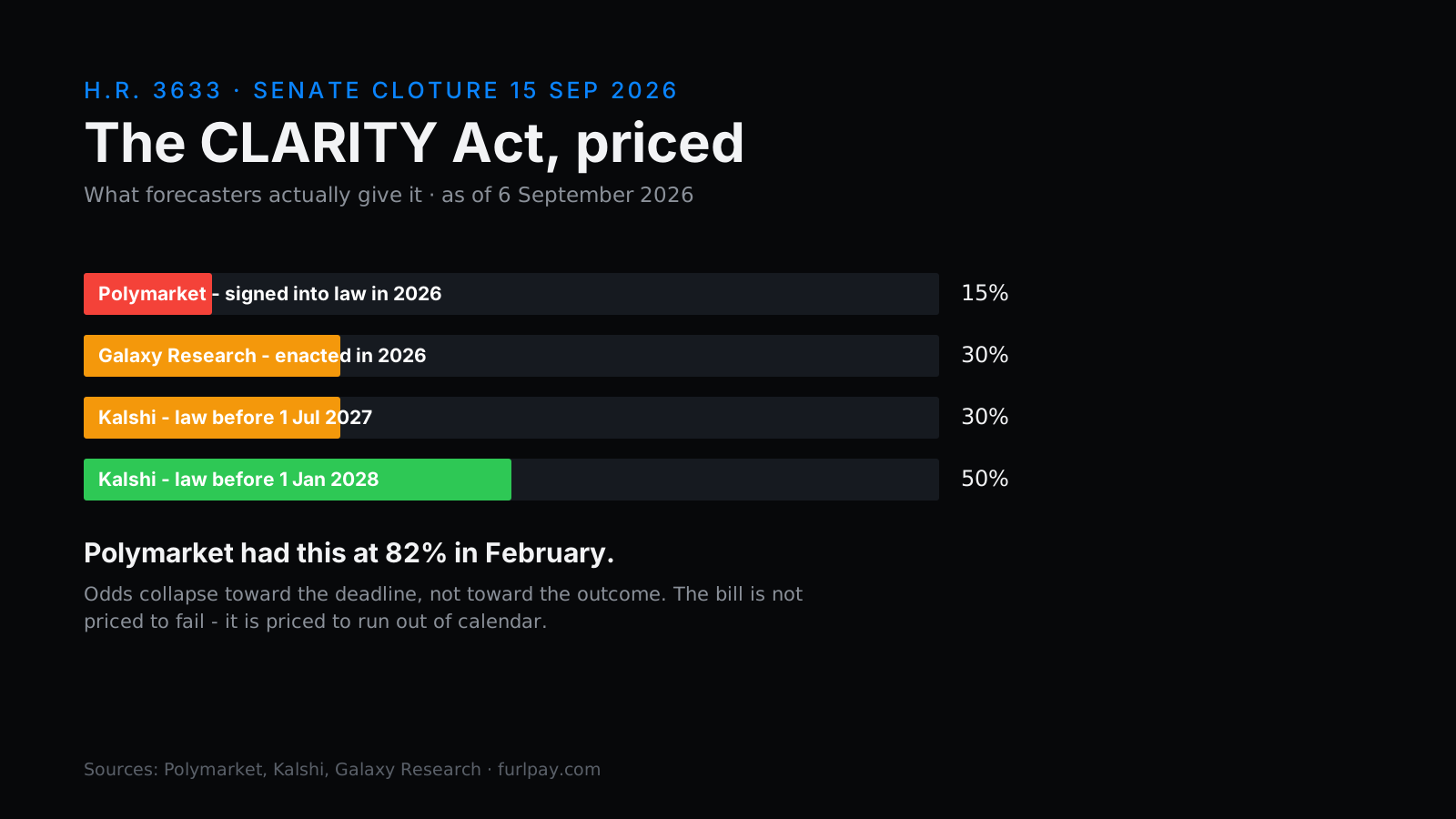
The CLARITY Act Is Not Dead. It Is Running Out of Calendar.
Updated 12 October: the 15 September cloture vote failed 49–50. Before it, prediction markets gave the CLARITY Act a 15% chance of becoming law in 2026 — and 50% by January 2028. The bill is late, not dead. Meanwhile JPMorgan settles more than $7bn a day in tokenized deposits without waiting for it. What the 15 September Senate vote decided, what atomic settlement does and does not fix, and why the strongest objections come from the people who understand market structure best.
September 7, 2026 · 23 min read
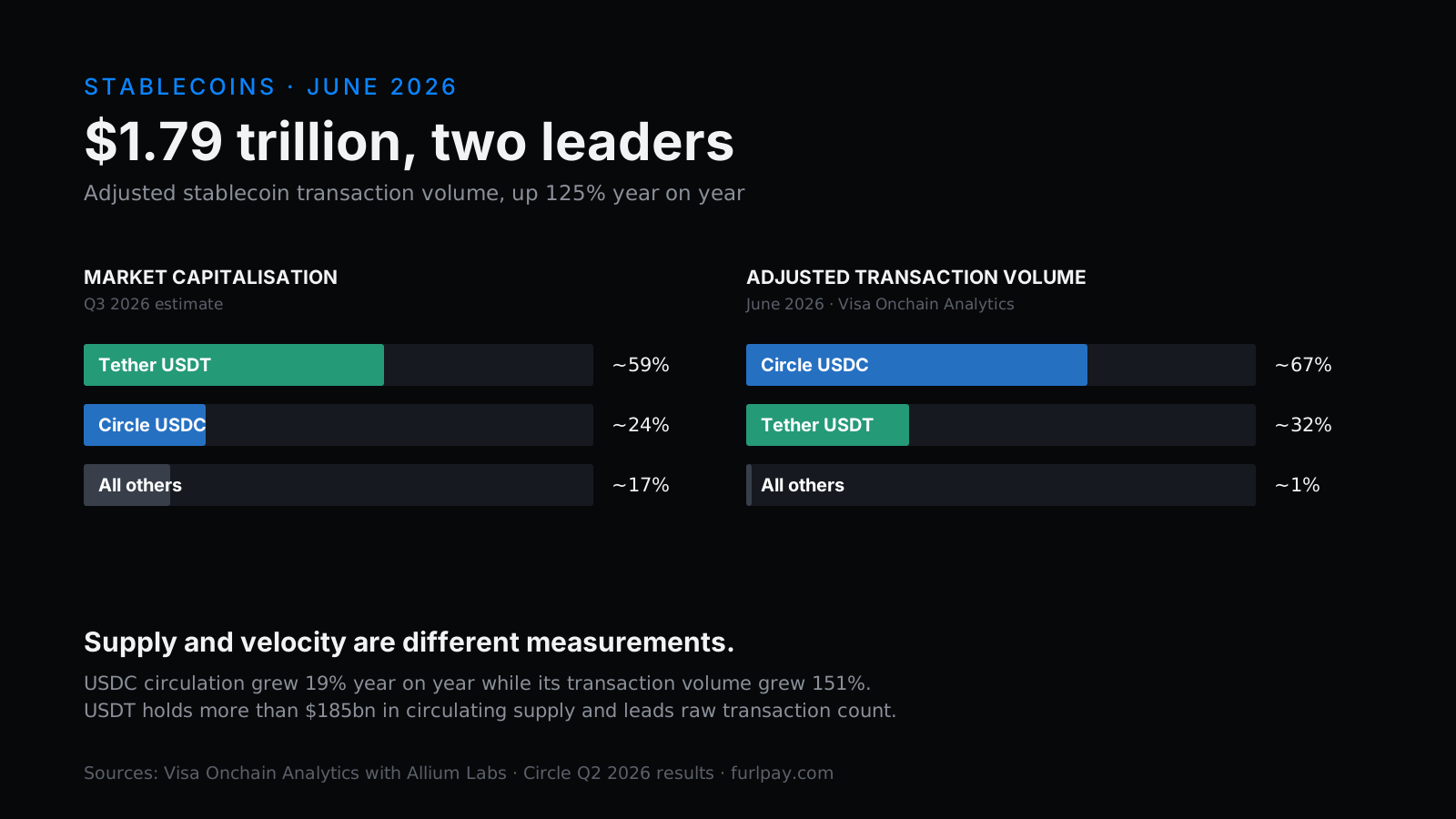
Stablecoin Transaction Volume in 2026: Circle, Tether and the Race to Build the Payment Rail
Stablecoins settled $1.79 trillion in adjusted transaction volume in June 2026, up 125% year on year. USDC accounted for approximately 67% of that volume; USDT remains the largest stablecoin by market capitalisation at more than $185 billion. An analysis of what each metric measures, where Circle and Tether actually stand, and what Visa, Mastercard, Stripe, PayPal and Coinbase are building around them.
September 7, 2026 · 15 min read

Stablecoins Quietly Overtook Crypto for Cross-Border Payments — Here Is the Data
In 2025 stablecoins settled about $33 trillion on-chain, more than Visa and Mastercard combined, while Bitcoin and Ethereum's share of cross-border flows kept shrinking. The GENIUS Act, Stripe's $1.1B Bridge deal and Mastercard's $1.8B BVNK deal all landed in the same window. Here is what actually happened, with the figures checked against primary sources — and where a middleware layer like FurlPay fits.
July 18, 2026 · 12 min read