Integrating Furlpay with Arbitrum: Payments, x402 and Contracts on the Largest L2
By Furlpay Engineering · July 5, 2026 · 9 min read
Arbitrum One has quietly become the institutional settlement layer of Ethereum. The network has processed over 2.1 billion lifetime transactions, secures roughly $20B in value, and holds the deepest stablecoin liquidity of any L2 — which is why Mastercard chose it for 24/7 stablecoin settlement and why Robinhood built its tokenized-stock chain on Arbitrum Orbit. January's ArbOS "Dia" upgrade added predictable gas pricing on top. For a payments company whose pitch is "0.5% USDC rails instead of 3.5% card interchange," this is the rail you settle on.
This week we made Furlpay Arbitrum-first. This post is the engineering log: what shipped, how it fits together, and what is still in front of us before the Arbitrum Open House in London (July 10-12).
What shipped: the API layer
- x402 on Arbitrum — our facilitator now verifies and settles agentic payments on arbitrum and arbitrum-sepolia alongside Base and Solana, and quotes default to native USDC on Arbitrum One (0xaf88...5831). The hardening we published in "Five Ways to Rob an AI Agent" carries over unchanged: HMAC-bound quotes, single-use nonces, strict web-layer parsing.
- A unified payments API — POST /api/payments/create returns a 0.5% fee quote plus EIP-712 typed data; /execute verifies the payer's signature, screens both parties against sanctions lists, and settles on Arbitrum One. Receipts link straight to Arbiscan. Batch, refund, history and a public fee estimator round out the surface.
- A chain registry — /api/chain/status, /gas-price, /contracts, /usdc/supply and /tx lookups across Arbitrum One (42161), Arbitrum Sepolia (421614), Robinhood Chain (4663), Base and Ethereum. Mock-first, so the whole stack runs with zero credentials; flip INTEGRATION_MODE=live for real JSON-RPC.
- An x402 resource catalog — agents can now discover what Furlpay sells (GET /api/x402/resources), quote any resource without triggering a 402 (/price), and confirm settlements (/settlement/:tx). Third-party servers onboard their own priced endpoints via /register.
What shipped: the contracts
Four Solidity contracts, OpenZeppelin 5 throughout, compiled for the Cancun EVM target Arbitrum supports, with a 17-test suite covering the full lifecycle of each — payments, replays, expiry, wrong-signer rejection, fee ceilings, escrow release and refund paths, and EIP-3009 settlement.
apps/web (Next.js API)                    packages/contracts (Arbitrum One)
POST /api/payments/create  ── EIP-712 ──>  FurlPayRouter.pay()      0.5% fee, nonce replay guard
POST /api/x402/facilitator/settle ──────>  X402Facilitator.settle() EIP-3009, resource-bound log
POST /api/travel/bookings  ─── USDC ───>   FurlPayEscrow            oracle release / timed refund
└──> BookingReceipt (ERC-721) minted to the traveler- FurlPayRouter — a payer signs a Payment authorization off-chain (the exact typed data our API already emits); a relayer submits it. The merchant receives amount minus fee, the treasury accrues the fee, and the contract enforces a hard 1% fee ceiling on-chain regardless of what any API quotes. Nonces are single-use; authorizations expire.
- X402Facilitator — forwards EIP-3009 transferWithAuthorization to USDC, so the facilitator never holds funds or keys, then writes an indexed settlement record binding the payment to a hash of the resource it bought. Coinbase's hosted facilitator and PayAI already settle x402 on Arbitrum; ours differs by indexing settlements on-chain and binding them to resources, which is what /api/x402/settlement serves back to agents.
- FurlPayEscrow — travel bookings fund in USDC and release on oracle-confirmed check-in, refund inside the cancellation window, or release permissionlessly after a 7-day grace period so providers are never hostage to a dead oracle.
- BookingReceipt — an ERC-721 minted on funding whose tokenId is the booking id, so proof-of-purchase is verifiable straight from the booking reference.
Design decisions worth stealing
- Sign off-chain, settle on-chain. Users and agents never pay gas to authorize; a relayer batches submissions. Arbitrum's post-Dia fee floor makes the relayer's cost per settlement fractions of a cent.
- Compliance before the chain. Both legs of every payment pass sanctions screening server-side before any transaction is submitted — the same pattern institutional settlers use, and the reason the contract layer can stay simple.
- Fee ceilings belong on-chain. The API quotes 0.5%, but the router refuses anything above 1% cryptographically. If our API is ever compromised, the blast radius is bounded by the contract.
- Mock-first infrastructure. Every endpoint runs deterministically with zero credentials and switches to live RPC with one environment variable. Demos never depend on testnet faucets cooperating.
What is left
- Deploy to Arbitrum Sepolia, then One — the deploy script already prints the FURLPAY_* environment variables the web app reads; the contract directory flips from "pending deployment" to live addresses the moment they exist.
- The relayer — a small service that takes executed API payments and submits them to FurlPayRouter, completing the off-chain-to-on-chain loop.
- Merchant API and compliance endpoints — checkout sessions, payouts, webhooks, and public sanctions-screening routes on top of the screening engine that already guards /execute.
- ERC-4337 passkey wallets — our WebAuthn authentication already exists; wiring it to a smart account with a USDC paymaster removes the last piece of gas UX entirely.
- The Orbit question — Robinhood validated launch-on-One, migrate-to-Orbit. If Furlpay's settlement volume justifies a dedicated chain with compliance hooks at the sequencer level, the Nitro stack is the obvious path.
The pattern behind all of it: stablecoin settlement is consolidating on Arbitrum, agentic payments are consolidating on x402, and Furlpay sits at the intersection — the payment rail where both humans and machines transact, with compliance built in rather than bolted on. If you are at the Open House in London, come find us; the contracts will be on Sepolia by then.
Furlpay
Written by the Furlpay team — engineers and compliance specialists building an on-chain financial operating system for stablecoin payments, travel, and investing on Arbitrum.
Don't miss the next one
Stay ahead of the curve
Get product updates, engineering deep-dives, and security bulletins. No spam — just the signal.
More in Engineering
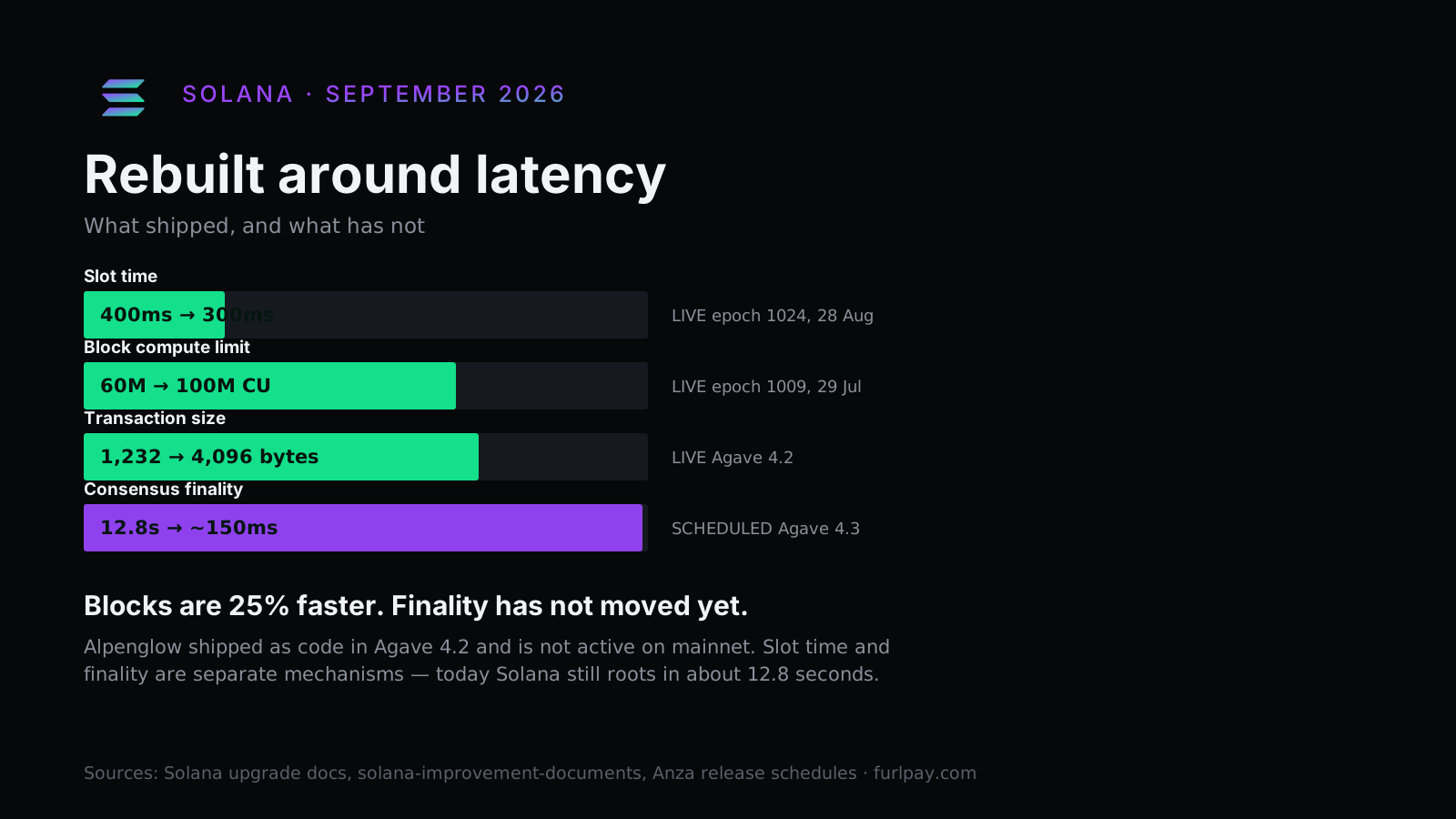
Solana Is Being Rebuilt Around Latency, Not Throughput
Updated 12 October: slot times reached 200ms in October, and Alpenglow is still not live on mainnet. In August 2026 Solana cut its slot time below 400ms for the first time since genesis, and block capacity had already risen 66% to 100M compute units. But finality still takes 12.8 seconds — the upgrade that changes that is scheduled, not shipped. What is actually live, what is not, and why the roadmap is a latency story rather than a TPS one.
September 7, 2026 · 15 min read
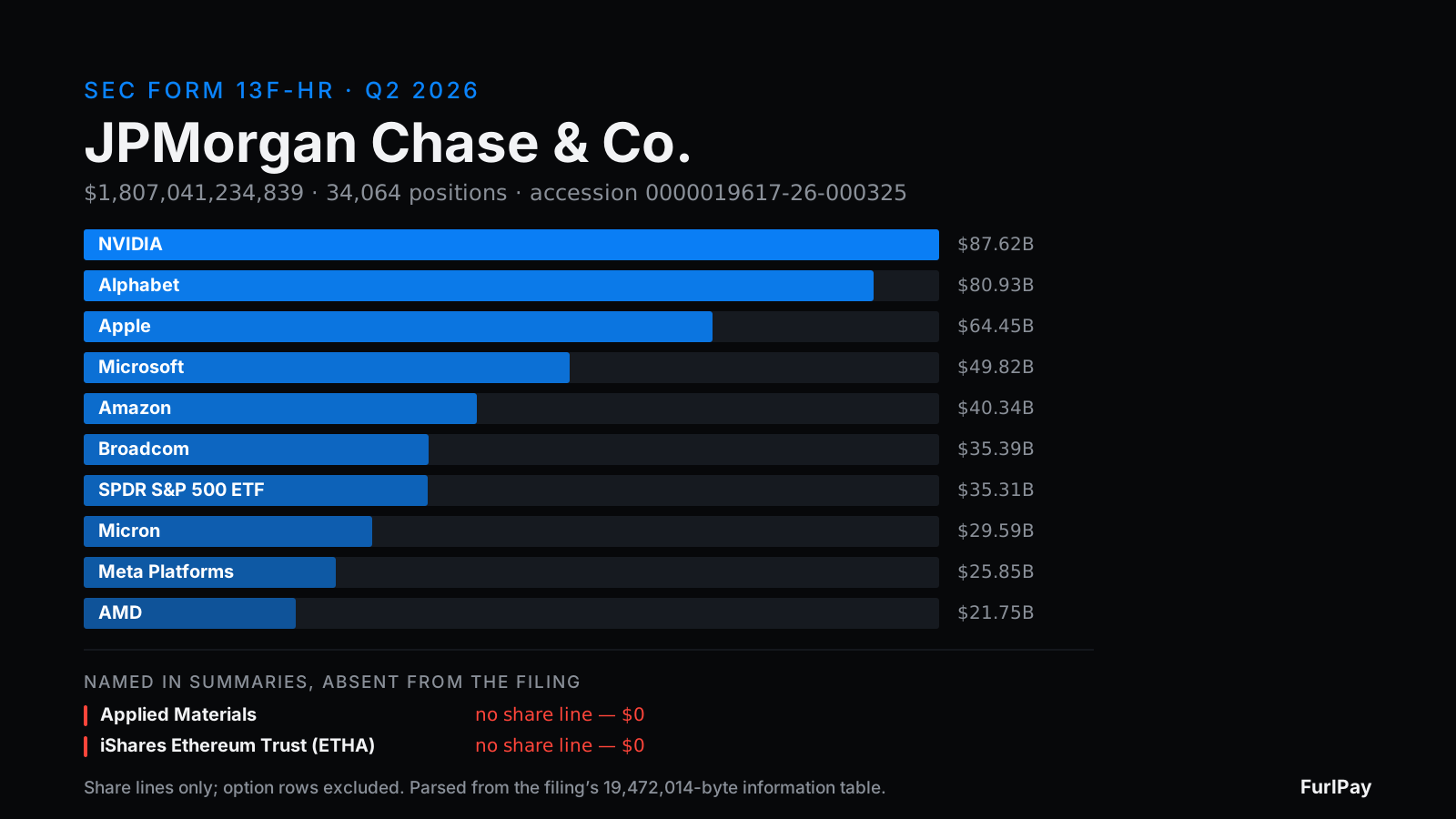
JPMorgan 13F Q2 2026: What the SEC Filing Actually Shows
JPMorgan reported $1,807,041,234,839 across 34,064 information-table rows for the quarter ended 30 June 2026. We parsed the original SEC XML twice and reconciled it to the dollar. Here is what the filing shows on the iShares Ethereum and Bitcoin trusts, Strategy, the bitcoin miners and the semiconductor names — and why the same filing produces different position counts, share totals and rankings depending on how the rows are read.
September 2, 2026 · 18 min read

Bypassing the 3% Card Tax: How I Built an x402 Settlement Layer for AI Agents and Travelers on Arbitrum
A $340 resort checkout loses $11.90 to five intermediaries before it reaches the hotel — three days later. Here is how I built Furlpay's x402 settlement layer on Arbitrum instead: the actual contract code, measured gas benchmarks from the 34-test suite, the paymaster math behind zero-gas UX, and a direct answer to 'why not just use Stripe?'
July 8, 2026 · 11 min read