Bypassing the 3% Card Tax: How I Built an x402 Settlement Layer for AI Agents and Travelers on Arbitrum
By Ashutosh Kumar Singh · July 8, 2026 · 11 min read

I started building Furlpay because of a hotel bill in Dubai. Last year I watched a $340 resort checkout generate $11.90 in card processing fees — interchange, network assessment, cross-border markup, acquirer margin — before it reached the hotel's bank account three days later. The hotel earned $328.10 for a room that cost them roughly $280 to service. The other $11.90 went to five intermediaries whose only job was moving numbers between databases.
That moment crystallized something I had been thinking about for months: the internet has a native protocol for every resource type — HTTP for documents, SMTP for mail, WebRTC for video — except money. And now that autonomous AI agents are booking travel, buying API calls and executing workflows in production, the absence of a native payment protocol is not a design curiosity. It is a $198 billion annual extraction in the US alone. Furlpay is my answer: x402-native stablecoin payments, 2.2M+ bookable stays and flights, and fractional investing in one client — settled in USDC on Arbitrum, with zero gas fees and passkey security. This post explains what I built, how it works at the contract level, and why the economics are structurally hard to beat.
The numbers: why the 3% card tax is structural
The global travel industry cleared $1.6 trillion in gross bookings in 2024 and is on track for $1.8 trillion by 2027 — and it still runs on financial plumbing designed in the 1970s. A 2026 card transaction stacks interchange of 1.15% to 3.15%, network assessments, and processor markups, and travel is hit hardest because premium travel-rewards cards carry some of the highest interchange in the system. For a resort group doing $50 million in annual bookings, the 2-3.5% all-in cost is over $1 million a year in pure transaction overhead — a deadweight loss that buys no rooms, no staff and no guest experience. On top of the fee stack, merchants absorb chargebacks with 120-day dispute windows and rolling reserves that lock up working capital for months.
Even the largest merchant settlement in history barely moves the number: the $38 billion Visa/Mastercard settlement granted preliminary approval in April 2026 trims average credit interchange by just 0.10% over five years. The 3% card tax is not a pricing decision — it is an architectural artifact of a five-party relay system, and litigation will not compress what only a different rail can. Meanwhile the rails are worse than expensive for machines: HTTP reserved status code 402 ("Payment Required") in the original web specification and it sat dormant for three decades, so a machine visiting a paid resource had no standardized way to discover a price, sign a payment and receive the resource in one round trip.
And 2026 is the year that gap started to matter commercially. Visa plugged its network into ChatGPT in June, Mastercard executed its first live agentic payment in Hong Kong in March — an AI agent booking and paying for an airport taxi with HSBC and DBS as issuers — and Sabre, PayPal and MindTrip announced the travel industry's first end-to-end agentic booking system. The demand side is arriving fast. What has been missing is a settlement layer priced and shaped for machines.
What I actually built: the x402 settlement flow
In April 2026 the Linux Foundation launched the x402 Foundation, taking contribution of the x402 protocol from Coinbase — with Cloudflare and Stripe as co-developers and initial support spanning Google, AWS, Microsoft, American Express, Mastercard, Visa, Circle and Shopify. That made HTTP-native machine payments an open, neutrally governed standard rather than one vendor's API. Adoption followed quickly: by late April, Coinbase reported 69,000 active agents and 165 million x402 transactions across the ecosystem.
Furlpay applies that standard to the travel vertical end to end. When an AI agent — or a human using our app — books a room, the endpoint answers with a 402 carrying machine-readable payment requirements: the exact USDC amount in atomic units, the asset contract on Arbitrum One, the address to pay, and the resource the payment buys:
HTTP/1.1 402 Payment Required
Content-Type: application/json

{
  "x402Version": 1,
  "accepts": [{
    "scheme": "exact",
    "network": "arbitrum-one",
    "asset": "0xaf88d065e77c8cC2239327C5EDb3A432268e5831",
    "payTo": "0x7a3f…",
    "maxAmountRequired": "340000000",
    "resource": "/api/travel/book?hotel=…",
    "maxTimeoutSeconds": 300
  }]
}- The agent signs an EIP-3009 transfer authorization over that exact amount, recipient and validity window — an off-chain signature that costs the signer zero gas.
- Our facilitator submits the authorization on Arbitrum, hardened against replay and free-riding attack classes by x402-guard.
- The API verifies the on-chain settlement record, escrows the funds against the booking and mints an ERC-721 booking receipt — end to end in seconds, with no human in the loop.
The same rails serve the investing side of the client. With Robinhood Chain's mainnet live on Arbitrum Orbit as of July 1 and tokenized stocks trading around the clock, Arbitrum is consolidating as the settlement venue for consumer real-world assets — and a traveler's idle USDC balance can earn or invest in the same account that books the trip.
Show, don't tell: the settlement contract
When I sat down to write the settlement logic, the goal was to make the entire payment one atomic function call — no multi-step approvals, no intermediate custody, no callback hell. Here is the core of X402Facilitator.sol as it runs in our test suite today:
/// @notice Settle a verified x402 payment. The signature is checked by
///         USDC against the payer, so the facilitator adds no trust
///         assumptions — it can't move funds the payer didn't authorize.
/// @param resourceHash keccak256(resource URL) binding payment → resource.
function settle(
    address from, address to, uint256 value,
    uint256 validAfter, uint256 validBefore,
    bytes32 nonce, bytes32 resourceHash,
    uint8 v, bytes32 r, bytes32 s
) external whenNotPaused {
    if (settlements[nonce].settledAt != 0) revert AlreadySettled(nonce);

    // Reverts inside USDC on bad signature, expired window or used nonce.
    usdc.transferWithAuthorization(
        from, to, value, validAfter, validBefore, nonce, v, r, s
    );

    settlements[nonce] = Settlement({
        payer: from,
        payTo: to,
        amount: value,
        resourceHash: resourceHash,
        settledAt: uint64(block.timestamp)
    });

    emit X402Settled(from, to, value, resourceHash, nonce);
}- The facilitator holds no funds and no keys. The EIP-3009 signature is verified by USDC itself against the payer, so this contract adds zero trust assumptions — it physically cannot move money the payer did not authorize, and USDC's own nonce accounting makes every authorization single-use.
- Payments are bound to what they bought. resourceHash is the keccak256 of the resource URL, and every settlement is recorded on-chain and served back to agents via GET /api/x402/settlement/:tx — so an agent can later prove exactly which booking a payment paid for, something hosted facilitators do not give you.
- Fees are capped on-chain, not just in the API. The 0.5% fee is applied by our FurlPayRouter payment rail, whose contract hard-codes a 1% fee ceiling (MAX_FEE_BPS = 100) — whatever a compromised or misconfigured API might quote, the chain refuses anything above 1%.
Gas benchmarks: why the paymaster model is sustainable
These are measured numbers from our Hardhat suite — 34 passing tests plus a mainnet-fork suite that validates the settlement paths against real Arbitrum One USDC and the Chainalysis sanctions oracle — compiled with solc 0.8.28, optimizer enabled:
| Operation | Gas (measured) | What it does |
|---|---|---|
| X402Facilitator.settle | 202,667 | Agent payment: EIP-3009 USDC transfer + on-chain settlement record |
| FurlPayRouter.pay | 129,240 | Signed EIP-712 payment: merchant gets amount minus fee, treasury gets fee, replay-safe |
| FurlPayRouter.batchPay | 198,810 / batch | Up to 100 payouts in one transaction (payroll, supplier runs) |
| FurlPayEscrow.createBooking | 206,233 | Escrows the booking funds and mints the ERC-721 receipt NFT |
The paymaster math follows directly. On a $340 hotel booking, the 0.5% fee is $1.70 of USDC revenue. At Arbitrum One's typical base fee the 202,667-gas settle transaction costs around a cent, and single-digit cents even when gas spikes — roughly two orders of magnitude below the fee it earns. That margin is what lets us sponsor gas for every user and every AI agent rather than teaching travelers what ETH is. On Ethereum L1 the identical call would cost dollars at congested prices, which is why gas sponsorship for sub-$200 bookings only works on an L2: Arbitrum's cost structure is not a nice-to-have, it is what makes the business model function.
Why not just use Stripe?
It is the first question every investor asks, and it deserves a direct answer. Stripe's stablecoin product charges a flat 1.5% and routes merchant payouts through the standard Stripe balance and payout cycle — a genuinely good product, priced to cover a fiat off-ramp and Stripe's margin. Furlpay charges 0.5% because we never leave the chain: USDC in, USDC out, settled on Arbitrum in seconds, with the fee ceiling enforceable by the merchant on-chain. That is not a pricing tactic — it is an architectural consequence of staying on-chain that a fiat-first processor cannot copy without rebuilding its settlement model.
| Dimension | Stripe (stablecoin) | Coinbase Commerce | Furlpay |
|---|---|---|---|
| Fee | 1.5% flat | 1% | 0.5% flat, 1% ceiling enforced on-chain |
| Settlement | Standard payout cycle (USD) or wallet payout | On-chain | ~2 seconds on Arbitrum, booking-bound receipts |
| AI agent support | None native | Basic crypto accept | Native x402 + spend mandates + MCP tools |
| Travel vertical | No booking engine | No booking engine | 2.2M+ stays and flights in-client |
| Gas model | N/A (off-chain) | User pays gas | Sponsored via paymaster |
| Custody | Processor-held balance | Optional self-custody | Always self-custody (smart accounts) |
Coinbase Commerce is closer to our architecture but operates as a generic payment button with no vertical integration: it does not book hotels, does not issue spend mandates to AI agents, and does not bind receipts to bookings. Horizontal infrastructure captures thin protocol fees. Vertical infrastructure captures the full transaction stack.
Frictionless by design: passkeys and gas-free accounts
Web3 payments have historically failed on user experience: seed phrases, gas tokens and opaque wallet prompts are non-starters for a traveler at checkout. Furlpay removes all three. Accounts are ERC-4337 smart accounts created and approved with passkeys — WebAuthn credentials whose private keys live in the device's hardware secure enclave and unlock with FaceID or a fingerprint, making them phishing-resistant by construction. Gas is invisible: transactions route through a paymaster on Arbitrum, sponsored out of the merchant-side fee, so neither guests nor agents ever hold ETH. The result feels like Apple Pay and settles like a wire that clears in two seconds.
The detail I spent the longest on was making "sign up and get paid" feel instant. A Furlpay account address is derived deterministically from the passkey's public key, so the address exists — and can receive USDC — before the smart-account contract is ever deployed; the first outgoing transaction triggers the actual counterfactual deployment. Getting that derivation stable across devices and credential re-registrations took longer than the payment rail itself, and it is exactly the kind of detail that separates a demo from a product.
Compliance as a moat, not a checkbox
Payments infrastructure does not get to route around regulation — and in 2026 the rulebook finally crystallized, which favors builders who engineered for it early. In the US, the GENIUS Act was signed in July 2025 and final implementing regulations are due by July 18, 2026, giving payment stablecoins a federal prudential framework. In Japan, the JFSA's mid-2026 electronic payment instrument approvals opened a licensed USDC-settlement pathway via SBI VC Trade. We design for the UK FCA's e-money regime, Dubai's VARA framework and Saudi Arabia's SAMA cashless-vision programs from day one, routing each payment through the disclosure regime its corridor requires — and we will be in Riyadh for Money20/20 Middle East this September.
Just as important is what we do not do: Furlpay never takes custody of customer deposits. Balances live in non-custodial smart accounts and 2-of-2 MPC vaults; we act strictly as an on-chain routing and settlement utility. That architecture cuts our regulatory surface dramatically while guaranteeing users self-custody — the same property that lets AI agents transact under cryptographically bound spend mandates (budget caps, merchant allowlists, expiry) without ever touching a master key.
The investment case: vertical integration wins
Venture capital has funded horizontal agent-payment protocols generously. But horizontal infrastructure only captures value when vertical applications drive real-world volume through it — and travel is the deepest consumer vertical there is. Furlpay owns the full loop in one client: stablecoin checkout, a travel engine with 2.2M+ stays and flights, and a USDC-funded investing hub.
- A 0.5% checkout take rate on every stablecoin payment routed through the facilitator.
- 2-5% travel commission on each hotel or flight booked through the aggregated inventory.
- x402 paywall hosting fees from developers selling API access to AI agents via our MCP server.
Three revenue engines compound inside a single transaction loop. As stablecoins absorb global money movement and autonomous agents scale from 69,000 to millions, the platforms that win will be the ones already routing real bookings, for real merchants, under real regulatory frameworks.
Cards taxed the travel industry 3% for fifty years because there was no alternative rail. For humans and machines alike, there is now.
Furlpay is launching its developer sandbox and raising a seed round to fund our first hotel pilots. Our smart contracts and SDKs are open source on GitHub, the developer docs cover the x402 integration end to end, and you can reach me directly at founder@furlpay.com or via talk to us.

Founder & CEO, FurlPay · Software Engineer at Skyhigh Security · NeurIPS 2026 author · Google DeepMind contributor · ex-Quantiphi
Ashutosh is a Software Engineer at Skyhigh Security (previously Quantiphi), working across ML systems and cloud infrastructure. He is a contributor to Google DeepMind and a NeurIPS 2026 author. He is building Furlpay: stablecoin payments, travel booking, and investing in one client — settled on Arbitrum. Pay in USDC, book 2.2M+ stays and flights, and let AI agents pay per-request via x402. Phishing-resistant. Compliance-aware. Zero gas.
Don't miss the next one
Stay ahead of the curve
Get product updates, engineering deep-dives, and security bulletins. No spam — just the signal.
More in Engineering
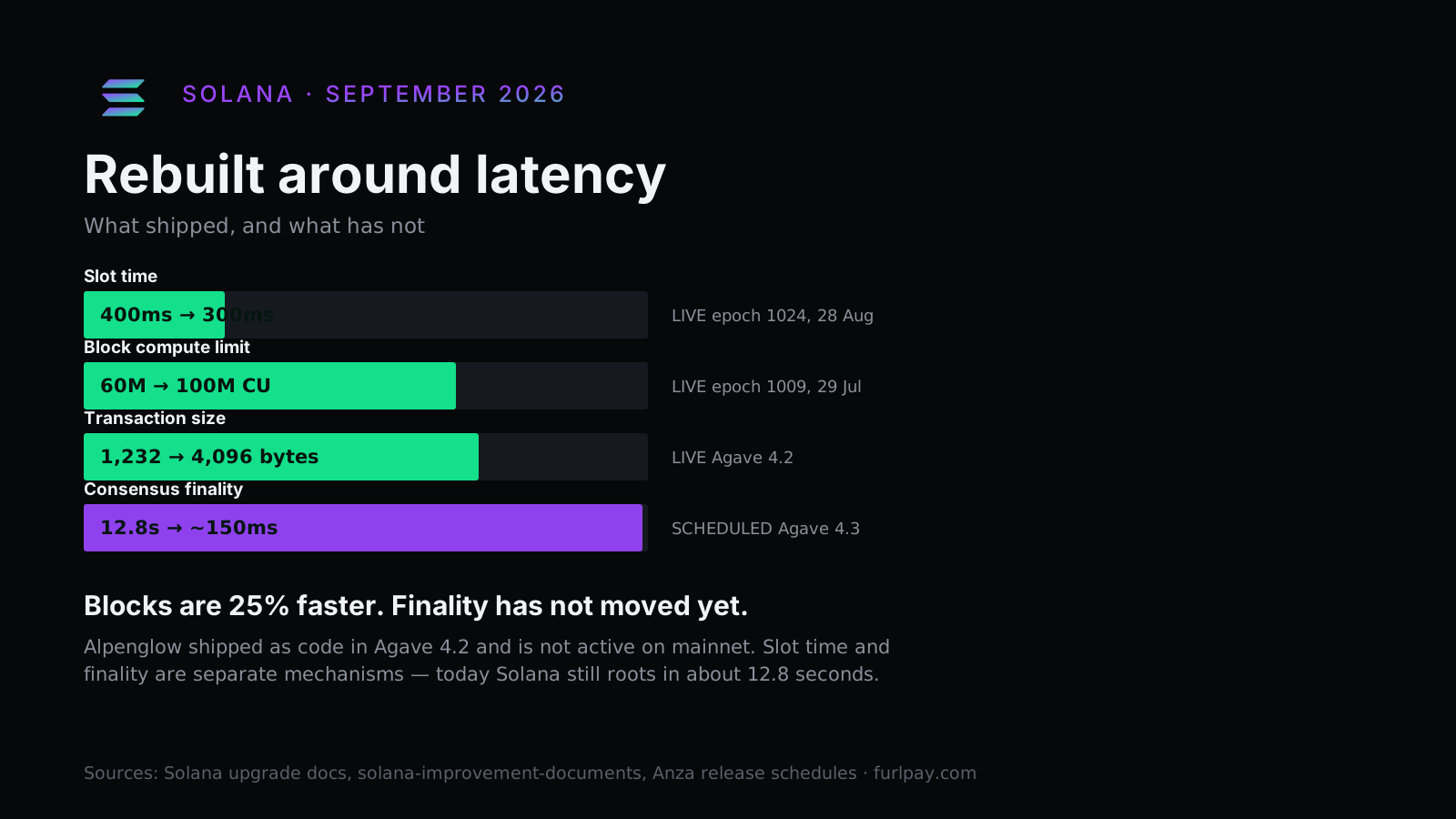
Solana Is Being Rebuilt Around Latency, Not Throughput
Updated 12 October: slot times reached 200ms in October, and Alpenglow is still not live on mainnet. In August 2026 Solana cut its slot time below 400ms for the first time since genesis, and block capacity had already risen 66% to 100M compute units. But finality still takes 12.8 seconds — the upgrade that changes that is scheduled, not shipped. What is actually live, what is not, and why the roadmap is a latency story rather than a TPS one.
September 7, 2026 · 15 min read
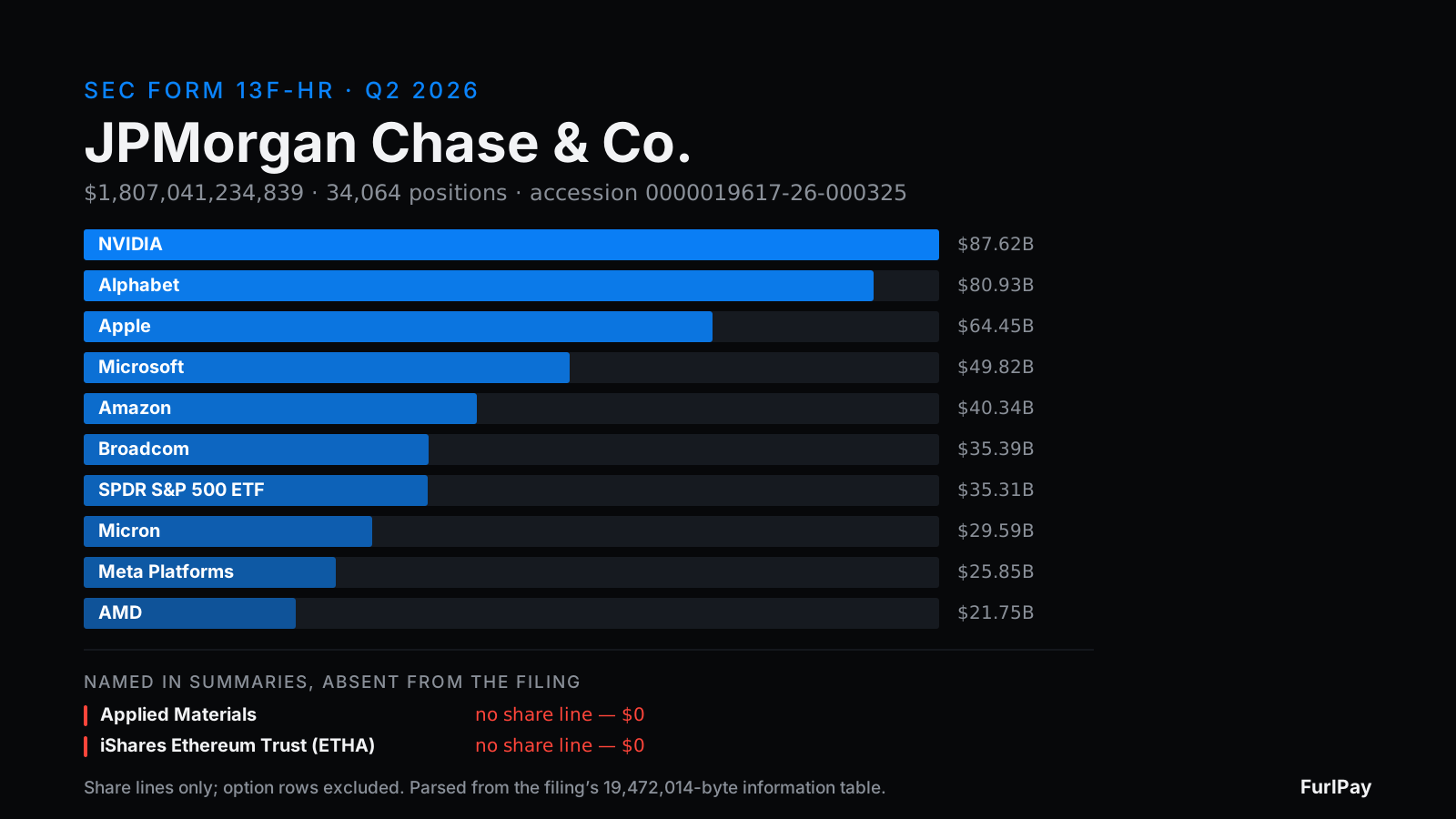
JPMorgan 13F Q2 2026: What the SEC Filing Actually Shows
JPMorgan reported $1,807,041,234,839 across 34,064 information-table rows for the quarter ended 30 June 2026. We parsed the original SEC XML twice and reconciled it to the dollar. Here is what the filing shows on the iShares Ethereum and Bitcoin trusts, Strategy, the bitcoin miners and the semiconductor names — and why the same filing produces different position counts, share totals and rankings depending on how the rows are read.
September 2, 2026 · 18 min read

Arbitrum vs Base for Payments: Which Layer 2 Should You Settle On?
Both are strong Ethereum Layer 2s with sub-cent fees. For stablecoin payments the deciding factors are settlement finality, ecosystem maturity, and where institutional volume already lives. Here is the honest comparison.
July 6, 2026 · 6 min read