Bitcoin in October 2026: The Price Moved. The Rules Did Not.
By Ashutosh Kumar Singh · October 15, 2026 · 11 min read
On 13 October 2026 bitcoin traded in the low $80,000s. Fortune's 7:45 a.m. Eastern print was $83,408.20, almost unchanged on the day and about $31,870 below the same date a year earlier. The October 2025 high, near $126,500, is a long way back.
None of that changed anything about how the network runs. Blocks kept arriving about every ten minutes. The issuance schedule did what it has done since 2009, and so did the difficulty adjustment. Institutions kept buying and selling exposure, and that did not touch the consensus rules either. This piece separates what the market is doing from what the protocol is doing, with every number dated. Several figures that circulate widely are wrong, and we note which ones.
The snapshot
| Metric | Value | As of / source |
|---|---|---|
| Price | ~$83,400 | 13 Oct 2026, 7:45 a.m. ET (Fortune) |
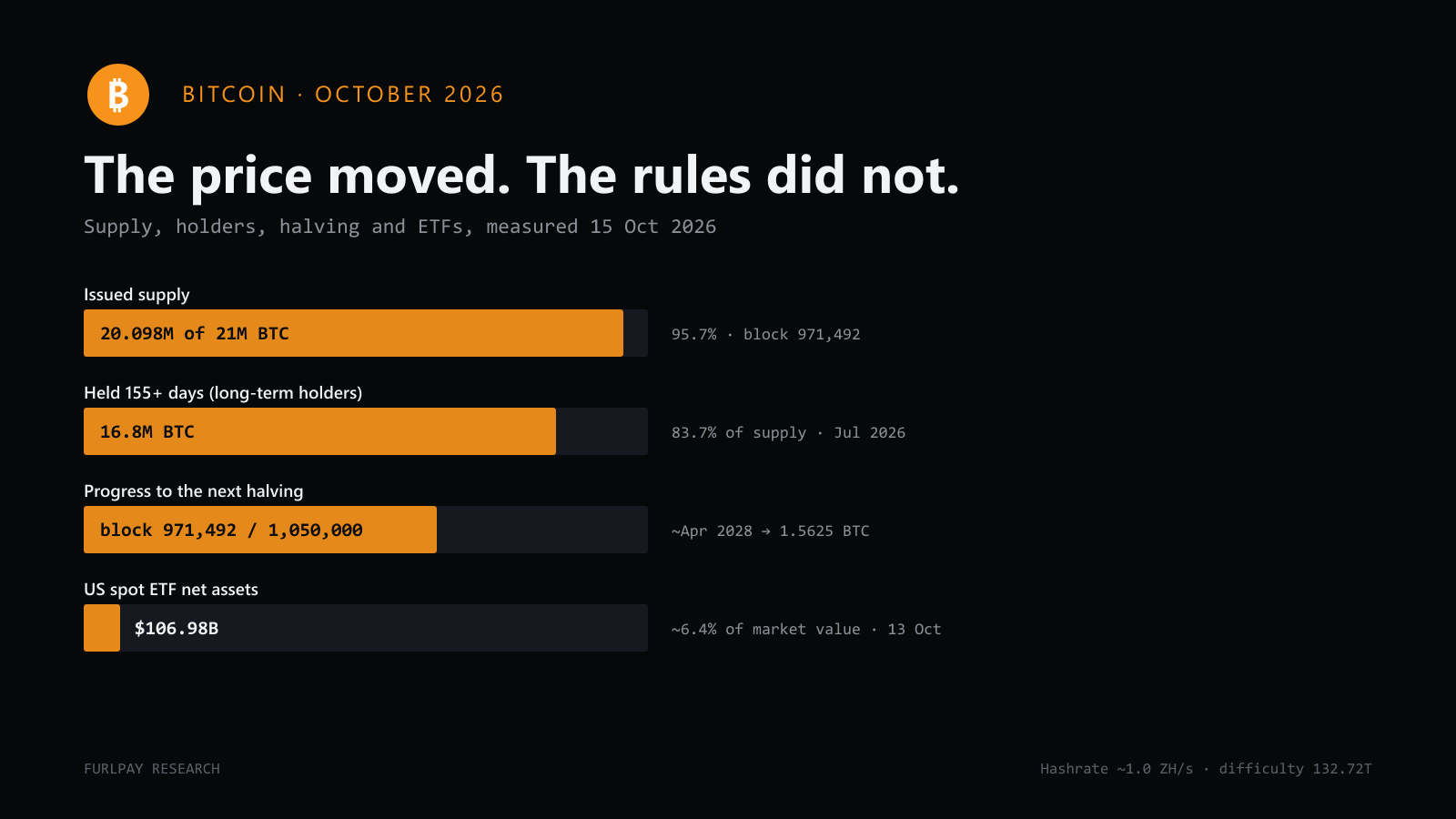
| Issued supply | ~20.098M BTC (~95.7% of 21M) | Block 971,492, 15 Oct 2026 (computed) |
| Market capitalisation | ~$1.68 trillion | Issued supply x $83,400 (computed) |
| Block subsidy | 3.125 BTC | Since block 840,000, April 2024 |
| Next halving | Block 1,050,000 -> 1.5625 BTC | ~78,500 blocks away; ~April 2028 |
| Difficulty | ~132.72 trillion | mempool.space, 15 Oct 2026 |
| Hashrate (7-day) | ~1,006 EH/s (~1.0 ZH/s) | mempool.space, 15 Oct 2026 |
| Long-term holder supply | 16.8M BTC (83.7%) | Late July 2026 |
| Reachable full nodes | 25,481 (about half via Tor) | Bitnodes, 15 Oct 2026 |
| US spot ETF net assets | $106.98 billion | 13 Oct 2026 |
| US spot ETF cumulative net inflows | $57.22 billion | 13 Oct 2026 |
| Strategy Inc. holdings | 848,250 BTC | 11 Oct 2026 |
| El Salvador reserve | ~7,760-7,792 BTC | Late Sep / early Oct 2026 |
The market capitalisation is computed, not quoted. Data sites disagree on it by hundreds of billions of dollars. Fortune's own page prints a $1.33 trillion cap next to an $83,408 price, which cannot both be right for a supply above 20 million coins. Price times issued supply is the simplest check, and anyone can run it.
Supply: 95.7% issued, much less of it liquid
Bitcoin's issuance is a function of block height, not of time or anyone's decision. The 840,000th block, mined in April 2024, cut the subsidy from 6.25 to 3.125 BTC. Total issuance up to that block was 19,687,500 BTC. The chain tip was at block 971,492 on 15 October 2026. That puts issued supply at roughly 20,098,000 BTC, about 95.7% of the 21 million cap, with about 902,000 BTC left to mine over the next century or so. The figure is a slight overstatement, because a handful of early blocks claimed less than their full subsidy and those coins can never be created.
Issued is not the same as available. Two things shrink the tradable float.
- Lost coins. Chainalysis has estimated that between 2.78 million and 3.79 million BTC are lost for good: early coins whose keys no longer exist, coins in wallets nobody can open, and coins sent to addresses with no recoverable key. That is roughly 13%-18% of the eventual supply. There is no on-chain proof that a coin is lost rather than dormant, so the figure is an estimate and will stay one.
- Coins that do not move. Bitcoin held unspent for more than 155 days is classed as long-term holder supply. In late July 2026 it reached a record 16.8 million BTC, 83.7% of all coins, while the price was about half its peak. The share that has not moved for five years or more also set a new high, at 33.2%.
Long-term holder supply includes the lost coins, so the two numbers overlap and should not be added together. Read together, though, they mean the supply that actually changes hands in a given month is a small fraction of 20 million.
Who enforces the rules: full nodes
Miners propose blocks, and full nodes decide whether to accept them. Every full node checks every block against the same rules: the subsidy schedule, the 21 million cap, signature validity and no double spends. A block that breaks a rule is rejected by every node that sees it, however much hashpower produced it. This is why miners alone cannot change the rules. A miner who raised the subsidy would produce blocks the rest of the network ignores.
How many nodes are there? The honest answer is that nobody knows exactly. Bitnodes counts reachable nodes, the ones that accept inbound connections. That number ran between about 23,000 and 26,000 through 2026. The snapshot at block 971,492 on 15 October counted 25,481. Almost half of them, 12,499, were reachable only over Tor, which deliberately reveals no location, so the largest single category is not a country at all. Among identifiable locations, the United States and Germany lead. Many more nodes make only outbound connections and never appear in a crawl. Estimates of the total, including figures of 45,000-50,000 or more, are multiples of the reachable count and not measurements.
The clearest demonstration of what nodes can do came in 2017. A large share of hashpower and several big companies backed SegWit2x, a plan that included doubling the block size. A user-activated soft fork, BIP 148, committed participating nodes to reject blocks that did not signal for SegWit from 1 August 2017. Miners activated SegWit through BIP 91 ahead of that deadline, and SegWit locked in later that month. The block-size increase was abandoned in November 2017. Historians argue about how much each factor contributed. But the episode showed that a coalition with most of the hashpower could not force a rule change that users' nodes would not run.
Security: about a zettahash, and a difficulty that answers to nobody
The seven-day average hashrate stood at roughly 1,006 EH/s on 15 October 2026, according to mempool.space. That is about one zettahash per second, or 10^21 SHA-256 guesses every second. The network first crossed that line in 2025, peaked near 1.1 ZH/s around the October 2025 price high, and has hovered close to it since, briefly dipping below.
Difficulty was 132.72 trillion. It is recalculated every 2,016 blocks, about two weeks, so that blocks keep arriving roughly every ten minutes whatever the hashpower. The next adjustment falls at block 971,712. On 15 October mempool.space estimated it would rise about 6%, because blocks had been coming in slightly faster than the target. That estimate moves until the adjustment block is mined.
The subsidy halves every 210,000 blocks. The next halving is at block 1,050,000, about 78,500 blocks after mid-October 2026. At ten minutes a block that is roughly 545 days, which points to around April 2028, when the subsidy falls to 1.5625 BTC. The date is approximate. The block height is exact.
Halvings matter for security as well as for supply. Each one cuts miner revenue per block in half, and transaction fees are expected to make up the difference over the long term. Whether fees will do that is the most serious open question about Bitcoin's security budget. The 2028 halving is the next real test of it.
Institutions: large holders, no extra votes
US spot bitcoin ETFs held $106.98 billion in net assets on 13 October 2026, and their cumulative net inflows since launch reached $57.22 billion. BlackRock's IBIT alone held $66.92 billion. Flows go both ways. The funds lost a net $65.4 million on 12 October, then took in $175.62 million on 13 October: $103.06 million into Fidelity's FBTC, $65.89 million into IBIT and $6.67 million into Morgan Stanley's MSBT.
Strategy Inc., formerly MicroStrategy, is still the largest corporate holder. It bought 250 BTC between 5 and 11 October for about $21.5 million, an average of $86,194 a coin, which took its holdings to 848,250 BTC. As of 4 October it had paid $63.97 billion for 848,000 BTC, an average cost of $75,440.70. At mid-October prices the position is in profit, but not by much. Its holdings come to about 4% of the 21 million cap.
El Salvador's reserve stood at roughly 7,760-7,792 BTC in late September and early October 2026, up from about 6,000 when its IMF programme began. That makes it the fifth-largest sovereign holder. The IMF has said that coins added since June 2025 came from private donations rather than public funds. Figures of "over 6,000 BTC" still circulate, but they describe where the reserve started, not where it is now.
A fund, a company or a country can own a large share of the supply. None of them gets a vote on the rules by doing so. Holding coins confers no power over what a valid block is. An ETF custodian that wanted different rules would have to persuade the people running nodes, like everyone else, and the 2017 episode shows how that tends to go.
What this means for payments
The figures above describe a settlement asset with a predictable supply and a very well defended ledger. They also describe an asset whose price moved by a third in a year. For payments, that matters more than any protocol property. A merchant pricing a hotel night in dollars cannot absorb that range, which is why most real-world crypto payment volume settles in dollar stablecoins rather than bitcoin. We covered that shift in Stablecoins overtook crypto for cross-border payments.
Bitcoin's strengths are different ones. It is the hardest asset to censor or debase on any chain, and it has the deepest and most watched ledger. Those properties are why it ends up on balance sheets. For now they rarely put it at the checkout.
How these numbers were checked
- Block height, difficulty, hashrate and the retarget estimate came from the public mempool.space API on 15 October 2026.
- Issued supply and market capitalisation are computed from block height and the subsidy schedule, not taken from an aggregator.
- ETF, treasury and sovereign figures are dated to the filing or flow report they come from. They will be stale within days, and the dates are there so you can tell.
- Where a commonly repeated figure did not match its source (lost coins, long-term holder share, El Salvador's reserve, total node count), this post gives the sourced figure and says so.

Founder & CEO, FurlPay · Software Engineer at Skyhigh Security · NeurIPS 2026 author · Google DeepMind contributor · ex-Quantiphi
Ashutosh is a Software Engineer at Skyhigh Security (previously Quantiphi), working across ML systems and cloud infrastructure. He is a contributor to Google DeepMind and a NeurIPS 2026 author. He is building Furlpay: stablecoin payments, travel booking, and investing in one client — settled on Arbitrum. Pay in USDC, book 2.2M+ stays and flights, and let AI agents pay per-request via x402. Phishing-resistant. Compliance-aware. Zero gas.
Don't miss the next one
Stay ahead of the curve
Get product updates, engineering deep-dives, and security bulletins. No spam — just the signal.
More in Engineering
Zcash in October 2026: A Bug, a New Pool, an ETF and 25-Second Blocks
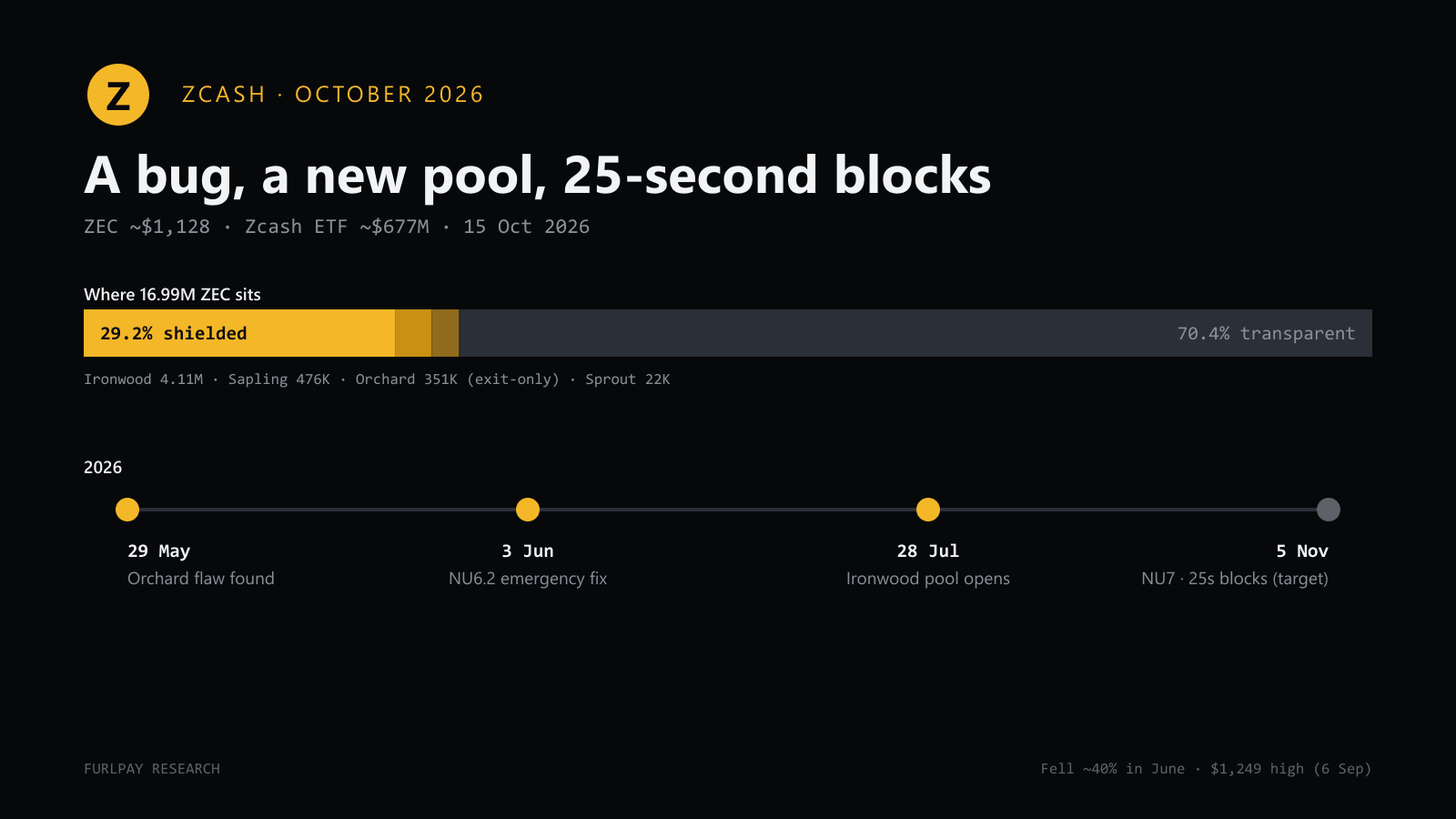
ZEC traded above $1,100 in mid-October 2026, months after a flaw that could have allowed undetectable counterfeiting forced Zcash to close its main shielded pool and open a new one. Here is the supply, the shielded share, the Orchard bug and Ironwood, NU7's 25-second blocks, the ETF and treasury buyers, and the EU rule that removes ZEC from regulated platforms in 2027.
October 15, 2026 · 14 min read
Solana in October 2026: Six Days Before It Changes Consensus
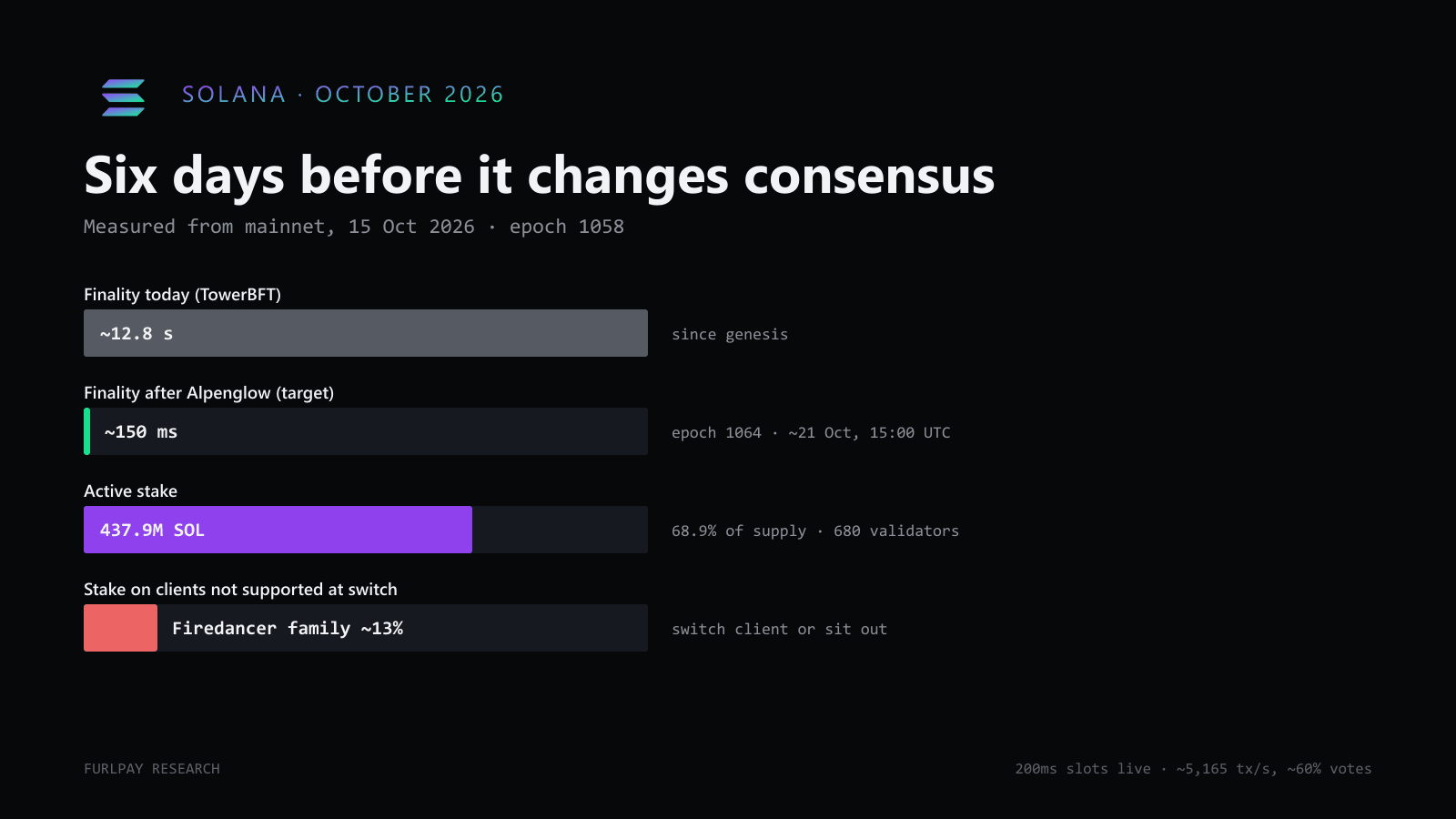
SOL traded near $106 in mid-October 2026, about 64% below its all-time high, while the network moved to 200ms slots and scheduled its largest consensus change since genesis for 21 October. Here is the supply, staking, validator, client, ETF and stablecoin picture as measured from mainnet, including where widely repeated figures are wrong.
October 15, 2026 · 12 min read
Ethereum in October 2026: Cheap Blocks, Rising Supply, No Glamsterdam Date
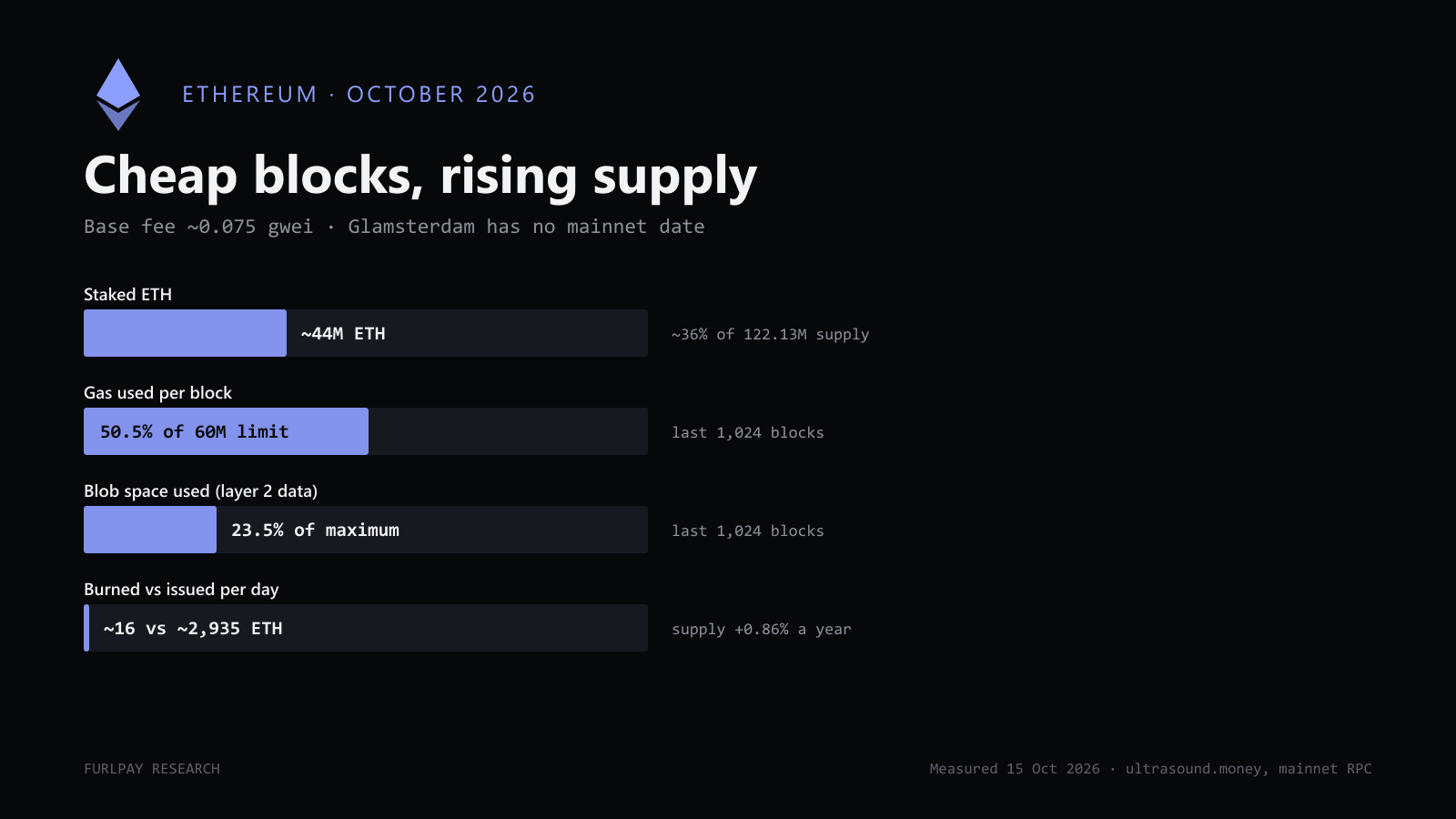
ETH traded near $2,450 in mid-October 2026, about half its August 2025 high. A mainnet transfer costs a fraction of a cent, supply is growing about 0.9% a year rather than shrinking, around 44 million ETH is staked, and Glamsterdam has passed its first testnet with no mainnet date. Every figure is measured or sourced and dated.
October 15, 2026 · 12 min read