Solana in October 2026: Six Days Before It Changes Consensus
By Ashutosh Kumar Singh · October 15, 2026 · 12 min read
On 14 October 2026 SOL traded at around $106. That is about 64% below its all-time high of $294.85. In price terms, the network is having a quiet year.
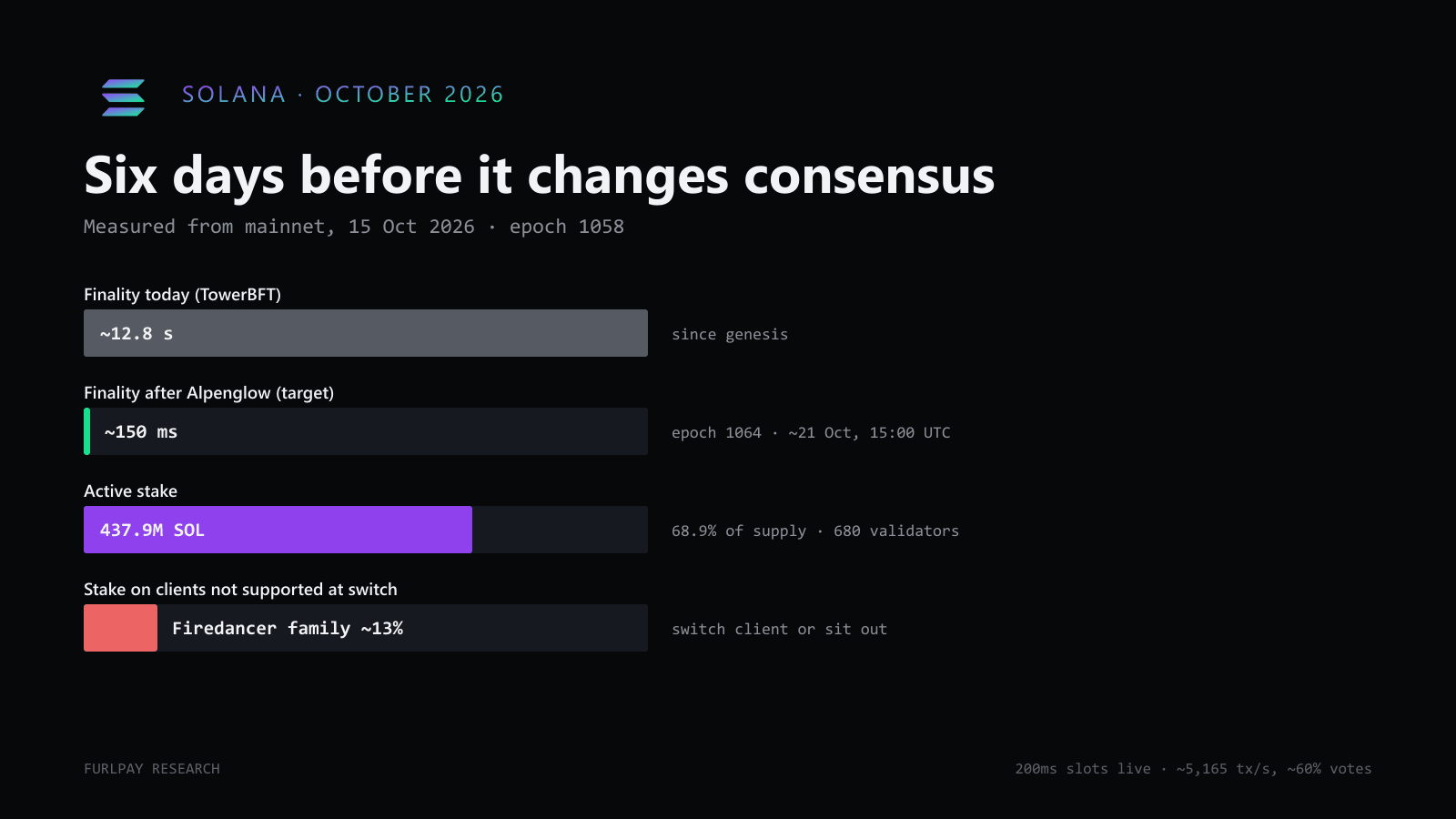
Technically it is doing the opposite. Slots are now 200 milliseconds, half the 400ms the chain ran from genesis. And on 21 October, if the schedule holds, Solana replaces the consensus algorithm it has used since launch. Finality should drop from about 12.8 seconds to about 150 milliseconds. Most of the figures below were read directly from mainnet on 15 October rather than taken from an aggregator. Where a widely repeated number disagrees with the measured one, we say so.
The snapshot
| Metric | Value | As of / source |
|---|---|---|
| Price | ~$106 | 14 Oct 2026 (Coinbase) |
| Circulating supply | 589.27M SOL | 15 Oct 2026, mainnet RPC getSupply |
| Total supply | 635.84M SOL | 15 Oct 2026, mainnet RPC getSupply |
| Market capitalisation | ~$62.5 billion | Circulating supply x $106 (computed) |
| Current inflation rate | 3.60% a year | Epoch 1058, mainnet RPC |
| Active stake | 437.9M SOL (68.9% of total supply) | 15 Oct 2026, mainnet RPC |
| Validators (vote accounts with stake) | 680 | 15 Oct 2026, mainnet RPC |
| Vote accounts needed for 1/3 of stake | 18 | Computed from mainnet RPC |
| Average slot time | ~216ms (200ms target) | Last 60 minutes of performance samples |
| Throughput | ~5,165 tx/s, ~2,083 of them non-vote | Last 60 minutes of performance samples |
| Finality | ~12.8s today; ~150ms targeted after Alpenglow | solana.com |
| US Solana ETF net assets | ~$1.71-1.73 billion | Mid-October 2026 |
| Stablecoins on Solana | $16.6-17.3 billion | 25 Sep 2026 record, by tracker |
| Largest corporate treasury | Forward Industries, 8,501,298 SOL | 30 Sep 2026 |
Alpenglow: the date, and who is not ready
Alpenglow activates with epoch 1064. That epoch is expected to start on Wednesday 21 October 2026 at about 15:00 UTC. The feature gate turns on at the epoch boundary. The consensus switch itself happens about 5,000 slots later, around 18 minutes, at slot 459,653,000. The network does not restart. It hands over from TowerBFT to the new voting protocol, Votor, while running. Devnet made the same switch on 25 September.
What changes for users: finality, the point after which a transaction cannot be reversed, falls from about 12.8 seconds to a target of about 150 milliseconds. Fees, accounts and programs do not change. Wallets and apps should not need to do anything.
What changes for validators is more. Under Votor, validators stop recording votes as on-chain transactions. They send them to each other directly, and only an aggregated certificate goes on chain. Fault tolerance changes shape too. Votor is designed to keep finalising with up to 20% of stake acting maliciously plus another 20% offline, the "20+20" model. Every validator also pays a Validator Admission Ticket, which means holding at least 0.8 SOL above the rent-exempt minimum in its vote account. A validator that cannot pay neither votes nor produces blocks.
The detail missing from most coverage is the client requirement. Solana's own upgrade page says validators must run an Agave-based client built on Agave 4.3.0, meaning Agave, Jito-Solana or Harmonic. It lists Firedancer and Frankendancer as not supported. We matched every staked vote account against the software version its node reports. About 13% of stake was on Firedancer-family releases. Firedancer and Frankendancer are built from the same codebase and share version tags, so the version alone cannot separate them, but neither is supported. That stake has to switch clients before 21 October or sit out. It will not threaten consensus, which works with far more than 87% participating. But it is a step backwards for client diversity, the reason Firedancer was built.
| Client family (reported version) | Share of active stake | Supported at Alpenglow activation |
|---|---|---|
| Agave and Agave-based forks (4.x) | ~87% | Yes, on 4.3.0 |
| Firedancer and Frankendancer (26.x, 0.x) | ~13% | No |
What 200ms slots look like in practice
The slot-time reductions we covered in September as scheduled have now landed. Solana completed the move to 200ms slots in October 2026. Mainnet's own performance samples for the hour before we measured showed an average of about 216ms per slot. The gap from the 200ms target is skipped slots and normal variance. For the background on why slot time matters more than TPS, see Solana Is Being Rebuilt Around Latency, Not Throughput.
Over the same hour the network processed about 5,165 transactions a second. About 2,083 of them were not votes, so votes made up roughly 60% of all transactions. That is lower than the 75% figure that circulates widely, and it is the number Alpenglow will remove from blocks. Do not expect the headline TPS to jump on 21 October. If anything, total transactions per second should fall, because votes stop being counted as transactions, while the space for real user transactions grows.
Supply and staking
Solana has no supply cap. New SOL is issued as staking rewards on a schedule that started at 8% a year in 2021 and drops by 15% a year, towards a long-term floor of 1.5%. Mainnet reported a current inflation rate of 3.60% for epoch 1058, all of it going to validators and their stakers and none to the Solana Foundation. Issuance is partly offset by burning. Half of every transaction's base fee is destroyed, and since SIMD-0096 priority fees go in full to the block producer instead of being half-burned.
Total supply is 635.84 million SOL, and 589.27 million of it counts as circulating. Active stake is 437.9 million SOL, 68.9% of total supply. That is a large share by proof-of-stake standards, and it explains the yield. With 3.6% issuance spread over about 69% of supply, staking pays roughly 5.2% before validator commission, plus fee and MEV income on top. Staked SOL does not dilute. Unstaked SOL is diluted by the full issuance rate every year.
Validators: fewer, and the concentration number
On 15 October there were 680 vote accounts with active stake, 672 voting and 8 delinquent. That is well down from the roughly 2,500 of early 2023. A count of 906 from June 2026 is still widely quoted and is already out of date. Gossip shows about 3,800 nodes in total, but most of them are RPC and other non-voting nodes, and they have no say in consensus.
Ranking vote accounts by stake, the smallest group holding more than a third of all stake has 18 members. A third matters because that much stake can halt finality under TowerBFT. Treat 18 as an upper bound on the true Nakamoto coefficient: one operator can run several vote accounts, and grouping them by operator would give a lower number. The direction is clear either way. Solana's validator set has been consolidating for three years, mostly because running a small validator does not pay. The Admission Ticket adds a small fixed cost at exactly the point where margins are thinnest.
Institutions: ETFs, treasuries and dollars on chain
US spot Solana ETFs, launched in October 2025, held about $1.73 billion in net assets as of 10 October 2026, with cumulative net inflows of $1.58 billion. That week they had $24.8 million of outflows, the largest weekly outflow since launch, which ended a record 14-week inflow streak. Bitwise's BSOL is the largest fund at about $1.20 billion and accounted for $20.9 million of those outflows. Morgan Stanley's MSOL and Invesco's QSOL took in money the same week. The category is about 2.7% of SOL's market capitalisation. That is meaningful, but less than half the share US bitcoin ETFs hold of bitcoin, which is about 6.4%.
Forward Industries is the largest corporate holder. It reported 8,501,298 SOL as of 30 September 2026, after adding about 949,000 SOL in its fiscal fourth quarter. That is about 1.4% of circulating supply, and more than the next three public Solana treasury companies hold combined. Forward stakes its SOL, so its holdings grow from staking rewards as well as purchases, which a bitcoin treasury cannot do.
For payments, the stablecoin figure matters most. Stablecoin supply on Solana hit a record on 25 September 2026: $17.3 billion by Solana's own count, $16.57 billion by DeFiLlama's. The trackers measure differently, which is why both are given. USDC accounts for roughly half. That makes Solana the third-largest stablecoin network after Ethereum and Tron, and ahead of BNB Chain.
What this means for payments
Finality is the number a payment system cares about. A merchant who releases goods, or a ledger that marks an invoice paid, needs to know the transfer cannot be reversed. Today that takes about 12.8 seconds on Solana. Most apps settle for the earlier "confirmed" status and accept a small risk. At 150ms, waiting for full finality costs less time than a card network's authorisation round trip, and the tradeoff goes away.
We will not treat Alpenglow as live until it is. On 7 September we described it as scheduled while much of the coverage reported it as shipped, and it missed the date then being targeted. The epoch 1064 date is the most concrete one yet, and devnet has run Votor since 25 September. Our payment integrations will keep counting a transfer as final according to what the chain reports, not what the roadmap promises.
How these numbers were checked
- Supply, inflation, stake, validator count, the one-third concentration figure, client versions, throughput and slot time were read from Solana's public mainnet RPC on 15 October 2026 (epoch 1058) and computed by us.
- Client families were identified from the version each staked node reports. Firedancer moved to date-style version tags (26.x) in August 2026.
- The Alpenglow date, slot, client support and Admission Ticket requirement come from solana.com's upgrade page. If activation slips, this post will be updated.
- ETF, treasury and stablecoin figures are dated to the report they come from. Where trackers disagree, both figures are given.

Founder & CEO, FurlPay · Software Engineer at Skyhigh Security · NeurIPS 2026 author · Google DeepMind contributor · ex-Quantiphi
Ashutosh is a Software Engineer at Skyhigh Security (previously Quantiphi), working across ML systems and cloud infrastructure. He is a contributor to Google DeepMind and a NeurIPS 2026 author. He is building Furlpay: stablecoin payments, travel booking, and investing in one client — settled on Arbitrum. Pay in USDC, book 2.2M+ stays and flights, and let AI agents pay per-request via x402. Phishing-resistant. Compliance-aware. Zero gas.
Don't miss the next one
Stay ahead of the curve
Get product updates, engineering deep-dives, and security bulletins. No spam — just the signal.
More in Engineering
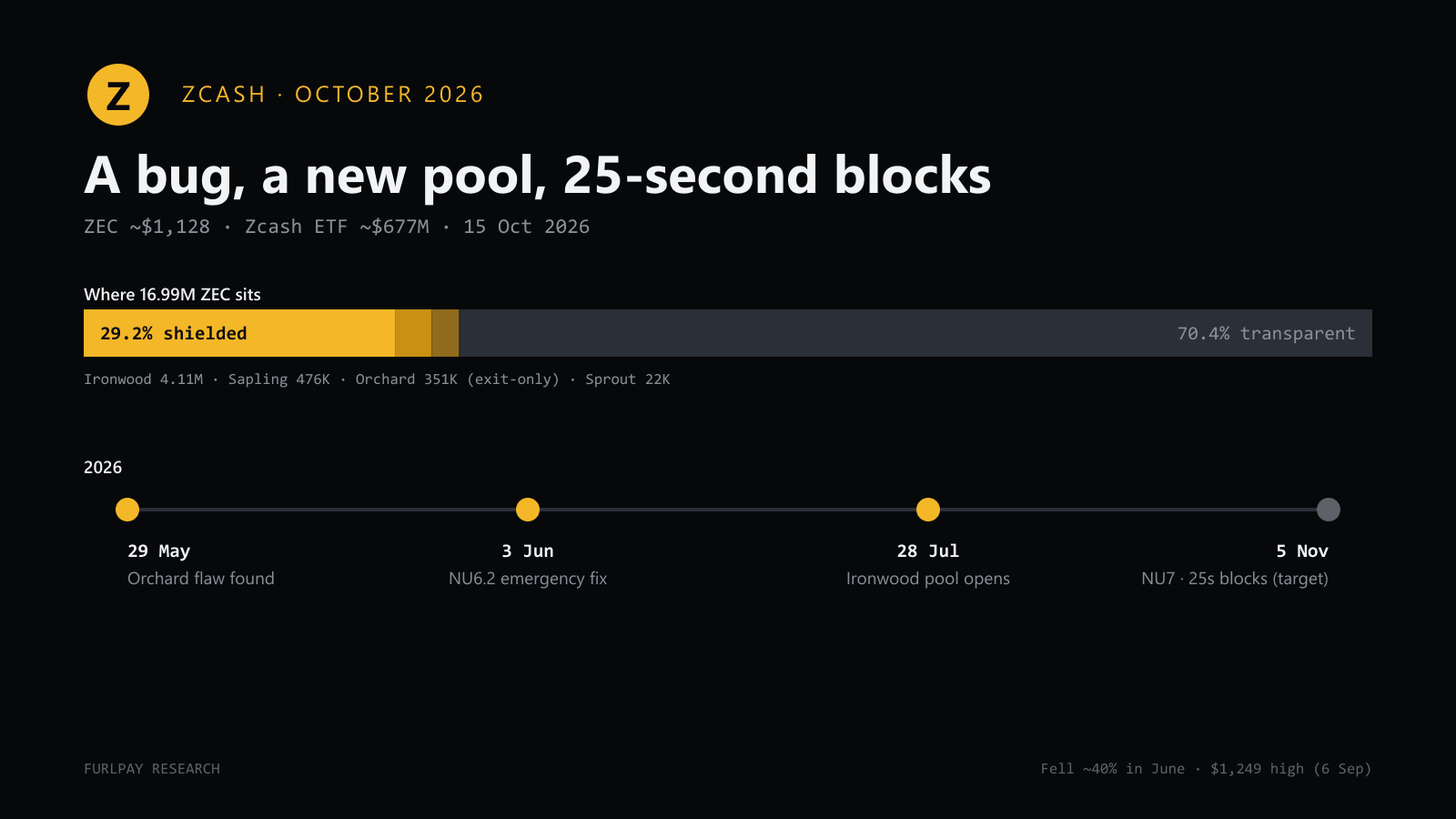
Zcash in October 2026: A Bug, a New Pool, an ETF and 25-Second Blocks
ZEC traded above $1,100 in mid-October 2026, months after a flaw that could have allowed undetectable counterfeiting forced Zcash to close its main shielded pool and open a new one. Here is the supply, the shielded share, the Orchard bug and Ironwood, NU7's 25-second blocks, the ETF and treasury buyers, and the EU rule that removes ZEC from regulated platforms in 2027.
October 15, 2026 · 14 min read
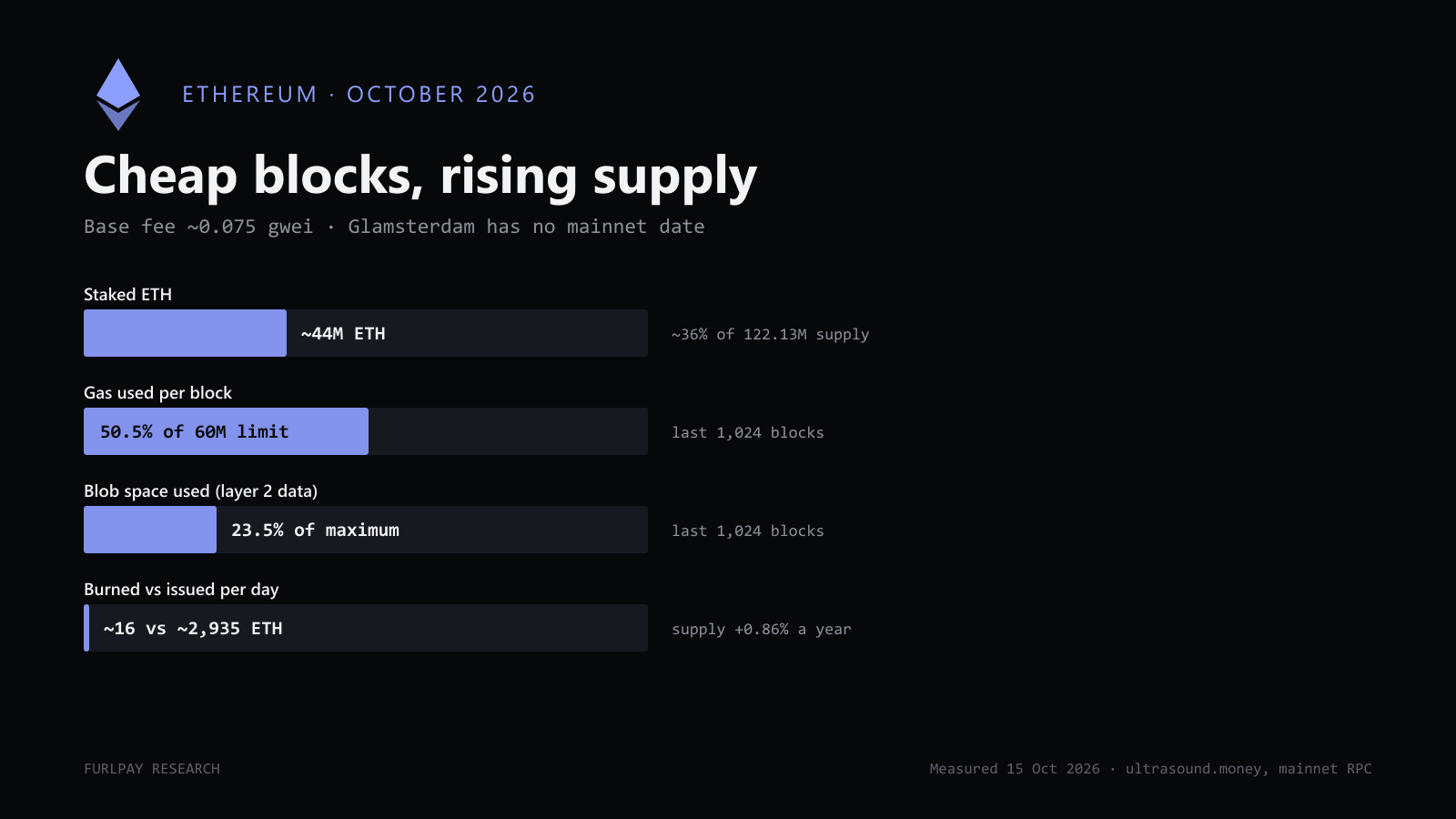
Ethereum in October 2026: Cheap Blocks, Rising Supply, No Glamsterdam Date
ETH traded near $2,450 in mid-October 2026, about half its August 2025 high. A mainnet transfer costs a fraction of a cent, supply is growing about 0.9% a year rather than shrinking, around 44 million ETH is staked, and Glamsterdam has passed its first testnet with no mainnet date. Every figure is measured or sourced and dated.
October 15, 2026 · 12 min read
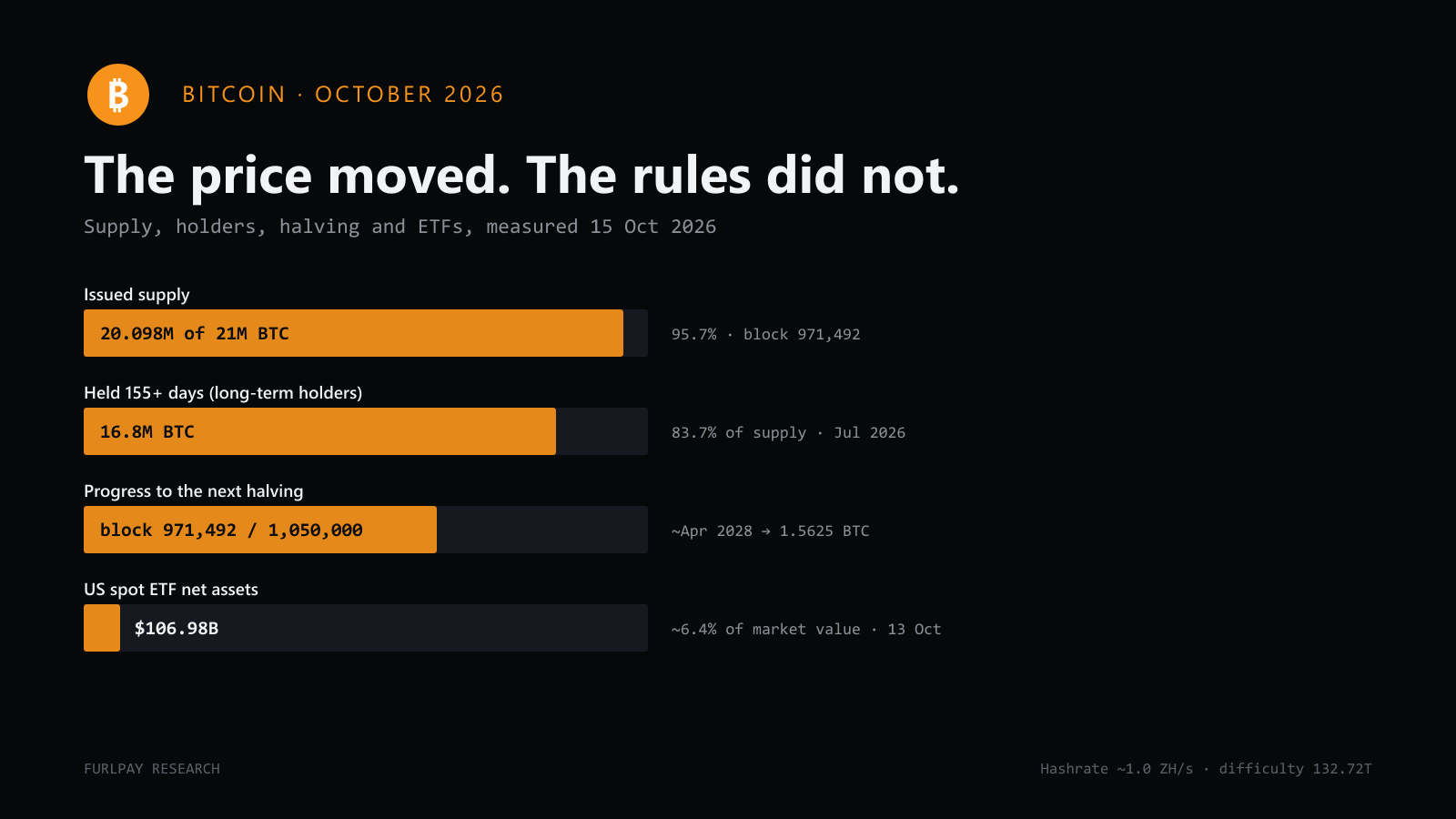
Bitcoin in October 2026: The Price Moved. The Rules Did Not.
Bitcoin traded in the low $80,000s on 13 October 2026, roughly a third below its October 2025 high. Meanwhile, about 95.7% of all bitcoin that will ever exist has been issued, the network secures itself with around one zettahash per second, and US spot ETFs hold close to $107 billion. Every figure here is checked and dated, including the ones that are commonly overstated.
October 15, 2026 · 11 min read