Ethereum in October 2026: Cheap Blocks, Rising Supply, No Glamsterdam Date
By Ashutosh Kumar Singh · October 15, 2026 · 12 min read
On 14 October 2026 ether traded between about $2,415 and $2,504, depending on the hour. That is roughly $1,600 lower than a year earlier and about half the all-time high of $4,953.73 set in August 2025.
On the network side, three things stand out. Block space on Ethereum's main chain is cheaper than it has been in years. The supply of ETH is growing, not shrinking. And the next major upgrade, Glamsterdam, is on testnets but has no mainnet date. As in our Bitcoin and Solana updates, the network figures below were read from the chain on 15 October rather than copied from an aggregator. Where a common claim disagrees with the data, we say so.
The snapshot
| Metric | Value | As of / source |
|---|---|---|
| Price | ~$2,415-2,504 | 14 Oct 2026, intraday range |
| Supply | 122,129,807 ETH | 15 Oct 2026, ultrasound.money |
| Market capitalisation | ~$295-306 billion | Supply x price range (computed) |
| Net supply change, last 30 days | +86,418 ETH (~0.86% a year) | 15 Sep-15 Oct 2026 (computed) |
| Net supply change since the Merge | +1.61M ETH (+1.34%) | 15 Sep 2022-15 Oct 2026 (computed) |
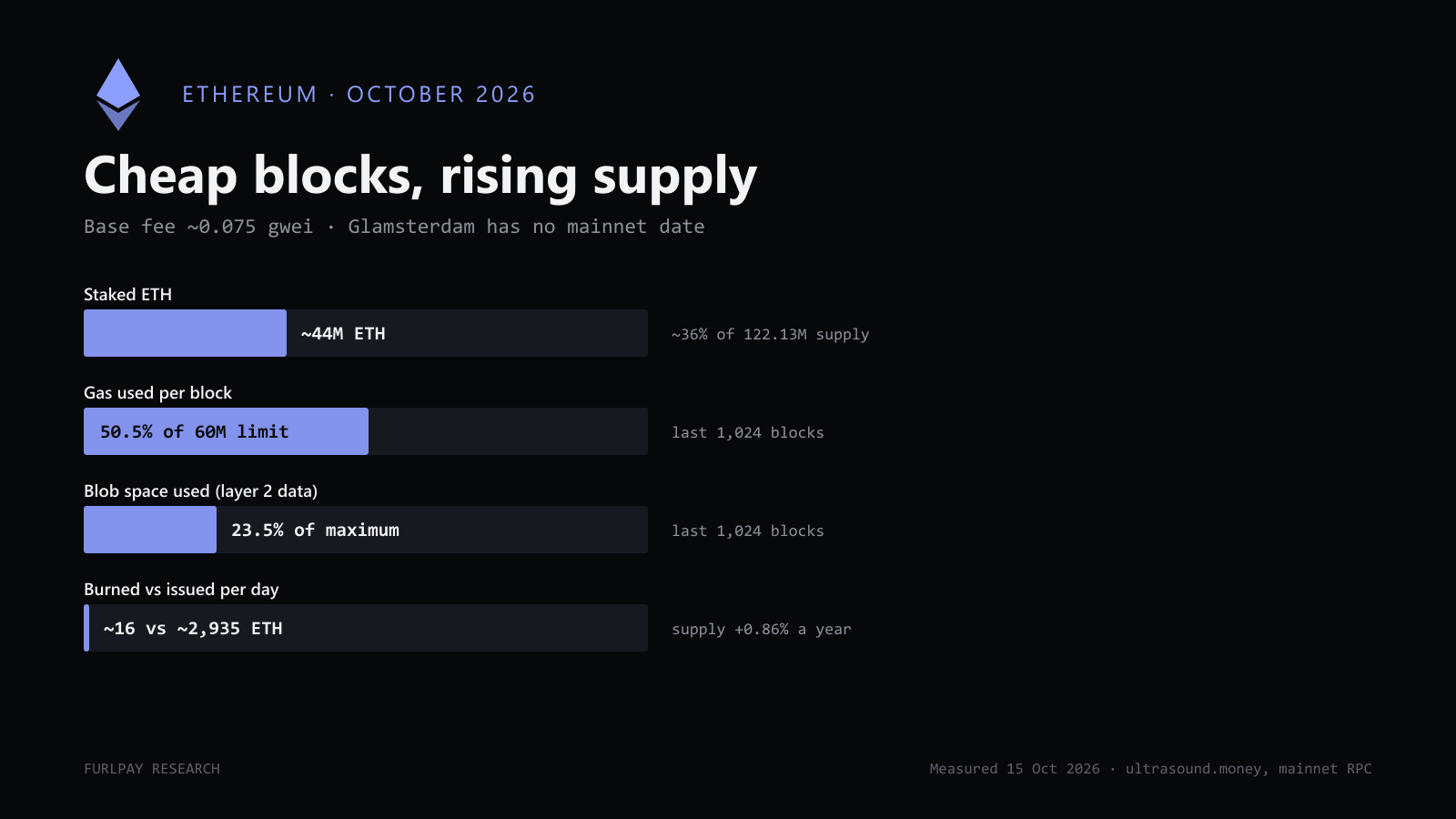
| Staked ETH | ~44 million (~36% of supply) | Beacon balances, 15 Oct 2026 |
| Gas limit | 60 million | Mainnet, 15 Oct 2026 |
| Base fee | ~0.075 gwei | Mainnet, 15 Oct 2026 |
| Blob space used | ~23.5% of maximum | Last 1,024 blocks |
| US spot ether ETF net assets | $15.83 billion | 13 Oct 2026 |
| US spot ether ETF cumulative net inflows | $13.20 billion | 13 Oct 2026 |
| Largest corporate treasury | BitMine, 6,028,946 ETH | 11 Oct 2026 |
| Glamsterdam | Live on Sepolia; no mainnet date | Sepolia fork 6 Oct 2026 |
As with bitcoin, the market capitalisation is computed. Fortune's 13 October bitcoin page puts Ethereum's market value at about $233 billion. That does not fit 122 million ETH at roughly $2,450, which is about $299 billion. It also does not fit the ETF data: $15.83 billion of ETF assets is reported as 5.16% of Ethereum's market cap, which implies about $307 billion.
Supply: up, not down
For a while after the Merge, more ETH was burned in fees than was issued to stakers, and "ultrasound money", the idea that ETH would become deflationary, was a reasonable description. It is not a description of 2026. On 15 October ultrasound.money reported a supply of 122,129,807 ETH. That is 1.61 million more than at the Merge in September 2022, a rise of 1.34% in just over four years. In the last 30 days supply grew by 86,418 ETH, which works out to about 0.86% a year.
The reason is the burn. Ethereum burns the base fee of every transaction. In the 1,024 blocks before we measured, about three and a half hours, the base fee averaged around 0.075 gwei and the burn came to about 2.25 ETH. That is about 16 ETH a day if it held, against roughly 2,900 ETH a day issued to validators. Issuance did not change. Fees fell, because most user activity moved to layer 2 networks, which post their data to Ethereum cheaply as blobs.
This is not a flaw so much as a choice that worked. Ethereum set out to make layer 2s cheap, and it did. The cost is that the burn no longer offsets issuance, and the supply story is now a modest-inflation one. At 0.86% a year it is well below Solana's 3.6% and slightly above bitcoin's current issuance, which is 3.125 BTC a block, or about 0.82% a year until the 2028 halving.
Fees: what a transaction costs now
The gas limit, which caps how much computation each block can hold, is 60 million, and blocks ran at about half of that on average in our sample. With the base fee near 0.075 gwei, a plain ETH transfer (21,000 gas) burns about 0.0000016 ETH, well under one US cent at current prices before any priority tip. Contract calls cost more in proportion to the gas they use, and a typical USDC transfer, at roughly 45,000-65,000 gas, comes to about one cent at these levels.
Fees spike when demand does, and a busy hour can multiply the base fee many times over. But the default state of Ethereum's main chain in October 2026 is cheap. That undercuts the old assumption that mainnet is only for large-value transfers.
Blob space, the data layer for layer 2s, is even emptier. Over the same 1,024 blocks, blobs used about 23.5% of the maximum. Capacity was raised by the Fusaka upgrade in December 2025 and the two blob-parameter forks that followed it. Demand has not caught up, so blob fees sit near their minimum. Since Fusaka that minimum has been tied to the execution base fee, which stops it falling to effectively zero.
Staking: about 44 million ETH, and the queues
The sum of validator balances on the beacon chain was about 44.2 million ETH on 15 October. Reports put it at 43.7 million on 5 October, with about 863,000 to 868,000 active validators, a number that is falling. Validators can now hold up to 2,048 ETH each instead of 32, and large operators have been consolidating. Staked ETH is about 36% of supply.
Spread across that stake, issuance of roughly 2,935 ETH a day works out to a base yield of about 2.4% a year, before priority tips and MEV. That is lower than Solana's roughly 5%, partly because a larger share of ETH is staked, and Ethereum's issuance falls per validator as more ETH stakes.
Leaving takes time. The exit queue jumped from about 166,000 ETH on 29 September to about 850,000 ETH by 2 October. That was driven largely by precautionary exits from MetaMask Staking after a security incident on 30 September, and it pushed the wait to about two weeks, the longest of 2026. The entry queue was larger still, at about 1.46 million ETH and a wait of around 25 days, so more ETH was waiting to stake than to leave. The queues exist by design. They rate-limit how fast the validator set can change, which protects finality, and they are why staked ETH cannot be treated as instantly liquid.
Glamsterdam: on testnet, no mainnet date
Glamsterdam is Ethereum's next hard fork. Its two headline changes are enshrined proposer-builder separation (EIP-7732) and block-level access lists (EIP-7928). The first moves the split between whoever builds a block and whoever proposes it into the protocol itself, instead of leaving it to outside relays. The second has each block declare up front which accounts and storage it touches, so clients can execute transactions in parallel and raise the gas limit safely.
It activated on the Sepolia testnet on 6 October 2026 and finalised normally. The next testnet, Hoodi, is tentatively set for 27 October. No mainnet date has been set. The Ethereum Foundation's stated target is the fourth quarter of 2026, which in practice points to December at the earliest if Hoodi goes cleanly. Treat any article that gives a mainnet date as guessing.
Institutions: ETFs out, treasuries in
US spot ether ETFs held $15.83 billion in net assets on 13 October 2026, and their cumulative net inflows came to $13.20 billion. That day brought $24.84 million of inflows, $16.73 million to Grayscale's ETH fund and $8.11 million to Fidelity's FETH. It ended a ten-session run of outflows that included $542.1 million in the week to 10 October. BlackRock's ETHA is the largest fund, with $8.66 billion. The ETFs hold about 5.2% of ether's market value, a little below the roughly 6.4% that US bitcoin ETFs hold of bitcoin.
Corporate treasuries now hold more ETH than the ETFs, which at about $2,450 a coin hold roughly 6.5 million ETH. BitMine Immersion reported 6,028,946 ETH as of 11 October 2026. That is about 4.9% of supply, and 5,067,309 of it is staked. BitMine has said it will stop buying when it reaches 5% of supply, which at today's supply is about 6.11 million ETH, roughly 77,000 more. SharpLink holds about 869,000 ETH. The largest single buyer of the past year is close to its stated limit, and the ETFs have been net sellers this month. Both are worth watching for anyone tracking demand.
On stablecoins, Ethereum is still far ahead of every other chain. Stablecoins on Ethereum came to about $145.9 billion in late September 2026, against $94.1 billion on Tron and $16.6-17.3 billion on Solana.
What this means for payments
Three things matter for anyone moving money on Ethereum. First, mainnet fees are low enough most of the time that settling a stablecoin payment on layer 1 is now an option rather than a luxury. It still costs more than an Arbitrum transfer, and it still spikes under load. Second, Ethereum finality is still about two epochs, roughly 13 minutes. Solana is scheduled to move to about 150 milliseconds on 21 October. For a payment flow, "included in a block" and "final" are different promises. Third, the deepest pool of dollar stablecoins is on Ethereum and its layer 2s. For most payment flows, the practical question is where the counterparty already holds dollars, and the answer is usually Ethereum or one of its layer 2s.
How these numbers were checked
- Supply and the 24-hour, 30-day and since-Merge changes come from ultrasound.money's supply series, read on 15 October 2026. The growth rates are computed by us.
- Gas limit, base fee, gas usage, blob usage and the burn sample come from a public Ethereum RPC node (1,024 blocks of fee history ending at block 26,194,849).
- Issuance and staking yield are inferred from the supply change plus the burn. They are estimates, not protocol constants.
- ETF, treasury, queue and stablecoin figures are dated to their reports. Glamsterdam's status comes from testnet results, and this post will be updated when a mainnet date is set.

Founder & CEO, FurlPay · Software Engineer at Skyhigh Security · NeurIPS 2026 author · Google DeepMind contributor · ex-Quantiphi
Ashutosh is a Software Engineer at Skyhigh Security (previously Quantiphi), working across ML systems and cloud infrastructure. He is a contributor to Google DeepMind and a NeurIPS 2026 author. He is building Furlpay: stablecoin payments, travel booking, and investing in one client — settled on Arbitrum. Pay in USDC, book 2.2M+ stays and flights, and let AI agents pay per-request via x402. Phishing-resistant. Compliance-aware. Zero gas.
Don't miss the next one
Stay ahead of the curve
Get product updates, engineering deep-dives, and security bulletins. No spam — just the signal.
More in Engineering
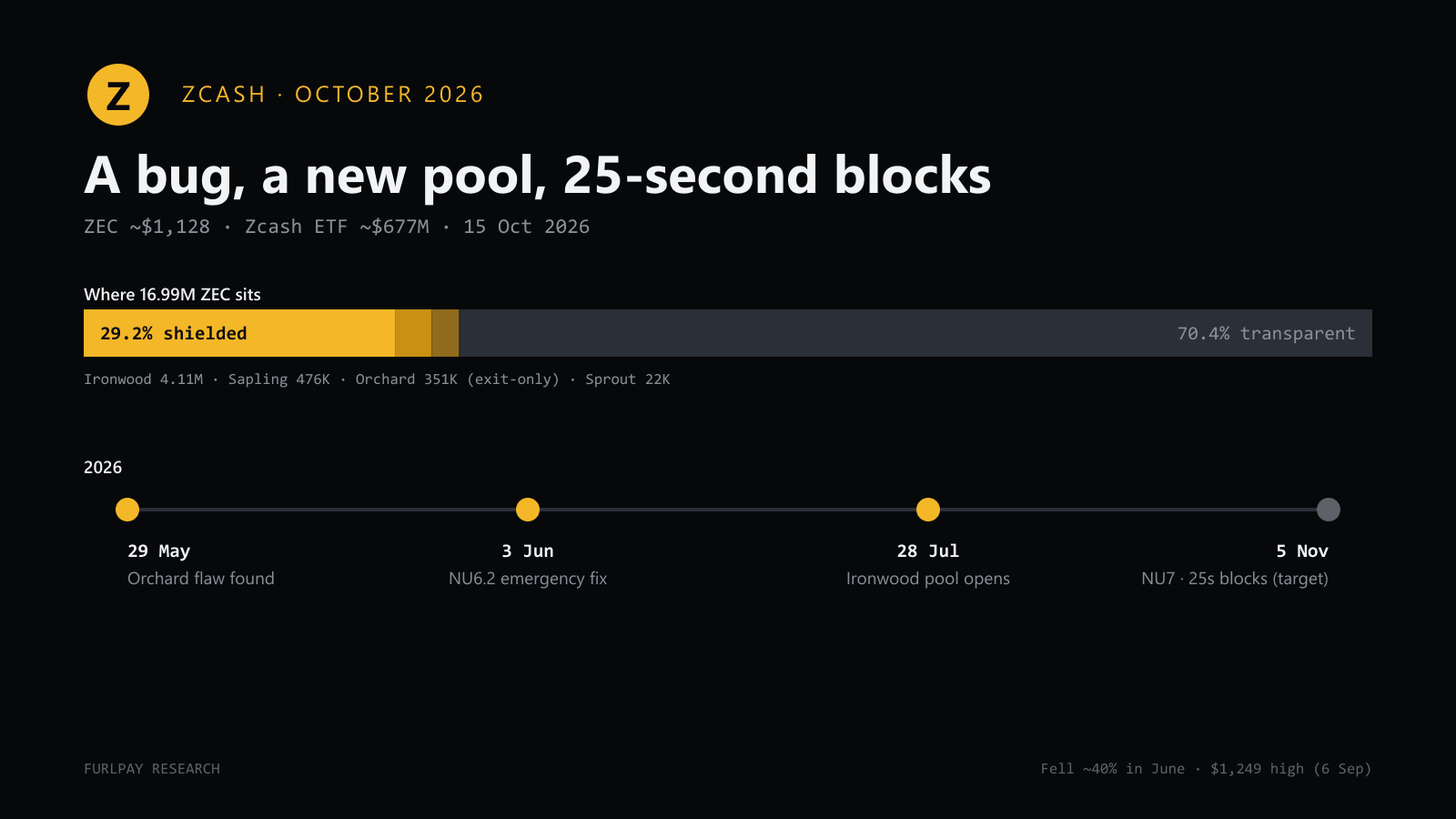
Zcash in October 2026: A Bug, a New Pool, an ETF and 25-Second Blocks
ZEC traded above $1,100 in mid-October 2026, months after a flaw that could have allowed undetectable counterfeiting forced Zcash to close its main shielded pool and open a new one. Here is the supply, the shielded share, the Orchard bug and Ironwood, NU7's 25-second blocks, the ETF and treasury buyers, and the EU rule that removes ZEC from regulated platforms in 2027.
October 15, 2026 · 14 min read
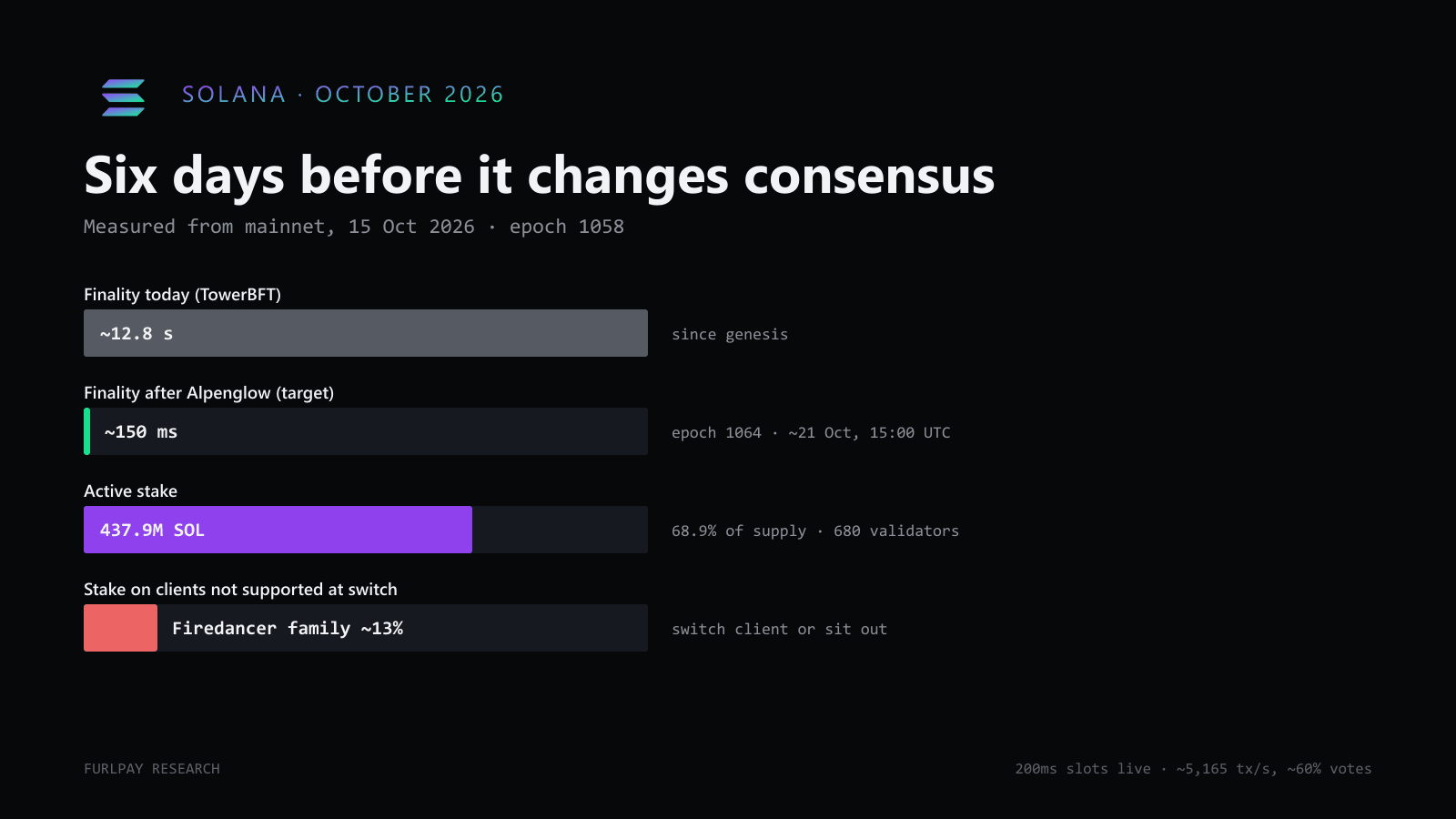
Solana in October 2026: Six Days Before It Changes Consensus
SOL traded near $106 in mid-October 2026, about 64% below its all-time high, while the network moved to 200ms slots and scheduled its largest consensus change since genesis for 21 October. Here is the supply, staking, validator, client, ETF and stablecoin picture as measured from mainnet, including where widely repeated figures are wrong.
October 15, 2026 · 12 min read
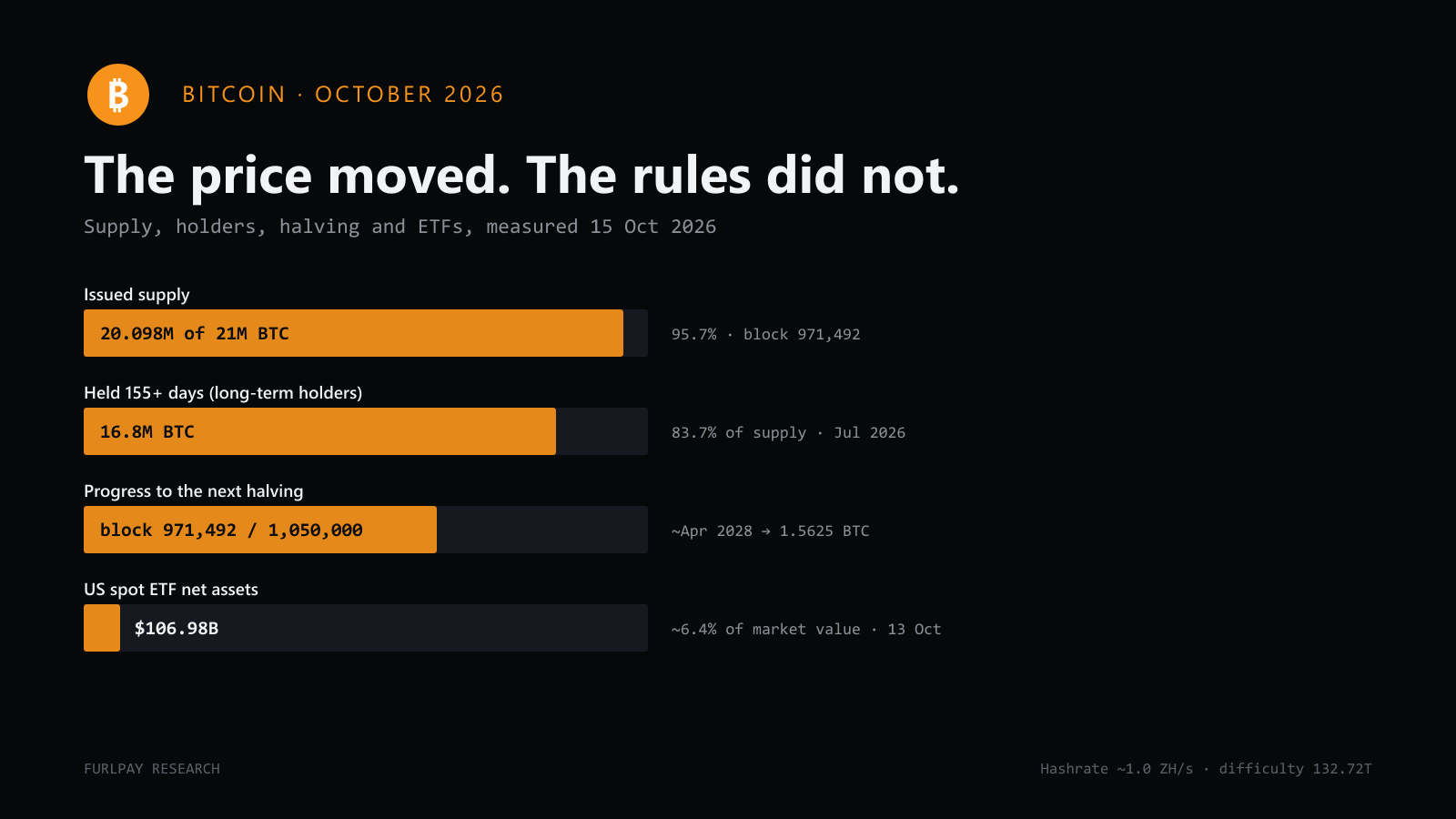
Bitcoin in October 2026: The Price Moved. The Rules Did Not.
Bitcoin traded in the low $80,000s on 13 October 2026, roughly a third below its October 2025 high. Meanwhile, about 95.7% of all bitcoin that will ever exist has been issued, the network secures itself with around one zettahash per second, and US spot ETFs hold close to $107 billion. Every figure here is checked and dated, including the ones that are commonly overstated.
October 15, 2026 · 11 min read