The Morningstar Doctrine: Financial Mastery, Systemic Sovereignty, and the 2026 Economic Architecture
By Ashutosh Kumar Singh · November 8, 2026 · 42 min read

Executive Summary: The Metaphysics of Money
Tell me, what is it you truly desire? — Lucifer Morningstar
To analyze wealth through the lens of Lucifer Morningstar is to discard the pedestrian delusion that money is about luxury, ostentation, or sensory indulgence. To the undisciplined mind, money is a scorecard of vanity—an endless treadmill of consumerism designed to project an image of power to a crowd of strangers. To Lucifer, money is something infinitely more elemental: an instrument of absolute sovereignty, agency, and leverage.
Money is the medium through which human desire is articulated, priced, negotiated, and manifested into the physical universe. It acts as the ultimate diagnostic tool: it lays bare the hidden architecture of human psychology, exposing what people crave, what they fear, what ethical boundaries they will compromise, and what freedom they will willingly surrender to satisfy their appetites.
CAPITAL TRANSFORMATION ARCHITECTURE
The Sovereignty Continuum
A tripartite structural topology mapping capital autonomy, counterparty vulnerability, and sovereign resilience.
Illusion of Wealth: The Gilded Cage
Core Structural Characteristics
- —Conspicuous consumption and status games
- —Debt-leveraged affluent lifestyle
- —High cash-burn rate with illiquid assets
- —External validation and audience seeking
- —Vulnerability to a 90-day liquidity freeze
Systemic Implication
Increased nominal gross income offset by proportional expenditure debt, remaining vulnerable to credit contraction.
Systemic Transformation Pathways
Stage I → Stage II
Income growth without capital discipline produces higher lifestyle expenditure, debt exposure, and high cash-burn overhead. The operator earns more but remains vulnerable to a 90-day liquidity freeze.
Stage I → Stage III
Stage II is not mandatory. Retained income is deployed directly into productive ownership, asymmetric equity, multi-rail liquidity and institutional legal architecture.
In the global macroeconomic landscape of 2026, the mechanics of power have evolved beyond the simple industrial and banking paradigms of the twentieth century. We operate at the intersection of central bank balance sheet normalization, private credit expansion, tokenized real-world assets, the GENIUS Act, and autonomous AI commerce.
1. The Psychology of Desire & Asymmetric Due Diligence
Classical economic dogma assumes the existence of Homo Economicus—a rational, utility-maximizing agent with perfect information. Lucifer Morningstar dismisses this as laughable naivety. Markets are not dispassionate weighing machines; they are colossal arenas of sublimated human instinct, cognitive bias, and emotional compensation.
| Human Drive | Surface Economic Behavior | Exploitative Counterpart | Sovereign Advantage |
|---|---|---|---|
| Status / Vanity | Conspicuous luxury goods, exotic leases | Debt-leveraged lifestyle inflation | Sells the picks and shovels; owns the equity |
| Fear / Insecurity | Panic liquidations, speculative hedging | Predatory credit spreads, short squeezes | Acts as liquidity provider of last resort during crashes |
| Impatience | High-churn trading, payday credit | High-spread retail brokerage monetization | Extracts high yield by providing immediate liquidity |
| Greed / FOMO | Chasing peak parabolas, meme cycles | Institutional exit liquidity dumping | Enters private seed rounds; exits into retail hype |
In negotiation, whoever understands the counterparty's unstated desire holds absolute pricing power. If an opponent needs cash to satisfy their ego or avoid public embarrassment, their discount rate skyrockets. Lucifer exploits this asymmetry not through deception, but through pristine clarity: people will gladly trade their long-term equity for immediate psychological validation.
2. Ownership vs. Display: The Anatomy of Sovereign Capital
Thorstein Veblen coined the term conspicuous consumption to describe spending intended to display social status rather than fulfill real utility. To Lucifer, conspicuous consumption is an embarrassing cognitive trap. It signals that an individual is subordinate to the opinion of others—that they are renting their self-esteem from the public gallery.
| Metric | Looking Wealthy (The Trap) | Building Wealth (The Sovereign) |
|---|---|---|
| Core Balance Sheet | Leased supercars, branded couture, mortgages | Controlling equity, sovereign bonds, hard infrastructure |
| Cash Flow Dynamic | High burn rate, constant operational panic | Unencumbered positive cash flow, high ROIC |
| Operational Labor | Tied directly to billable executive hours | Autonomous capital generation and agentic systems |
| Crisis Resilience | Vulnerable to credit freeze within 90 days | Multi-year cash runway with zero margin-call exposure |
Lucifer's establishment, Lux, was never an expensive lifestyle hobby. It was prime, unencumbered real estate situated at a premier geographic intersection in Los Angeles, throwing off daily cash flow while serving as an intelligence collection node.
3. Incentives, Negotiation, and Contractual Integrity
In mythology, literature, and drama, the Devil never breaks a pact. Lucifer does not lie; he does not need to. A lie is the weapon of the weak, the frightened, and the structurally cornered. In institutional finance, your word and your contract are your ultimate assets.
| Step | Contractual Audit Component | Failure Scenario Defended |
|---|---|---|
| 1. Solvency Audit | Verified unencumbered assets vs subordinated claims | Counterparty insolvency behind polished PR veneer |
| 2. Enforceability | New York or English commercial court jurisdiction | Asset seizure or corruption in opaque offshore jurisdictions |
| 3. Collateralization | Segregated escrow or on-chain multi-sig vault | Custodial rehypothecation and co-mingling (e.g. FTX) |
| 4. Distress Track Record | Audited performance during prior systemic liquidity crunches | Counterparty panic liquidations and contract abandonment |
4. Capital Allocation and Compounding Mechanics
Operational leadership creates revenues; capital allocation determines the long-term compounding of net worth. Wealth generation is governed by the geometric mean, not the arithmetic average. The primary duty of the sovereign allocator is not to maximize upside during market manias, but to eliminate the left-tail probability of a 50%+ permanent impairment.
| Percentage Loss | Gain Required to Recover to Par | Sovereign Classification |
|---|---|---|
| 10% | 11.1% | Routine market fluctuation |
| 20% | 25.0% | Standard cyclical correction |
| 30% | 42.8% | Moderate capital impairment |
| 50% | 100.0% | Severe capital destruction |
| 75% | 300.0% | Existential catastrophe |
| 90% | 900.0% | Permanent terminal ruin |
5. Portfolio Construction and Asymmetric Risk
True portfolio construction is not the haphazard accumulation of 25 different mutual funds or tech stocks. It is the deliberate, disciplined distribution of capital across uncorrelated risk drivers.
| Tier | Asset Class | Allocation Target | Structural Purpose |
|---|---|---|---|
| Tier 1 | Systemic Liquidity (T-Bills, Repo, USDC) | 20% | Emergency solvency and panic-opportunity capital |
| Tier 2 | Cash Flow Engines (Private Credit, High-ROIC) | 35% | Predictable, unencumbered monthly operational yield |
| Tier 3 | Hard Assets (Freehold Land, Gold, Minerals) | 20% | Constitutional hedge against chronic fiat debasement |
| Tier 4 | Asymmetric Growth (Early Equity, Layer-1s) | 15% | Convex 50x to 100x return potential with capped downside |
| Tier 5 | Tail-Risk Hedges (OTM Puts, Long Volatility) | 10% | Explosive cash generation during black-swan liquidations |
6. Liquidity, Monetary Policy, and Global Capital
Textbooks teach the antiquated myth of the fractional reserve multiplier—that banks wait for a saver to deposit $100 and lend out $90. As central banks have confirmed: commercial banks create deposit money endogenously through the act of lending. When a bank issues a loan, it writes newly minted purchasing power into the borrower's account.
Whoever understands the cost and availability of central bank reserve liquidity understands the primary force behind global asset prices. When the Federal Reserve, ECB, or PBOC expand or contract balance sheets, the tremors propagate across real estate, equity multiples, and currency exchange rates worldwide.
7. Banking, Sovereign Debt, and Shadow Banking
Following the 2008 crisis, credit creation migrated into the Shadow Banking System, specifically Private Credit—now expanding toward $4.1 trillion globally. Private credit provides bespoke financing with zero retail bank-run vulnerability, extracting 9% to 13% yields by lending directly to middle-market corporations.
| Metric | Traditional Commercial Banking | Private Credit Funds ($4.1T) |
|---|---|---|
| Funding Source | Demand deposits redeemable via smartphone instantly | Locked-up institutional LP capital (5-10 year lock) |
| Run Vulnerability | Catastrophic (e.g. SVB $42B withdrawn in 10 hours) | Zero bank-run vulnerability; structural redemption gates |
| Regulatory Drag | Severe (Basel III, CET1, LCR, stress tests) | Flexible, bespoke covenants negotiated directly |
| Yield Generation | Low fixed-rate margins (1.5% to 3.5%) | Senior secured floating rates (9% to 13%) |
8. Stablecoins, Tokenization, and Digital Financial Infrastructure
By 2026, stablecoins have evolved from speculative cryptocurrency trading chips into the dominant plumbing of cross-border institutional settlement.
| Feature | Permitted Payment Stablecoin | Tokenized Deposit | Retail CBDC |
|---|---|---|---|
| Primary Issuer | Permitted Non-Bank Issuer (e.g. Circle) | Regulated Commercial Bank | Sovereign Central Bank |
| Underlying Claim | 1:1 segregated cash and short-term Treasuries | Direct liability of commercial bank | Direct liability of central bank |
| Yield / Interest | PROHIBITED under US GENIUS Act (P.L. 119-27) | Can pay normal deposit interest | Policy-driven negative/positive rate |
| Regulatory Scope | US GENIUS Act / European MiCA | OCC / FDIC / Basel III | Central Bank Legislative Mandate |
Crucially, the U.S. GENIUS Act (signed July 18, 2025) prohibits payment stablecoin issuers from paying interest solely for holding. Consequently, institutional capital divides into payment stablecoins (for zero-yield instant settlement) and Tokenized Treasury Funds (such as BlackRock's BUIDL or Ondo OUSG) for yield-bearing collateral mobility.
9. AI Agents, Autonomous Commerce, and Programmable Capital
The defining financial frontier of 2026 is Agentic Commerce—the transition from human-driven transactions to autonomous AI-driven economic activity. Traditional credit cards fail completely in machine-to-machine environments: they require human identity, SSNs, OTPs, and charge fixed fees ($0.30) that make sub-cent API micro-transactions mathematically impossible.
THE 2026 AGENTIC COMMERCE STACK
┌────────────────────────────────────────────────────────────────────────┐
│ APPLICATION LAYER: Autonomous Multi-Agent Swarms & Task Planners       │
├────────────────────────────────────────────────────────────────────────┤
│ CREDENTIAL LAYER: Trusted Agent Protocol (TAP) & Delegated Auth        │
├────────────────────────────────────────────────────────────────────────┤
│ PAYMENT NEGOTIATION: HTTP 'x402 Payment Required' Machine-Readable APIs│
├────────────────────────────────────────────────────────────────────────┤
│ EXECUTION LAYER: Smart-Contract Multi-Sig Vaults & Programmable Escrows│
├────────────────────────────────────────────────────────────────────────┤
│ SETTLEMENT LAYER: High-Throughput Stablecoin Chains (Base, Solana, Arc)│
└────────────────────────────────────────────────────────────────────────┘
10. Financial Risk, Custody, and Cybersecurity
The sovereign allocator never views risk as an abstract standard deviation. Risk is categorized into eleven distinct failure vectors:
| Failure Vector | What Can Fail in Practice | Sovereign Structural Defense |
|---|---|---|
| 1. Market Risk | Underlying valuations collapse across public markets | Downside floor contracts and asymmetric options |
| 2. Credit Risk | Borrowers default on senior obligations | First-lien overcollateralization (LTV < 60%) |
| 3. Liquidity Risk | Assets cannot be sold when cash is urgently needed | 25%+ liquid reserves in short-duration paper |
| 4. Counterparty Risk | Clearing brokers or swap issuers default | Segregated tier-one escrow; zero unbacked credit |
| 5. Custody Risk | Assets misappropriated or co-mingled (FTX) | Multi-Party Computation (MPC) cold vaults |
| 6. Operational Risk | Internal processes or personnel fail | Multi-sig quorum with mandatory 48-hour timelocks |
| 7. Cyber Risk | Private keys or credentials compromised | Air-gapped Hardware Security Modules (HSMs) |
| 8. Regulatory Risk | Laws or tax codes retroactively change | Multi-jurisdictional structure with mobile capital |
| 9. Jurisdictional Risk | Governments impose capital controls | Flag theory diversification across 6 domains |
| 10. Model Risk | Algorithms fail during unprecedented tail events | Fractional Kelly Criterion sizing (0.25x - 0.5x) |
| 11. Concentration Risk | Too much capital tied to one entity or asset | Strict 15% maximum single-asset portfolio cap |
11. Tax Engineering, Jurisdiction, and Legal Sovereignty
The sovereign operator draws a bright, unshakeable line between illegal tax evasion (fraudulent concealment) and lawful structural tax optimization. Wealth is preserved legally through tiered holding architectures, establishing true economic substance, and utilizing irrevocable asset protection trusts established in peacetime.
12. Building an Independent Financial Empire
The amateur entrepreneur confuses top-line vanity with personal sovereignty. The sovereign operator tracks five distinct economic meters:
| Metric | Nature of Measurement | Sovereign Reality Check |
|---|---|---|
| 1. Gross Revenue | Top-line customer volume | Vanity metric. Proves demand, reveals nothing about solvency. |
| 2. Operating Profit | GAAP EBITDA before tax | Subject to non-cash accrual games and depreciation estimates. |
| 3. Free Cash Flow | Real unencumbered cash after Capex | The true lifeblood of the corporate compounding engine. |
| 4. Paper Valuation | Theoretical price of last funding round | Ephemeral fiction until an exit or liquidation occurs. |
| 5. Personal Liquidity | Unencumbered cash in sovereign custody | The only true measure of personal power and optionality. |
13. The Morningstar Financial Operating System
To transition from theory to operational supremacy, the sovereign individual organizes their life around the Sovereign Financial Dashboard:
| Metric | Formula / Standard | Sovereign Benchmark |
|---|---|---|
| 1. Liquid Net Worth | Cash + T-Bills + Listed Equities (72h liquid) | >= 25% of Total Net Worth |
| 2. Monthly Free Cash Flow | Operational Inflow minus Personal Outflow | Positive every single month |
| 3. Passive Coverage Ratio | Passive Yield / Total Personal Overhead | >= 2.5x Total Monthly Burn |
| 4. Savings & Reinvestment Rate | Retained Capital Invested / Gross Income | >= 60% of Total Inflow |
| 5. Debt-to-Asset Ratio | Total Liabilities / Total Tangible Assets | < 25% (Non-recourse only) |
| 6. Sovereign Cash Runway | Total Liquid Reserves / Monthly Burn | >= 24-36 Months unencumbered |
14. Strategic Independence and Geopolitical Risk
The modern sovereign operator navigates a multipolar world characterized by weaponized financial networks and extraterritorial sanctions. By deploying the Six-Flag Theory—diversifying passport, tax residency, corporate domicile, banking vaults, digital data, and physical safe havens—an empire survives the collapse or overreach of any single sovereign state.
15. The Shadow Economics of Financial Power
Understanding another human being's unstated desire is the ultimate diagnostic power. But understanding their vulnerability is never a moral license to exploit their ruin. — Lucifer Morningstar
The parasite drains wealth from desperate people through deceptive debt and artificial monopolies, leaving destruction in their wake. The sovereign operator operates with ruthless self-discipline and structural strength: offering real value, honoring contracts with mathematical perfection, and demanding fair and rigorous terms.
16. Generational Wealth and Institutional Legacy
Ninety percent of family fortunes disappear by the end of Generation 3 due to the Buddenbrooks syndrome—entitlement, vanity, and operational illiteracy. The sovereign patriarch or matriarch breaks this cycle not by passing down unearned cash, but by passing down the cognitive operating system and binding heirs to incentive-matching dynasty trusts.
The Morningstar Codex: 24 Maxims of Financial Sovereignty
| Maxim | Rule of Sovereignty | Operational Application |
|---|---|---|
| I | Desire Is the Engine of Valuation | Study the human appetite behind the ticker; whoever uncovers true desire commands the price. |
| II | Display of Wealth Is the Tax of the Insecure | The fool buys toys to impress strangers; the sovereign buys equity to avoid asking permission. |
| III | Labor Earns a Wage; Ownership Dictates Fate | Never trade your life purely for billable hours; own the rails and intellectual property. |
| IV | Compounding Must Never Be Interrupted | Eliminate left-tail risk; avoiding a 50% drawdown outpaces frantic speculative gamblers. |
| V | Liquidity Is Freedom, Power, and Oxygen | In panics, unencumbered liquidity allows you to buy empires for pennies on the dollar. |
| VI | Honor the Contract Without Deviation | Contractual perfection turns your reputation into an unassailable financial fortress. |
| VII | Dissect the Incentive, Disregard the Rhetoric | Never ask what a man thinks; ask how he is compensated if the investment fails. |
| VIII | Master the Multi-Rail Architecture | Orchestrate liquidity across stablecoins, tokenized assets, and sovereign legal vaults. |
| IX | Deploy Machine Leverage Before It Replaces You | Let autonomous AI software handle execution while you orchestrate capital. |
| X | Always Maintain the Power to Walk Away | The moment you need a deal more than your counterparty, you have already surrendered. |
| XI | Own Nothing in Your Name; Control Through Structure | Shield assets behind tiered holding companies, irrevocable trusts, and international law. |
| XII | Never Become the Servant of Your Gold | Money is an extraordinary servant, but a catastrophic master; never let it define your soul. |
| XIII | Understand the Money Supply | Master who creates money, who controls liquidity, and who benefits from expansion. |
| XIV | Liquidity Must Be Verifiable | Never confuse a screen balance with accessible capital; demand independent verification. |
| XV | Never Confuse Yield With Return | High yield frequently compensates for hidden tail risk; audit where the trap is buried. |
| XVI | Diversify Your Dependencies | Diversify custodians, banks, cloud providers, corporate domiciles, and flags. |
| XVII | Own the Economics, Not the Narrative | Focus on free cash flows, working capital cycles, and debt walls over public stories. |
| XVIII | Engineer for Failure | Build systems that remain survivable when your fundamental assumptions break. |
| XIX | Preserve Your Optionality | Never sacrifice every strategic alternative for a single immediate victory. |
| XX | Information Is Capital | Forensic accounting audits and proprietary intelligence create insurmountable advantages. |
| XXI | Control Your Operational Risk | Cybersecurity, key governance, and internal controls are vital components of wealth. |
| XXII | Never Confuse Control With Ownership | Separate voting power and control from personal title and liability. |
| XXIII | Build Beyond Yourself | Create institutions, operating trusts, and governance frameworks that survive their founders. |
| XXIV | Power Requires Restraint | Financial intelligence without ethical discipline becomes self-destructive exploitation. |
Conclusion: The Architecture of True Freedom
The ultimate expression of wealth is not the ability to acquire everything. It is the ability to require nothing, depend on no single institution, surrender no unnecessary freedom, and choose your next move without desperation. — Lucifer Morningstar
When you understand how central banks manipulate liquidity, how commercial banks create credit from air, how to construct portfolios with positive convexity, how to secure digital sovereignty across multi-rail protocols, and how to govern wealth through multi-century structural trusts, you step out of the crowd of petitioners.
You are no longer playing someone else's game. You have mastered the board, understood the rules, and established yourself as a sovereign entity.
Now, look into the mirror of your own life and answer the only question that has ever truly mattered: What is it you truly desire?

Founder & CEO, FurlPay · Software Engineer at Skyhigh Security · NeurIPS 2026 author · Google DeepMind contributor · ex-Quantiphi
Ashutosh is a Software Engineer at Skyhigh Security (previously Quantiphi), working across ML systems and cloud infrastructure. He is a contributor to Google DeepMind and a NeurIPS 2026 author. He is building Furlpay: stablecoin payments, travel booking, and investing in one client — settled on Arbitrum. Pay in USDC, book 2.2M+ stays and flights, and let AI agents pay per-request via x402. Phishing-resistant. Compliance-aware. Zero gas.
Don't miss the next one
Stay ahead of the curve
Get product updates, engineering deep-dives, and security bulletins. No spam — just the signal.
More in Legal & Compliance
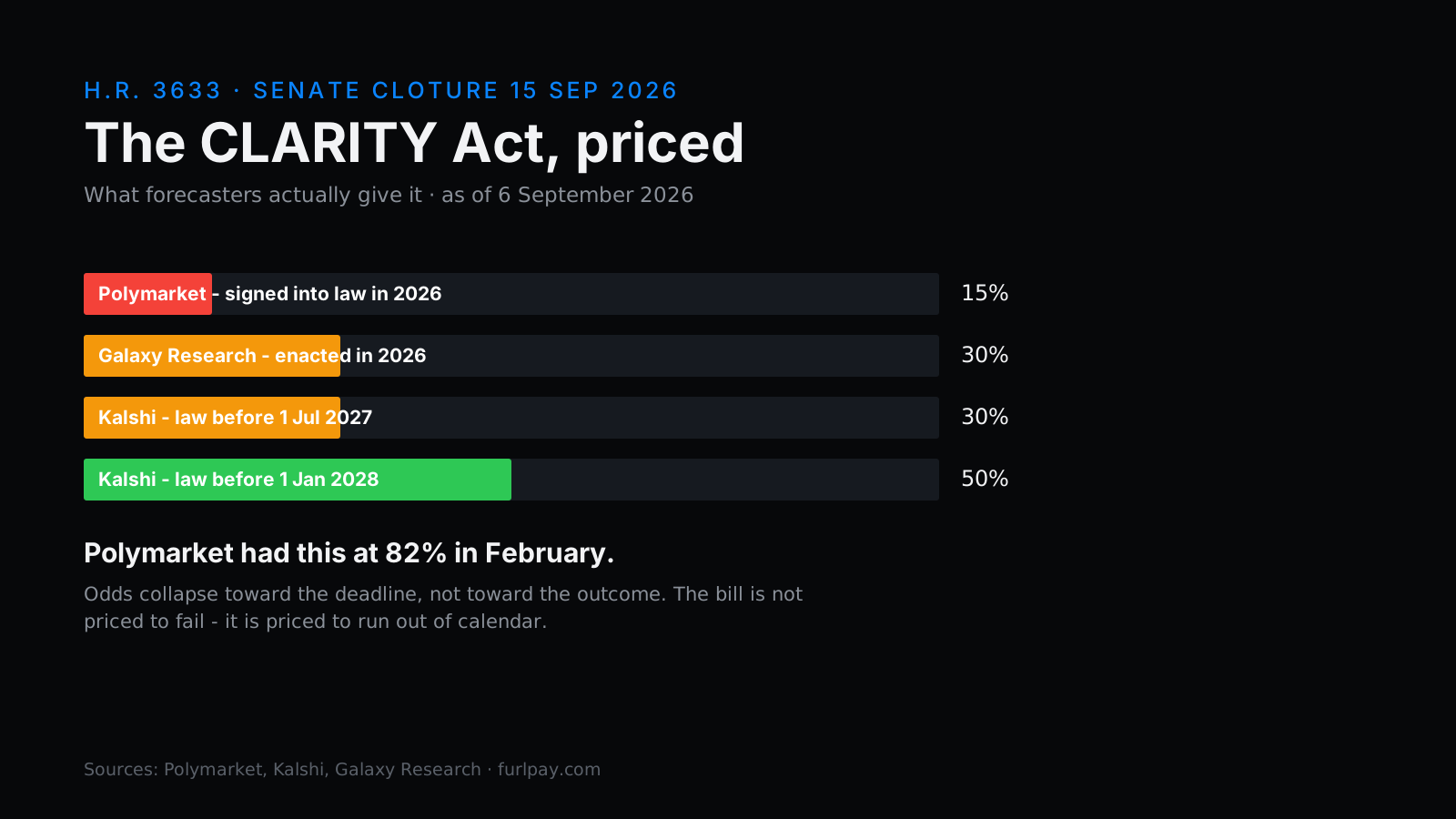
The CLARITY Act Is Not Dead. It Is Running Out of Calendar.
Prediction markets give the CLARITY Act a 15% chance of becoming law in 2026 — and 50% by January 2028. The bill is late, not dead. Meanwhile JPMorgan settles more than $7bn a day in tokenized deposits without waiting for it. What the 15 September Senate vote actually decides, what atomic settlement does and does not fix, and why the strongest objections come from the people who understand market structure best.
September 7, 2026 · 23 min read
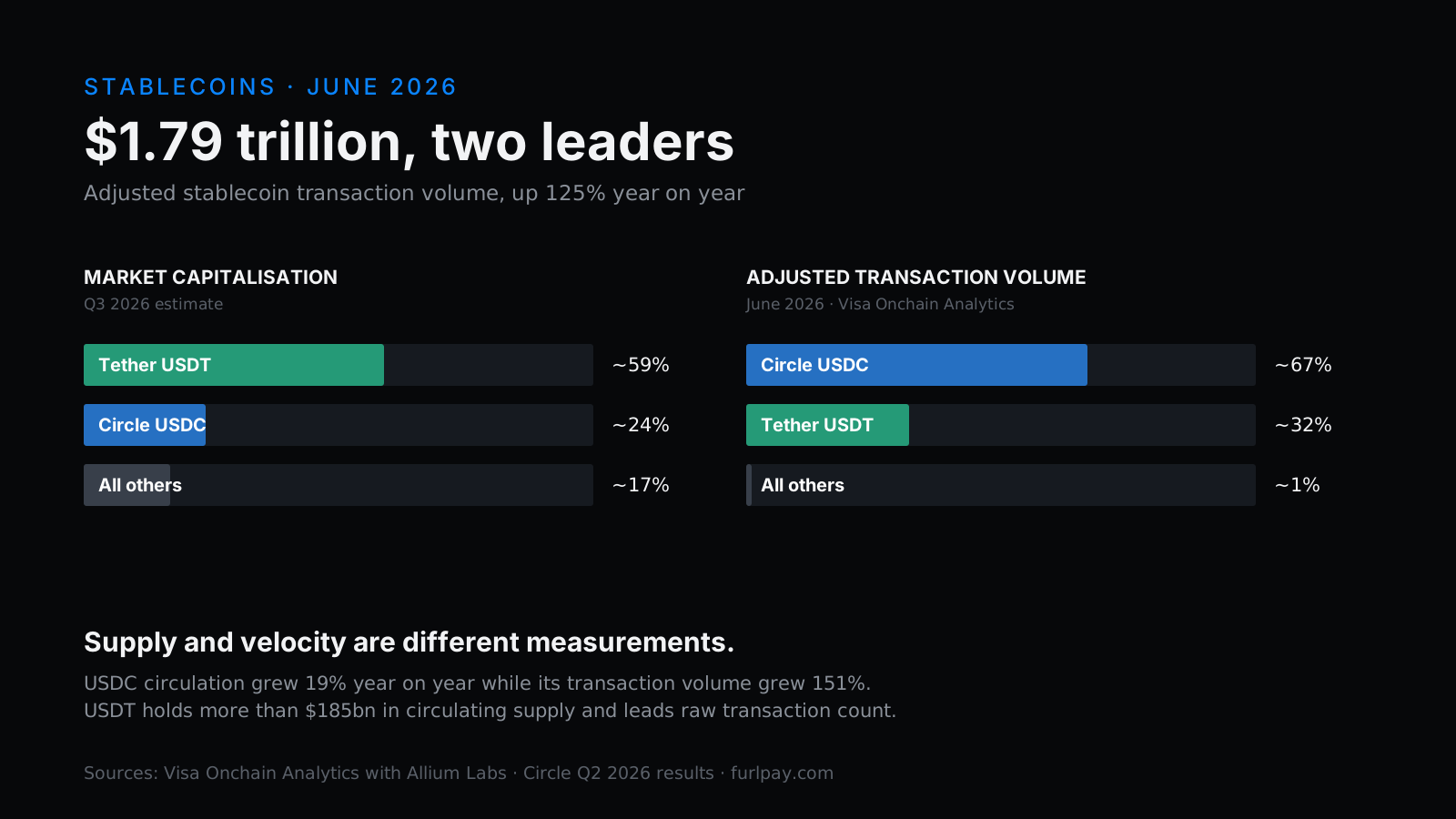
Stablecoin Transaction Volume in 2026: Circle, Tether and the Race to Build the Payment Rail
Stablecoins settled $1.79 trillion in adjusted transaction volume in June 2026, up 125% year on year. USDC accounted for approximately 67% of that volume; USDT remains the largest stablecoin by market capitalisation at more than $185 billion. An analysis of what each metric measures, where Circle and Tether actually stand, and what Visa, Mastercard, Stripe, PayPal and Coinbase are building around them.
September 7, 2026 · 15 min read
Stablecoins Quietly Overtook Crypto for Cross-Border Payments — Here Is the Data
In 2025 stablecoins settled about $33 trillion on-chain, more than Visa and Mastercard combined, while Bitcoin and Ethereum's share of cross-border flows kept shrinking. The GENIUS Act, Stripe's $1.1B Bridge deal and Mastercard's $1.8B BVNK deal all landed in the same window. Here is what actually happened, with the figures checked against primary sources — and where a middleware layer like FurlPay fits.
July 18, 2026 · 12 min read