Stablecoin Transaction Volume in 2026: Circle, Tether and the Race to Build the Payment Rail
By Ashutosh Kumar Singh · September 7, 2026 · 15 min read
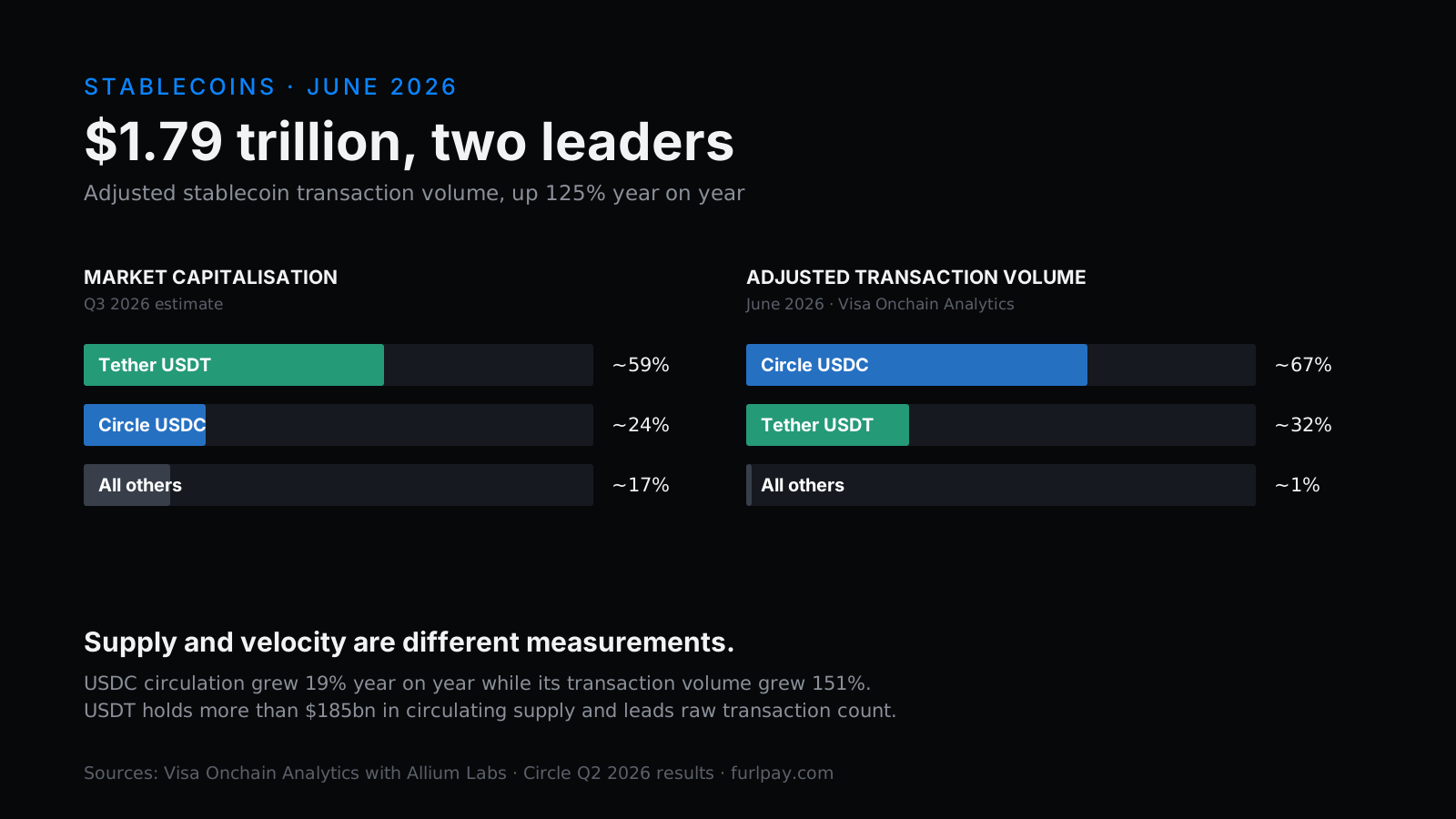
Stablecoins settled $1.79 trillion in adjusted transaction volume in June 2026 — a monthly record, up 63% from May and 125% from a year earlier. For context, the first half of 2026 produced $8.82 trillion in adjusted volume, already approaching the $10.8 trillion recorded across all of 2025.
Numbers at that scale invite a simple question: who is leading? The answer depends entirely on which measurement you use, and the two most commonly cited measurements currently have different leaders.
Circle's USDC leads adjusted transaction volume, accounting for approximately 67% of the June total. Tether's USDT remains the largest stablecoin by market capitalisation, with more than $185 billion in circulation. Both are accurate descriptions of the same market, measuring different things.
This article sets out what each metric captures, where the two issuers actually stand, and what Visa, Mastercard, Stripe, PayPal and Coinbase have been building around them.
The market has reached a new scale
The June 2026 figures come from Visa Onchain Analytics, a public dashboard Visa built with the blockchain data firm Allium Labs. It reports adjusted stablecoin transaction volume — a filtered measure described in detail below.
| Measure | June 2026 | Change |
|---|---|---|
| Total adjusted stablecoin volume | $1.79tn | +63% month on month, +125% year on year |
| USDC share | ~$1.21tn | ~67% of the monthly total |
| USDT share | ~$576bn | ~32% of the monthly total |
| PYUSD | ~$2.42bn | Third by adjusted volume |
| H1 2026 cumulative | $8.82tn | Against $10.8tn for all of 2025 |
Two features of that table are worth noting. The growth rate is steep by any standard, and the distribution is highly concentrated: the top two stablecoins account for approximately 99% of adjusted volume, with the third-largest roughly two orders of magnitude behind the second.
What adjusted transaction volume measures
Raw on-chain volume counts every stablecoin transfer recorded on a blockchain. A significant share of that activity is automated rather than economic: arbitrage between trading venues, automated market-maker rebalancing, maximal extractable value (MEV) strategies, flash loans that borrow and repay within a single transaction, and smart-contract routing where the same value passes through several addresses en route to one destination.
Adjusted volume applies filters intended to remove that activity and approximate transfers with genuine economic intent — payments, settlements, treasury movements. It is an estimate produced by a defined methodology, not a directly observed quantity, and the choice of filters is a legitimate subject of technical debate.
The distinction matters for interpretation. Raw volume answers 'how much moved on-chain'. Adjusted volume attempts to answer 'how much moved for a commercial reason'. Most people asking which stablecoin is used more are asking the second question.
Circle and USDC
Circle reported its Q2 2026 results on 5 August 2026. The company-reported figures:
- USDC on-chain transaction volume of $14.8 trillion in Q2 2026, growing 151% year on year
- Daily on-chain transaction volume averaging $163 billion across the quarter, also up 151% year on year
- USDC in circulation of $73.3 billion at quarter end, up 19% year on year
- Average USDC circulation of $76.5 billion during the quarter, an all-time high
- Total revenue and reserve income of $701 million, up 7% year on year, with adjusted EBITDA of $143 million
The gap between those two growth rates — circulation up 19%, transaction volume up 151% — describes how USDC is used. The same supply is turning over considerably faster than it is growing, which is the signature of a payment instrument rather than a store of value.
Circle's position is concentrated in institutional and business flows: settlement between financial institutions, business-to-business cross-border payments, fintech and marketplace payouts, corporate treasury movement, and payment-processor settlement legs. These transactions are large, occur repeatedly between the same counterparties, and are unambiguously commercial — exactly the activity adjusted volume is designed to capture.
Circle's Cross-Chain Transfer Protocol supports this by moving USDC between blockchains through a burn-and-mint mechanism rather than a third-party bridge, which removes the bridge-custody risk that institutional counterparties typically will not accept. Circle has also announced a public mainnet launch for its Arc blockchain on 16 September 2026.
Tether and USDT
USDT remains the largest stablecoin by circulating supply, with more than $185 billion outstanding — roughly 59% of total stablecoin market capitalisation. Tether reportedly generates over $1 billion per quarter in net profit, primarily from yield on the US Treasury holdings backing that supply.
USDT also leads raw transaction count. Its activity is concentrated in different use cases from USDC's: over-the-counter trading, exchange liquidity and trading pairs, peer-to-peer transfers, and dollar access in economies where obtaining and holding dollars through the banking system is difficult or expensive.
That last category is significant in reach if not in dollar volume. Much of it runs on Tron, which handles roughly $320 billion of monthly adjusted volume — about 18% of the global total — largely through retail corridors in Latin America and Asia where low transaction fees make small transfers economically viable.
Small transfers move fewer dollars per transaction than institutional settlement does. A metric denominated in dollars will therefore always understate a use case denominated in people.
Why the two rankings differ
| Circle / USDC | Tether / USDT | |
|---|---|---|
| Market capitalisation | ~$73.3bn at Q2 2026 quarter end (company-reported) | More than $185bn, ~59% of the market |
| Adjusted transaction volume, June 2026 | ~$1.21tn, ~67% share | ~$576bn, ~32% share |
| On-chain transaction volume | $14.8tn in Q2 2026, +151% YoY (company-reported) | Leads on raw transaction count |
| Principal networks | Base, Ethereum, Solana, Polygon | Tron, Ethereum, TON, Solana |
| Principal use cases | Institutional settlement, B2B cross-border, fintech payouts, treasury | OTC, exchange liquidity, P2P transfers, dollar access |
| Infrastructure | Cross-Chain Transfer Protocol; Arc mainnet announced for 16 Sep 2026 | Hadron tokenization platform; trade-finance expansion |
The divergence is structural. A stablecoin held as a dollar substitute contributes to circulating supply for as long as it is held and generates no settlement volume while held. A stablecoin used as a payment rail can settle the same dollar many times within a month, contributing repeatedly to transaction volume without changing supply at all.
Velocity, in other words, is the variable. USDC circulation grew 19% year on year while its transaction volume grew 151%. Neither behaviour is a deficiency; they are different products serving different demand.
Market capitalisation measures how much of a stablecoin exists. Adjusted transaction volume measures how hard it is working. A complete picture requires both.
Where the volume settles
Adjusted volume by network for June 2026, from the same Visa Onchain Analytics dataset:
| Network | Monthly adjusted volume | Share | Principal stablecoins | Dominant activity |
|---|---|---|---|---|
| Base | ~$565bn | ~31.5% | USDC | Sub-cent fees; direct Stripe and Coinbase wallet integration |
| Ethereum | ~$562bn | ~31.4% | USDC, USDT | High-value institutional settlement, treasury movement |
| Tron | ~$320bn | ~17.9% | USDT | Retail payments, P2P corridors in Latin America and Asia |
| Solana | ~$225bn | ~12.5% | USDC, PYUSD | High-throughput merchant checkout, DeFi liquidity |
| Others | ~$118bn | ~6.7% | USDC, USDS | Rollup liquidity, regional fintech deployments |
Base and Ethereum are separated by roughly $3 billion in a $1.79 trillion month — a margin narrow enough that the ordering should be treated as a snapshot rather than a standing rank. Their profiles differ regardless: Base's share comes substantially from high-frequency, low-fee flows, Ethereum's from fewer transactions of higher individual value, where settlement finality outweighs transaction cost.
One methodological note: this table ranks by transaction VALUE, not transaction COUNT. A network can lead one and not the other, and the two are frequently reported interchangeably.
The stablecoin leaderboard
Market capitalisations are Q3 2026 estimates and move continuously; adjusted-volume shares are H1 2026 estimates from the Visa/Allium dataset. The two columns measure different things and are shown together to make the distinction visible.
| # | Stablecoin | Issuer | Market cap (est.) | Adj. volume share (est.) | Principal use |
|---|---|---|---|---|---|
| 1 | USDT | Tether | ~$183–186bn | ~25–32% | OTC, exchange liquidity, emerging-market dollar access |
| 2 | USDC | Circle | ~$72–75bn | ~67–70% | Institutional settlement, B2B, fintech payouts |
| 3 | USDS / DAI | Sky | ~$4.8–5.4bn | ~1.5% | DeFi collateral and lending |
| 4 | USD1 | World Liberty Financial | ~$4.0–4.7bn | <1% | DeFi liquidity, institutional yield |
| 5 | USDe | Ethena Labs | ~$3.9–5.2bn | ~1.2% | Synthetic delta-neutral basis trading |
| 6 | USDG | Paxos / Global Dollar Network | ~$3.2–3.5bn | <1% | Enterprise rewards-sharing network |
| 7 | PYUSD | PayPal / Paxos | ~$2.5–2.7bn | ~0.2–0.5% | Consumer P2P, checkout, remittances |
| 8 | RLUSD | Ripple | ~$1.5–1.6bn | <0.2% | Bank corridor settlement |
| 9 | USDD | TRON DAO Reserve | ~$1.4–1.6bn | <0.2% | Tron DeFi liquidity |
| 10 | FDUSD | First Digital | ~$1.1–1.3bn | ~0.5% | Exchange trading pairs |
Sorting by either column produces a different top two. Below the top two, both measures fall away sharply — the third-ranked asset holds under 2% on either.
Visa and stablecoin settlement
A distinction is useful before the detail. In card payments, AUTHORISATION is the real-time approval of a transaction at the point of purchase. SETTLEMENT is the movement of funds between financial institutions afterwards, typically on a delayed cycle. Visa's stablecoin work sits almost entirely on the settlement side.
Visa announced US stablecoin settlement in December 2025, enabling issuer and acquirer partners to settle with Visa in USDC on Solana — initially with Cross River Bank and Lead Bank, and a broader rollout expected through 2026. Because blockchains operate continuously, participating institutions can settle on weekends and holidays, when traditional settlement systems are closed.
On disclosed volume, two figures with different scopes and dates are in circulation and should not be combined. Visa reported that monthly stablecoin settlement volume passed a $3.5 billion annualised run rate as of 30 November, in the announcement of the US launch. Later 2026 reporting describes a settlement pilot spanning nine blockchains at approximately a $7 billion annualised rate, growing around 50% quarter on quarter. The first is a US-launch figure; the second is broader in scope and later in date.
Either figure is a small share of Visa's overall payments volume and a meaningful absolute sum. Visa also operates the Visa Tokenized Asset Platform, which allows banks to pilot tokenized deposits, and the Visa Stablecoin Platform, alongside support for 60-plus crypto-linked card programmes where a cardholder spends a stablecoin balance at ordinary merchants.
Two different meanings of tokenization
The word tokenization is used for two unrelated technologies in payments, and it is worth defining both because Visa is active in each.
CARD-NETWORK TOKENIZATION replaces a card's primary account number — the 16-digit number on the front — with a substitute value called a network token, typically restricted to one device or merchant. It is a security measure for conventional card payments and involves no blockchain. Industry reporting in 2026 places roughly 35% of transactions overall as tokenized, with around half of Visa's e-commerce volume using network tokens; Visa attributes an approximately 4.6% global uplift in card-not-present authorisation rates to token use, because tokens do not expire when a physical card is reissued.
BLOCKCHAIN TOKENIZATION represents an asset — a deposit, a security, a fund share — as a transferable record on a distributed ledger. This is what the Visa Tokenized Asset Platform addresses.
Both are called tokenization. They share the concept of substituting a representation for an underlying value, and nothing else.
Mastercard's acquisition of BVNK
Mastercard announced an agreement to acquire the stablecoin infrastructure company BVNK on 17 March 2026, in a deal valued at up to $1.8 billion including contingent payments, and completed the acquisition on 3 August 2026. It is the largest stablecoin acquisition recorded to date.
BVNK provides the conversion layer between fiat currency and stablecoins — the on-ramp and off-ramp infrastructure that lets a business accept a payment in one form and settle in another. Reporting at the time of closing indicated BVNK brought approximately $30 billion in annual stablecoin volume.
The strategic logic is about position rather than product. Cross-border B2B payments, payouts and treasury movement all require a controlled boundary between traditional currency and on-chain settlement, and owning that boundary means owning the economics of every transaction crossing it.
The two card networks have taken visibly different routes to the same objective. Mastercard acquired its conversion layer outright; Visa has largely partnered, including work with Stripe-owned Bridge on stablecoin-linked card programmes.
Stripe and Bridge
Stripe acquired the stablecoin orchestration platform Bridge for $1.1 billion in February 2025, at the time the largest acquisition in the sector. Bridge provides the infrastructure for issuing, converting and moving stablecoins, which Stripe has integrated into its merchant products.
Stripe now supports stablecoin checkout for merchants across more than 150 countries and stablecoin payouts for platforms with distributed contractor and seller bases — a use case where conventional cross-border payout rails are slow and costly relative to transaction size. Its stablecoin support spans USDC, USDP and USDG across Solana, Ethereum and Base.
PayPal and PYUSD
PayPal issues PYUSD in partnership with Paxos, on Ethereum and Solana. It has been expanded to more than 70 global markets and integrated into PayPal's merchant checkout, with zero-fee cross-border transfers available through Xoom, PayPal's remittance service.
PYUSD's approximately $2.5–2.7 billion market capitalisation and roughly $2.42 billion in June adjusted volume place it third among stablecoins by volume, at a scale roughly two orders of magnitude below the top two. Its distinguishing characteristic is distribution rather than size: PYUSD reaches an existing consumer base that does not otherwise interact with blockchain infrastructure.
Coinbase and Base
Coinbase co-governs USDC with Circle and operates Base, the Ethereum layer-2 network that led adjusted stablecoin volume in June 2026 at approximately $565 billion, or 31.5% of the monthly total.
Base's position derives from cost and integration together. Transaction fees below one cent make high-frequency settlement viable, and direct integration with Coinbase wallets and Stripe's infrastructure means the network sits inside the products that businesses already use to move USDC. Coinbase also offers zero-fee USDC transactions on Base.
As noted above, Base's lead over Ethereum in this dataset is narrow and period-specific.
The infrastructure race
| Company | Role | Principal 2026 development |
|---|---|---|
| Circle | Issuer and infrastructure | $14.8tn USDC on-chain volume in Q2 2026, +151% YoY; Arc mainnet announced for 16 Sep 2026 |
| Tether | Issuer | More than $185bn circulating supply; Hadron tokenization platform; trade-finance expansion |
| Mastercard | Card network | Completed $1.8bn BVNK acquisition on 3 Aug 2026, announced 17 Mar 2026 |
| Visa | Card network | US USDC settlement on Solana with issuer and acquirer partners; VTAP and Visa Stablecoin Platform |
| Stripe | Merchant acquirer | Bridge acquisition ($1.1bn, Feb 2025) integrated into checkout and payouts across 150+ countries |
| PayPal | Consumer payments | PYUSD expanded to 70+ markets; zero-fee cross-border transfers via Xoom |
| Coinbase | Exchange and L2 | Base led adjusted stablecoin volume at ~$565bn in June 2026 |
The pattern across these entries is that established payment companies have moved from pilots to permanent infrastructure, and in two cases to nine- and ten-figure acquisitions. Neither card network launched a stablecoin of its own; both invested in the connective layer between existing stablecoins and existing payment rails.
What the activity actually consists of
The composition of stablecoin volume in 2026 differs from earlier periods. The categories driving adjusted volume are recognisably conventional payment activities:
- Cross-border B2B payments, where correspondent banking is slow and the fee is large relative to the transfer
- Marketplace and platform payouts to contractors and sellers across multiple jurisdictions
- Corporate treasury movement between entities and accounts
- Payment-processor settlement legs between institutions
- Merchant checkout, principally on Solana and Base
- Remittances, including through consumer-facing services such as Xoom
These are the flows that card networks, acquirers and processors already serve. The relevant comparison for stablecoin settlement is therefore not other crypto assets but the existing correspondent banking and payout infrastructure it runs alongside.
Who leads, by measure
| Measure | Leader | Figure | Period |
|---|---|---|---|
| Market capitalisation | Tether (USDT) | More than $185bn, ~59% share | Q3 2026 estimate |
| Adjusted transaction volume | Circle (USDC) | ~$1.21tn, ~67% share | June 2026 |
| Company-reported on-chain volume | Circle (USDC) | $14.8tn in the quarter, +151% YoY | Q2 2026 |
| Raw transaction count | Tether (USDT) | Driven by retail and P2P transfers | 2026 |
| Network by adjusted volume | Base, narrowly | ~$565bn vs Ethereum ~$562bn | June 2026 |
| Card-network settlement infrastructure | Contested | Mastercard via acquisition; Visa via partnership and direct settlement | 2026 |
There is no single figure that resolves the question, because the metrics measure different properties of the same system. Supply, velocity, transaction count, settlement value and infrastructure position are separate variables, and the current leaders differ across them.
The most durable observation is not which issuer leads a given metric. It is that stablecoins in 2026 are being measured with the vocabulary of payments infrastructure rather than that of crypto assets — settlement volume, payout corridors, conversion layers, run rates.
Frequently asked questions
Which company leads stablecoin transaction volume in 2026?
Circle, measured by adjusted transaction volume. USDC accounted for approximately 67% of adjusted stablecoin volume in June 2026 — roughly $1.21 trillion of a $1.79 trillion monthly total, according to Visa Onchain Analytics data produced with Allium Labs. Circle separately reported $14.8 trillion in USDC on-chain transaction volume for Q2 2026, up 151% year on year.
Which stablecoin has the largest market capitalisation?
USDT. Tether has more than $185 billion in circulating supply, approximately 59% of total stablecoin market capitalisation. USDC is second; Circle reported $73.3 billion in circulation at the end of Q2 2026, up 19% year on year.
Is USDC bigger than USDT?
By adjusted transaction volume, yes — USDC held roughly a two-to-one lead in June 2026. By market capitalisation, no; USDT is approximately 2.5 times larger. The two metrics measure different properties: how much of a stablecoin exists, versus how much transaction activity it carries.
How much stablecoin volume occurred in June 2026?
$1.79 trillion in adjusted transaction volume, a monthly record, up 63% from May 2026 and 125% year on year. Cumulative adjusted volume for the first half of 2026 was $8.82 trillion, against $10.8 trillion for the whole of 2025.
What is adjusted stablecoin transaction volume?
An estimate of stablecoin transfers representing genuine economic activity, produced by filtering raw on-chain volume to remove automated activity such as arbitrage, market-maker rebalancing, MEV strategies, flash loans and internal smart-contract routing. It is a methodology-dependent estimate rather than a directly observed figure.
What role does Visa play in stablecoins?
Visa enables issuer and acquirer partners to settle with it in USDC, launched in the United States on Solana in December 2025 with Cross River Bank and Lead Bank as initial partners. Visa reported settlement volume passing a $3.5 billion annualised run rate as of 30 November; later 2026 reporting describes a broader nine-blockchain pilot at approximately a $7 billion annualised rate. Visa also operates the Visa Tokenized Asset Platform and Visa Stablecoin Platform and supports 60-plus crypto-linked card programmes. This work concerns settlement between institutions rather than card authorisation.
What did Mastercard's BVNK acquisition accomplish?
It gave Mastercard ownership of fiat-to-stablecoin conversion infrastructure — the on-ramp and off-ramp layer connecting traditional payment rails to on-chain settlement. Mastercard announced the deal on 17 March 2026 at up to $1.8 billion and completed it on 3 August 2026. Reporting at closing indicated BVNK brought approximately $30 billion in annual stablecoin volume.
Which blockchain has the highest stablecoin volume?
By adjusted volume in June 2026, Base led at approximately $565 billion (31.5%), narrowly ahead of Ethereum at approximately $562 billion (31.4%). Tron was third at approximately $320 billion (17.9%) and remains the principal network for USDT retail and P2P transfers. The Base/Ethereum margin is narrow enough that the ordering should be treated as period-specific.
What is Circle's USDC transaction volume?
Circle reported $14.8 trillion in USDC on-chain transaction volume for Q2 2026, growing 151% year on year, with daily volume averaging $163 billion across the quarter. These are company-reported figures from Circle's Q2 2026 results, published 5 August 2026.
What is Tether's market share?
Approximately 59% of stablecoin market capitalisation, with more than $185 billion in circulating supply. By adjusted transaction volume, USDT's share was approximately 32% in June 2026 — a different metric measuring transaction activity rather than supply.
Sources and methodology
Adjusted stablecoin transaction volume, issuer shares and network shares are from Visa Onchain Analytics, produced with Allium Labs, for June 2026 and H1 2026. Adjusted volume is a filtered estimate, not a directly observed quantity.
Circle's transaction volume, circulation and financial figures are company-reported from its Q2 2026 results, published 5 August 2026. Visa's stablecoin settlement figures are from its December 2025 US launch announcement ($3.5 billion annualised run rate as of 30 November) and from later 2026 reporting describing a nine-blockchain pilot at approximately $7 billion annualised; these have different scopes and dates and are not combined here.
The Mastercard acquisition of BVNK was announced 17 March 2026 at up to $1.8 billion and completed 3 August 2026. Stripe acquired Bridge for $1.1 billion in February 2025. Visa card-network tokenization percentages are from 2026 industry reporting.
Market capitalisations are estimates that move continuously; where source material provided a range, the range is preserved rather than reduced to a midpoint. Market capitalisation, circulating supply, raw transaction count, adjusted transaction volume, company-reported on-chain volume and card settlement volume are distinct measurements and are not treated as interchangeable at any point in this analysis.

Founder & CEO, FurlPay · Software Engineer at Skyhigh Security · NeurIPS 2026 author · Google DeepMind contributor · ex-Quantiphi
Ashutosh is a Software Engineer at Skyhigh Security (previously Quantiphi), working across ML systems and cloud infrastructure. He is a contributor to Google DeepMind and a NeurIPS 2026 author. He is building Furlpay: stablecoin payments, travel booking, and investing in one client — settled on Arbitrum. Pay in USDC, book 2.2M+ stays and flights, and let AI agents pay per-request via x402. Phishing-resistant. Compliance-aware. Zero gas.
Don't miss the next one
Stay ahead of the curve
Get product updates, engineering deep-dives, and security bulletins. No spam — just the signal.
More in Legal & Compliance
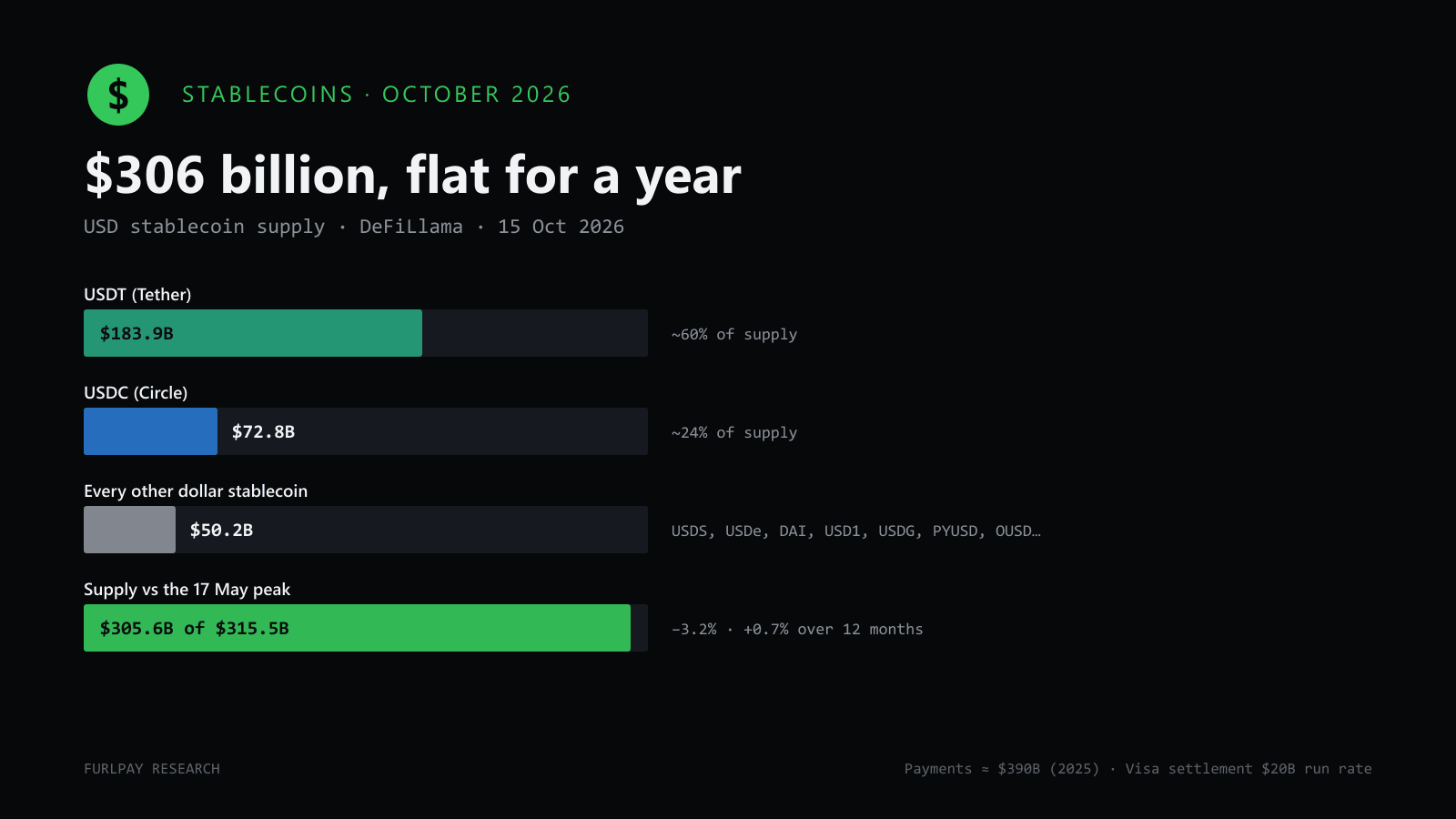
Stablecoins in October 2026: $306 Billion, Flat Supply, and the Networks Moving In
Dollar stablecoins total about $306 billion, almost exactly where they were a year ago, while the companies that run payments have stopped watching and started issuing. Here is the supply, issuer and chain picture measured on 15 October 2026, what is payments and what is not, and the rules that changed in the last month.
October 15, 2026 · 14 min read
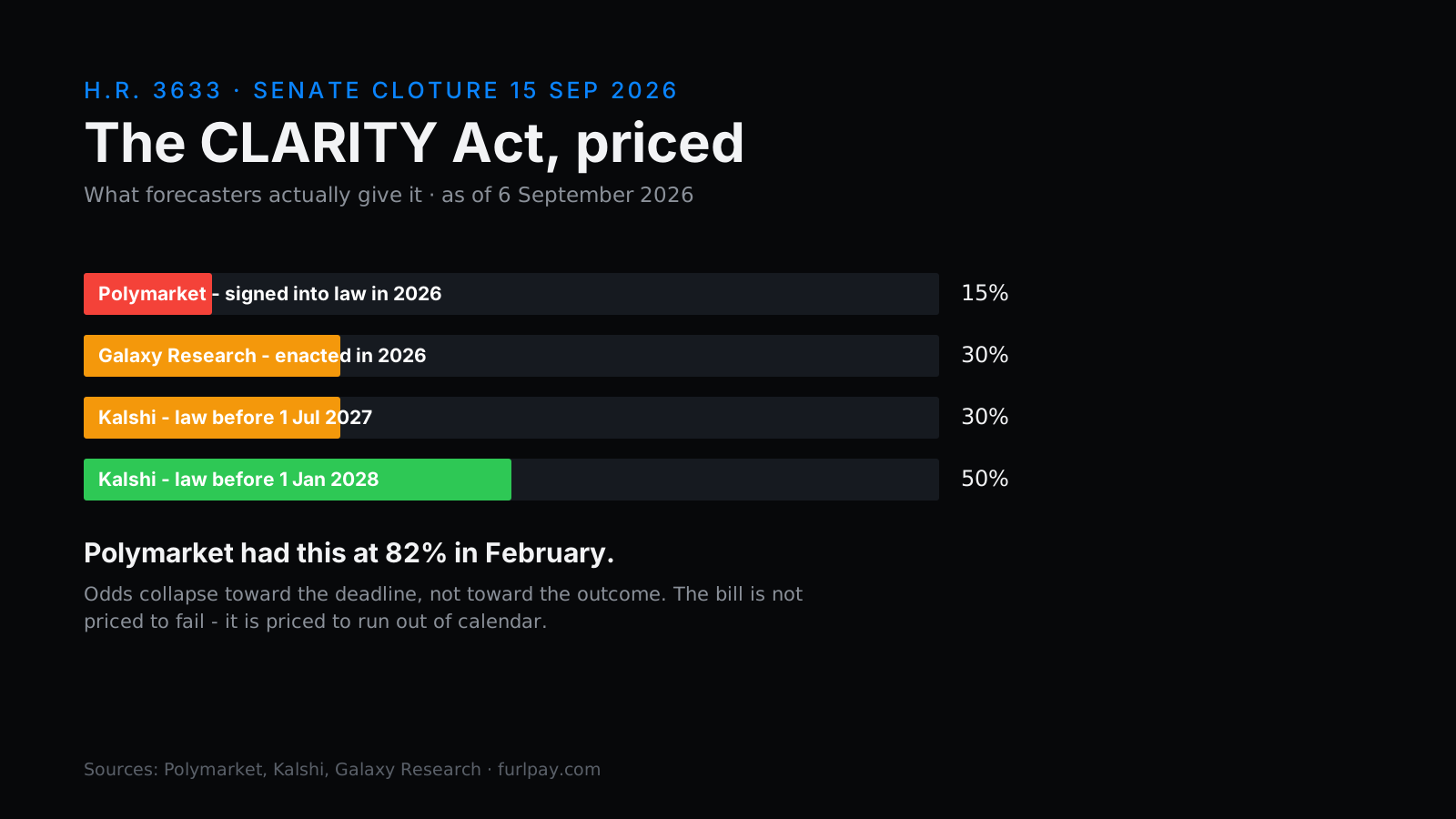
The CLARITY Act Is Not Dead. It Is Running Out of Calendar.
Updated 12 October: the 15 September cloture vote failed 49–50. Before it, prediction markets gave the CLARITY Act a 15% chance of becoming law in 2026 — and 50% by January 2028. The bill is late, not dead. Meanwhile JPMorgan settles more than $7bn a day in tokenized deposits without waiting for it. What the 15 September Senate vote decided, what atomic settlement does and does not fix, and why the strongest objections come from the people who understand market structure best.
September 7, 2026 · 23 min read

Stablecoins Quietly Overtook Crypto for Cross-Border Payments — Here Is the Data
In 2025 stablecoins settled about $33 trillion on-chain, more than Visa and Mastercard combined, while Bitcoin and Ethereum's share of cross-border flows kept shrinking. The GENIUS Act, Stripe's $1.1B Bridge deal and Mastercard's $1.8B BVNK deal all landed in the same window. Here is what actually happened, with the figures checked against primary sources — and where a middleware layer like FurlPay fits.
July 18, 2026 · 12 min read