The CLARITY Act Is Not Dead. It Is Running Out of Calendar.
By Ashutosh Kumar Singh · September 7, 2026 · 23 min read
UPDATE — 12 October 2026. The cloture vote on the motion to proceed took place on 15 September 2026 and failed 49 to 50, eleven votes short of the 60 required, so the Senate did not begin debating the bill. Reporting attributes the defeat to the ethics provisions on officials' crypto holdings rather than to the SEC/CFTC market-structure framework, which never reached the floor. The bill is not dead, since it can return to the calendar, but it did not advance in September. The analysis below is what we published beforehand, on 7 September, and its prediction-market figures are as of 6 September; they are not current. Sources for the result: Paul Hastings and Troutman Pepper Locke crypto-policy updates, September 2026.
On Tuesday 15 September 2026 at 2:15 p.m. Eastern, the United States Senate votes on a motion to proceed on H.R. 3633, the Digital Asset Market Clarity Act. It is not a vote on the bill. It is a vote on whether the Senate may begin debating it, and it needs 60 of 100 votes. Republicans hold 53 seats, so at least seven Democrats have to cross.
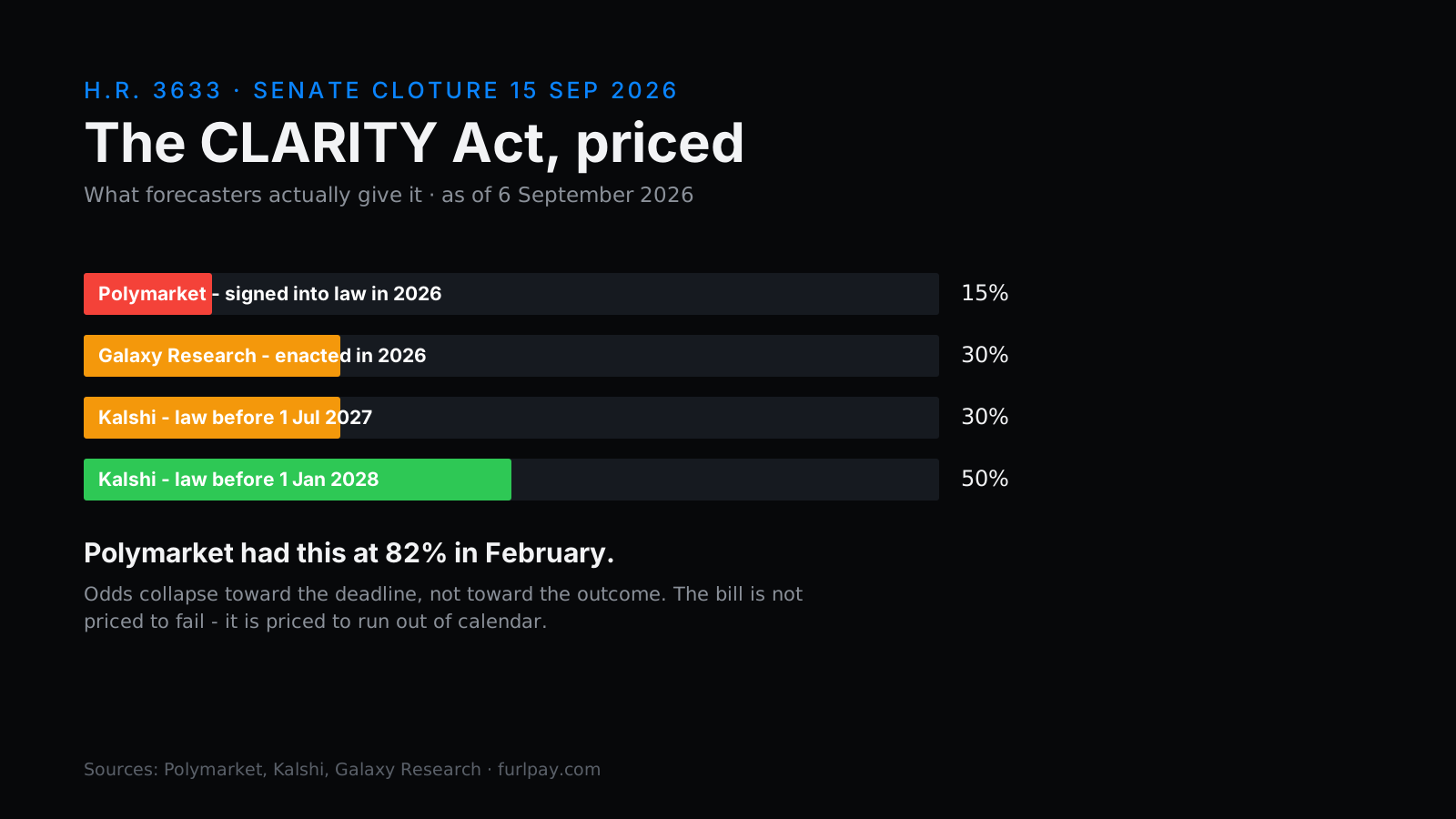
Prediction markets give the bill roughly a 15% chance of being signed into law in 2026 and roughly a 50% chance of a market-structure law by January 2028. Those numbers answer different questions, and read together they say something precise: the market does not expect the CLARITY Act to fail. It expects the CLARITY Act to run out of days.
That distinction is the whole argument of this piece. A bill that dies for want of votes and a bill that dies for want of floor time look identical on a probability chart and imply opposite strategies for anyone building financial infrastructure. This article is about which one this is, and what follows from the answer.
The CLARITY Act in 60 seconds
WHAT IT IS. A bill (H.R. 3633) that would write into law which digital assets are securities, which are commodities, and which are payment stablecoins — and which federal agency regulates each. Right now that question has no statutory answer, which is the problem it exists to solve.
WHAT HAPPENS ON 15 SEPTEMBER 2026. The Senate votes at 2:15 p.m. Eastern on whether to START DEBATING the bill. It needs 60 of 100 votes.
DOES IT BECOME LAW THAT DAY? No. This is the first of at least five more steps. A successful vote opens debate; it does not pass anything.
WHY ANYONE SHOULD CARE. The same rules would govern how exchanges operate, who is allowed to hold digital assets on your behalf, whether banks can custody them, and whether shares in a company can legally be issued and settled as digital records. That last one is why this is a financial-markets story, not only a crypto story.
WILL IT PASS? Probably not this year. As of 6 September 2026, prediction markets priced roughly 15% for enactment in 2026 and roughly 50% for a market-structure law by January 2028. The obstacle is the congressional calendar, not the votes.
Two ways to read this
This article is written for two different readers and you should skip accordingly. If you want the answer: read the 60 seconds above, then 'What happens on 15 September', then the FAQ at the end. That is about four minutes and you will understand the situation better than most coverage of it.
If you want the analysis: the sections from 'Why this is a market-infrastructure bill' onward assume you know what a settlement cycle is, and go into netting, atomic settlement, the SEC/CFTC perimeter and what institutions are already building. That is the part written for people who do this professionally.
Why this matters even if you never buy crypto
The word 'crypto' does most of the damage in coverage of this bill, because it makes the whole subject sound optional. Here is the version that is not about crypto at all.
Every time you buy a share, the trade and the actual exchange of money for ownership happen on different days. Since May 2024 that gap in the US is one business day — T+1. A large amount of financial machinery exists purely to carry the risk across that gap: collateral posted, margin held, procedures for when delivery fails. It works. It is also expensive, and the expense is ultimately paid by whoever is investing.
Technology now exists to make the trade and the settlement the same event, so that ownership and payment change hands simultaneously or not at all. That is a genuine improvement to how markets work, and it is not a cryptocurrency — it is a settlement method. But in the United States, no one can legally issue a mainstream share that settles this way at scale, because the law does not clearly say who regulates such an instrument or who may hold it for you.
The CLARITY Act is not really a bill about crypto. It is a bill about whether American financial infrastructure is allowed to be upgraded, and by whom.
That is why banks care, why exchanges care, and why this is being fought over by people with no interest in digital assets as an investment.
What actually happens on 15 September
The single most common error in coverage of this vote is treating it as a vote on the bill. It is not. Here is the full path from Tuesday to law.
The sequence runs like this. At 2:15 p.m. Eastern the Senate votes on cloture on the motion to proceed. Sixty of the hundred senators must vote yes. Republicans hold 53 seats, so at least seven Democrats have to join them.
If that vote fails, the bill stalls. It does not die — the text stays on the Legislative Calendar and can be taken up again — but it runs out of floor time for this year, and the Senate is expected to leave Washington around 17 September and not return until after the midterms.
If it succeeds, formal Senate debate opens. That is the beginning of the process rather than the end of it. Debate is followed by an amendment stage, which is where the stablecoin perimeter question gets fought explicitly and where each concession reshapes the coalition. Only after that does the Senate hold a passage vote — a separate vote from the one on 15 September, and the first one that actually passes anything.
A Senate text then has to be reconciled with the House version, H.R. 3633, which passed in July 2025. The reconciled bill goes to the President, and only a signature makes it law. Five further steps, each with its own failure mode, sit between Tuesday's vote and a statute.
15 September is not the day the CLARITY Act becomes law. It is the day the Senate decides whether it is allowed to talk about it.
The Senate is expected to leave Washington around 17 September and not return until after the midterm elections. That is why a vote to open debate matters so much: without floor time immediately afterwards, even a successful cloture vote produces no further progress this year.
SEC or CFTC: who regulates what
THE FIFTEEN-SECOND VERSION. The SEC regulates securities — investments in an enterprise, where you are relying on other people's efforts to make you money. The CFTC regulates commodities and their derivatives. The fight is that digital assets do not obviously sit in either box, and until a statute says which, the same asset can be argued into either agency's remit depending on who is arguing.
WHAT THE BILL WOULD DO. It creates a category called 'digital commodities' — assets whose value derives from the use of a decentralised blockchain protocol rather than from a company's managerial efforts — and gives the CFTC exclusive jurisdiction over their spot markets. The SEC keeps digital securities and primary-market fundraising for tokens that begin life as securities.
WHY THAT IS A BIGGER DEAL THAN IT SOUNDS. The CFTC's remit has historically been derivatives, not spot markets. Supervising cash markets in digital commodities would be a genuinely new function: registering and examining trading venues, running surveillance across venues that trade continuously, and setting customer-protection standards. That is a resourcing question as much as a legal one.
One correction worth making, because it appears constantly: the CFTC cannot pass the CLARITY Act, cannot amend it, and does not choose its own jurisdiction. Congress writes statutes; agencies implement them. Any argument that a regulator 'should pass' this bill is describing a system that does not exist.
What tokenized equities actually are
A tokenized equity is a share in a company whose ownership is recorded as a transferable digital record rather than solely in the books of a central depository. The company, the claim on its earnings, the voting rights and the disclosure obligations are all unchanged. What changes is the plumbing.
| A share today | A tokenized share | |
|---|---|---|
| What you own | A claim on the company | The same claim on the same company |
| Where ownership sits | Broker's books, netted through a central depository | A transferable record, held directly or by a custodian |
| When settlement happens | One business day after the trade (T+1) | Potentially at the moment of the trade |
| When you can trade | Roughly 32.5 hours a week | Potentially continuously |
| Who regulates it | The SEC. Settled law | The SEC — but custody and transfer rules are the open question |
Tokenizing a share does not make the economic claim disappear. It changes how ownership is recorded and how transfer settles — which is precisely why the legal question is about custody and transfer, not about the share.
This is why the bill matters to equities at all. A tokenized share is still a security and the SEC still regulates it. The unresolved part is whether a regulated broker-dealer may custody it, and under what rules it may be transferred. That is the gap that keeps institutions out.
What this means for you
- If you hold crypto: the direct effect is on the exchanges and custodians you use, not on your coins. A statutory perimeter would tell venues which regulator examines them and under what customer-protection rules, which mostly shows up as clearer disclosures and more institutions willing to serve you.
- If you invest in shares: nothing changes immediately, and nothing about your existing holdings is affected. Over years, a clearer perimeter is what would allow settlement to shorten below T+1 for some instruments.
- If you run a bank: the live question is whether dollar flows move over tokenized deposits, which are your liability, or stablecoins, which are not. That perimeter is drawn by the GENIUS Act and by whatever CLARITY does to its edges.
- If you are building a fintech: the binding constraint today is not technical, it is that your compliance counsel cannot tell you which regulator governs an instrument. That is what a statute fixes, and why the calendar matters more than the technology.
- If you are a developer: nothing in this bill stops you writing settlement code, and the properties that code needs are the same either way. Build it now; the perimeter arrives later.
- If you are just curious: watch whether seven Democrats vote yes on Tuesday. That is the whole story for this year.
The probability gap, and why most people read it wrong
Four numbers are circulating and are frequently quoted against each other as though they disagree. They do not: they answer different questions on different horizons. Three are PREDICTION-MARKET PRICES, which move continuously and are not forecasts; one is a published analyst ESTIMATE. All are stated with the date they were observed, and all will have moved by the time you read this.
| Forecaster | Question being priced | Probability | As of |
|---|---|---|---|
| Polymarket | CLARITY Act signed into law during calendar 2026 | ~15% | 6 Sep 2026, >$14M volume |
| Galaxy Research | Enacted in 2026 | 30% | Aug 2026, cut from 50% |
| Kalshi | A qualifying market-structure law before 1 Jul 2027 | ~30% | Sep 2026 |
| Kalshi | A qualifying market-structure law before 1 Jan 2028 | ~50% | Sep 2026 |
Polymarket's 2026 contract traded at about 82% in February. The probability fell to roughly 15% by September even though the legislative process had not formally collapsed: the bill was not voted down, and the committee process did not fail. The most obvious change over that period was the shrinking Senate calendar.
A bill priced at 15% this year and 50% by early 2028 is not a bill the market thinks is wrong. It is a bill the market thinks is late.
Be careful with these numbers in either direction. A prediction market is a price, not a forecast with a confidence interval, and thin markets on procedural questions are easy to move. But the SHAPE across four independent forecasters — low near-term, materially higher over three years — is consistent, and that shape is the signal.
What the CLARITY Act actually does, without the politics
Strip the framing and the bill does three structural things.
- It allocates jurisdiction. The CFTC gets exclusive authority over spot markets in 'digital commodities' — assets whose value is tied to use of a decentralised protocol. The SEC keeps digital securities and primary-market fundraising for tokens that begin life as securities.
- It addresses broker-dealer custody of digital assets, which is the specific gap that keeps regulated intermediaries on the sidelines.
- It lets tokenized instruments, digital commodities and payment stablecoins sit under one coherent framework rather than three overlapping ones.
Note what is already settled and what is not. Payment stablecoins are no longer an open question at the federal level: the GENIUS Act was signed into law on 18 July 2025, requires full reserve backing, and bans issuers from paying any return to holders. That ban already exists. The stablecoin fight inside CLARITY is not about whether issuers may pay yield — federal law says they may not. It is about whether affiliates, exchanges and intermediaries can achieve the same economics by another route.
This matters because the fight is routinely described as 'banks versus stablecoin yield', which implies the yield is currently legal. It is not, at the issuer level. The dispute is over the perimeter of an existing prohibition, which is a narrower and more tractable disagreement than the headline suggests.
Why this is a market-infrastructure bill, not a crypto bill
The most consequential thing about the CLARITY Act has little to do with whether Washington 'supports crypto'. It is whether the United States builds a legal framework capable of carrying tokenized securities, institutional custody and continuous settlement at scale — or whether that infrastructure matures somewhere else and America imports it later.
The evidence that this is an infrastructure question rather than a crypto question is that the infrastructure is already being built by institutions with no ideological interest in crypto at all. JPMorgan's Kinexys platform settles tokenized deposits at a reported average of more than $7 billion a day, has extended its deposit-token network to the Australian dollar, Hong Kong dollar, yen, renminbi and Singapore dollar, and launched a deposit token for institutional clients in November 2025 after testing with B2C2, Coinbase and Mastercard. JPMorgan and DBS have been exploring interoperability between their respective tokenized-deposit systems.
Reported cumulative volume figures for Kinexys vary widely across sources — we have seen both roughly $1.5 trillion and roughly $4 trillion cited in 2026 coverage, which is too wide a gap to treat as settled. The daily figure is more consistently reported. Either way the direction is unambiguous: the largest bank in the United States is running production tokenized settlement while the statute that would govern tokenized securities has not passed.
Tokenization is not waiting for permission. It is waiting for a perimeter.
Three layers of institutional tokenization
Most writing on this subject collapses three separate problems into one word. Separating them explains why progress looks stalled in one place and rapid in another.
| Layer | The question it answers | Who decides | Status, Sep 2026 |
|---|---|---|---|
| Legal | Is this instrument a security, a commodity, or a payment stablecoin — and who regulates it? | Congress, SEC, CFTC | Unresolved for securities; settled for payment stablecoins under GENIUS |
| Market structure | Who may custody it, clear it, list it, and make markets in it? | Regulators, exchanges, DTCC, broker-dealers | Blocked on the legal layer |
| Settlement engineering | Can delivery and payment be made one atomic event that either happens or does not? | Engineers | Being built now, ahead of the other two |
The layers are related by dependency, but they do not develop sequentially. Legal certainty is what unlocks the market-structure layer: a compliance committee cannot approve custody of an instrument whose regulator is undetermined. Engineering, by contrast, advances in parallel and is doing so now, because the properties it needs are the same whichever way the jurisdictional question is settled.
This is why 'the CLARITY Act is stalled' and 'tokenization is accelerating' are both true statements about September 2026. They describe different layers.
What atomic settlement actually changes, and what it does not
THE SIMPLE VERSION. Atomic settlement means both sides of a trade complete together or neither does. You cannot end up having paid without receiving, or having delivered without being paid, because there is no moment in between for anything to go wrong.
THE INSTITUTIONAL VERSION follows, and it is less one-sided than advocates usually admit. The case for tokenized equities is generally made as a technology argument. It is really a settlement argument, and it is worth being precise about the mechanism.
US equity markets run roughly 32.5 hours a week of regular session. Settlement moved to T+1 in May 2024 — a genuine improvement, and still a model where a trade and its settlement occur on different days. Everything in that gap exists to carry risk across it: margin, clearing-fund contributions, buy-in procedures, and the operational tail of a failed delivery.
Atomic settlement collapses the gap to zero. Delivery and payment become one state transition that either commits or does not. There is no interval in which one leg has moved and the other has not. What that eliminates is precisely the settlement exposure created by the gap between delivery and payment, and the fails that follow from it. It does not eliminate margin requirements arising from market, counterparty, clearing or liquidity risk, which exist for reasons that have nothing to do with settlement timing. The gain is real and it is narrower than it is usually described.
Now the part most advocacy leaves out. Netting is not overhead — it is the reason a day of gross trading compresses into a small fraction of that gross in actual movements. A market that settles every trade atomically must fund every trade gross. The liquidity requirement rises, and it rises most exactly when markets are most stressed and funding is least available.
- Atomic settlement removes settlement risk. It does not remove counterparty risk before the trade, market risk after it, or the need for someone to make prices.
- It removes fails. It does not remove the need for pre-funding, and pre-funding at gross is a real and recurring cost.
- It removes reconciliation between two ledgers. It does not remove the need for one ledger to be correct.
- It shortens the credit window. It does not eliminate credit — it relocates it to intraday liquidity provision.
- It enables continuous markets. It does not make continuous markets liquid; overnight and weekend liquidity is thin, and thin markets price worse.
Anyone who tells you 24/7 atomic settlement is strictly better has not priced the liquidity.
The honest position is that atomic settlement trades a well-understood risk (settlement exposure across a day) for a less-understood one (gross intraday funding, continuously). That trade is probably worth making for many instruments and probably not for all of them, and the serious objections from market-structure professionals are versions of this point rather than hostility to the technology.
The size of the prize, stated honestly
These forecasts are quoted loosely and often wrongly. Here is who said what, and when.
| Source | Forecast | Published | Note |
|---|---|---|---|
| Citi Institute | $5.5T by 2030 | June 2026 | Range $2.7T–$8.2T by adoption speed; baseline cited ~$17B |
| BCG with Ripple | $9.4T by 2030 | April 2025 | A downward revision of BCG's earlier estimate |
| BCG, original | $16.1T by 2030 | 2022 | SUPERSEDED. Still widely quoted as current |
| Observed RWA market | ~$27.7B | April 2026 | Crossed $30B in 2026, roughly 300% year on year |
The third row is the useful one. BCG's $16.1 trillion figure appears in most decks on this subject, and BCG themselves revised it to $9.4 trillion. Quoting the larger number in 2026 is a reliable indicator that a deck was assembled from other decks. For an audience that prices this professionally, the revision is a more informative fact than either forecast.
The defensible read: tokenized real-world assets are a real market of roughly $30 billion growing quickly, and every 2030 projection is a range spanning an order of magnitude. Point estimates to three significant figures are marketing.
Why a bill with bipartisan support still struggles
'They just need to pass it' is not analysis. The mechanics are specific.
- Cloture on the motion to proceed needs 60 votes. With 53 Republican seats, seven Democrats must cross before debate can even begin.
- That vote is the first of several. Success on 15 September opens floor debate and an amendment process, not passage.
- Amendments are where the stablecoin perimeter question gets fought explicitly. Every concession changes the coalition.
- A Senate text then has to be reconciled with the House's. Four to eight months of further work from here is a reasonable estimate.
- The chamber is expected to leave Washington around 17 September and not return until after the midterms. Floor time, not support, is the binding constraint.
- Committee dynamics have already done their work: the House passed the bill in July 2025 and Senate Banking reported it out with amendments on 1 June 2026. Neither happens to a bill without a constituency.
This is how a measure with majority support, committee approval and passage in one chamber ends up priced at 15% for the current year. Nothing about that number implies the underlying policy is unpopular.
Why smart people oppose this
The strongest objections do not come from people who misunderstand the technology. They come from people who understand market structure well and have specific concerns.
- Deposit competition. A stablecoin that behaves like a checking account but does not fund a loan book is a first-order threat to net interest margin and, at scale, to credit availability. Banks are fighting this as an existential question because for their business model it is one.
- Liquidity fragmentation. Tokenized equities trading alongside the same equities on existing venues can split the book. Two thin markets price worse than one deep one, and retail wears the spread.
- Loss of netting. Covered above; the most technically serious objection, and the least addressed by advocates.
- Operational resilience. A 24/7 market has no maintenance window. Every upgrade, migration and incident response happens in a live market, and no one has run one of these at national scale through a genuine crisis.
- Irreversibility. Atomic finality is the feature. It is also the reason an erroneous trade, a compromised key or a sanctioned counterparty cannot be unwound the way today's system permits.
- Investor protection. Continuous access to leveraged markets by retail investors at three in the morning is not obviously a consumer benefit.
- Regulatory arbitrage. A statute that draws a jurisdictional line also creates an incentive to structure instruments so they land on the preferred side of it.
These are good arguments. The response to most of them is not that they are wrong but that they are arguments about sequencing and scope — which instruments, which venues, which hours — rather than arguments against a legal perimeter existing at all. The status quo is not neutral: it is a choice to keep the perimeter undefined, which has its own costs and distributes them to whoever cannot afford the legal ambiguity.
What this would mean for a bank like JPMorgan
We have no information about JPMorgan's position on the CLARITY Act and make no claim about it. What is verifiable is what the firm is already building, and that is more informative than a position statement would be.
Kinexys settles tokenized deposits in production at reported volumes above $7 billion daily, across an expanding set of currencies, with a deposit token launched for institutional clients in November 2025. Whatever JPMorgan's broader view of digital assets, that activity demonstrates programmable settlement being deployed at institutional scale today. Our own reading of why is straightforward, and is inference rather than reporting: moving value between ledgers on a shared programmable rail is cheaper and faster than correspondent banking, and that is an operating-cost argument rather than a view on any asset.
Which frames the strategic question for any large bank, independent of whether it likes crypto:
- Custody. If tokenized securities become a regulated asset class, custody of them is a natural extension of an existing franchise — but only if the legal layer permits a broker-dealer to hold them.
- Tokenized deposits versus stablecoins. Both are dollar-denominated claims that move on programmable rails. One is a bank liability; the other is not. The perimeter drawn by GENIUS and CLARITY decides how much of that flow is intermediated by banks.
- Collateral mobility. Collateral that can move atomically between venues intraday is worth more than the same collateral trapped by settlement windows. This is a direct funding-cost argument.
- Treasury and repo. The largest near-term tokenization use case is not equities; it is short-dated government paper and repo, where settlement friction is most expensive relative to yield.
- Cross-border. Correspondent banking is the process the entire industry would replace if it could. Tokenized deposits are the incumbent-friendly version of that replacement.
A bank does not have to be pro-crypto for tokenization to be strategically unavoidable. It only has to care where settlement infrastructure is heading — and it can read its own volume numbers.
Why the CFTC has a direct institutional interest
A point of precision first, because getting this wrong is how a piece loses a regulatory reader in one sentence: the CFTC cannot pass the CLARITY Act, cannot amend it, and does not choose its own jurisdiction. Congress writes the statute; the agencies implement it. Any framing in which a regulator 'should pass' legislation is describing a system that does not exist.
What the bill would do is give the CFTC exclusive jurisdiction over spot markets in digital commodities — a class of authority the agency does not currently hold, since its remit is historically derivatives rather than spot. That is a material expansion, and it comes with obligations the agency would have to resource: registration and supervision of spot venues, market-surveillance capability across venues that trade continuously, and customer-protection standards in a cash market.
The institutional interest is therefore not ideological. It is that the current arrangement leaves the same asset arguable into either agency's remit depending on who is arguing, which is bad for the agency that ends up supervising it without a statutory mandate to do so, and worse for the one that does not know whether it should be. A clear perimeter is administratively easier to run than an ambiguous one, whichever side of it a given instrument lands on.
What changes if the legal layer resolves
Separating the horizons matters, because most of the excitement attaches to effects that would take years and most of the actual near-term change is unglamorous.
| Horizon | What plausibly changes | What does not |
|---|---|---|
| Immediate | Compliance committees can evaluate custody of digital assets against a statute rather than a guess. Registration paths become knowable. | No new liquidity appears. No product launches on day one. |
| 6–12 months | Broker-dealer custody arrangements, first registered spot venues, institutional pilots move from sandbox to limited production. | Retail-facing tokenized equities at scale. Settlement volumes remain small. |
| 2–5 years | Tokenized Treasuries and repo at meaningful scale; collateral mobility; selected equity venues with continuous settlement. | Replacement of DTCC. The existing system is not going away, and the realistic outcome is parallel rails, not migration. |
The most likely shape is not a transition but a coexistence: tokenized rails handling instruments where settlement friction is most expensive, alongside a netted, T+1 system that continues to handle the bulk of equity volume because netting remains cheaper for it.
What happens if it does not pass
The failure case is not that tokenization stops. It is that it continues without the United States setting the terms. Some of this is evidenced, some is inference, and we mark which.
- Evidenced: institutions are already building on tokenized rails under the current ambiguity — Kinexys is in production today. Absence of a statute has slowed the regulated-securities case, not the payments case.
- Evidenced: the EU has an operative framework in MiCA and several Asian jurisdictions have supervised tokenization regimes. Firms can and do route activity to where the perimeter is defined.
- Inference: a continued federal gap invites state-level frameworks, and a patchwork is more expensive to comply with than a single federal standard, which favours the largest incumbents.
- Inference: the cost of ambiguity falls hardest on firms that cannot afford to be wrong — which means it is a barrier to entry that protects incumbents, whatever its intent.
- Unknowable: whether capital 'flees'. That claim is made constantly, rarely with evidence, and we are not going to add to it.
Regulatory uncertainty is not the absence of a rule. It is a rule that says: whoever can afford the lawyers gets to build.
If regulation is the legal layer, settlement is the engineering layer
This is where we have to declare an interest: FurlPay builds settlement infrastructure, so we are not a neutral observer of the third layer. What follows is our engineering position rather than a product claim, and it is testable against our code — the stablecoin settlement and agent payment rails are documented, and the wallet custody model is described in full.
The bet is straightforward. The legal layer will resolve on a timeline nobody controls. The engineering layer can be built now, and the properties it needs are the same whichever way the jurisdictional question is settled. Four of them do the work:
- Atomicity by construction. If delivery and payment can fail independently, the system must carry machinery to reconcile those states, and that machinery is where errors accumulate. Atomicity makes the intermediate state impossible by construction rather than recoverable after the fact.
- Asset identity that carries its settlement domain. USDC on one chain and USDC on another are different claims with different failure modes. A ledger that collapses them into one balance is a ledger that will one day report money it cannot deliver.
- Authorization bound to exact bytes. Simulation, device attestation, user confirmation and the signature must all commit to the same canonical transaction. If they can commit to different ones, every individual control can pass while the wrong transaction is signed — and that is not a hypothetical failure mode, it is the ordinary one.
- Provider state is evidence, never truth. A counterparty saying a payment settled is a claim to be reconciled against your own ledger. Systems that treat an HTTP 200 as proof that money moved are the systems that discover the discrepancy from a customer.
None of those four require the CLARITY Act. All of them are presupposed by it. A statute that permits a broker-dealer to custody tokenized securities does not tell you how to make delivery-versus-payment atomic, how to keep two chains' balances distinct, or how to prove that what was authorised is what was signed. Those are engineering problems, and they are solvable today.
The legal layer decides whether you are allowed to build. It never decides whether what you built is correct.
15 September: what to actually watch
- Whether cloture on the motion to proceed reaches 60. Seven Democratic votes is the number.
- If it fails, the margin. A 55-vote failure and a 45-vote failure are different bills in the next Congress.
- If it succeeds, whether floor time is actually allocated before the chamber leaves around 17 September. Cloture without floor time is a symbolic win.
- The amendment set on the stablecoin perimeter — specifically whether affiliate and exchange rewards are brought inside the GENIUS prohibition. That is where the banking objection gets fought on the record.
- Whether any Democratic co-sponsor language emerges before the vote. Public positions in the 72 hours prior are the best available signal on the seven.
We will update this article in place with the outcome rather than write a second one, so the record of what we expected sits beside what happened. Related reading: our analysis of JPMorgan's Q2 2026 13F, parsed from the original SEC filing, and FurlPay Markets for live pricing on the listed names in this piece.
Timeline
| Date | Event |
|---|---|
| 18 Jul 2025 | GENIUS Act signed into law: federal stablecoin framework, full reserve backing, issuers barred from paying holders a return |
| Jul 2025 | H.R. 3633 passes the House with bipartisan support |
| May 2024 | US equities move to T+1 settlement |
| 1 Jun 2026 | Senate Banking Committee reports the bill out with amendments; placed on the Legislative Calendar |
| Jun 2026 | Citi Institute publishes its Tokenization 2030 forecast |
| 8 Aug 2026 | Majority Leader files cloture, setting the September vote |
| Aug 2026 | Galaxy Research cuts its 2026 enactment estimate from 50% to 30% |
| 15 Sep 2026 | Cloture vote on the motion to proceed, 2:15 p.m. ET |
| ~17 Sep 2026 | Senate expected to adjourn until after the midterms |
| 2027–28 | Kalshi prices ~30% by 1 Jul 2027 and ~50% by 1 Jan 2028 for a market-structure law |
Conclusion
The CLARITY Act is not primarily a crypto bill and 15 September is not primarily a crypto vote. The question on the floor is whether the United States defines a perimeter for tokenized financial infrastructure, or leaves it undefined while that infrastructure gets built anyway — by banks, offshore, and in jurisdictions that have already answered the question.
The prediction markets are probably right that it does not happen this year. They are also, on a three-year horizon, close to a coin flip — a strange thing to say about a bill that has passed a chamber and cleared a committee. That gap between political timing and technical direction is the most useful fact in this debate, and it points somewhere unglamorous: the binding constraint is a legislative calendar, and calendars resolve.
The CLARITY Act may run out of calendar in 2026. Tokenization will not. The political question is when Washington draws the perimeter; the engineering question is whether the infrastructure inside it is ready when they do. That is the part worth building now.
Sources, and what we could not verify
Probabilities are as of 6 September 2026 and will move. Polymarket's 2026-enactment contract (~15%, >$14M volume); Kalshi's market-structure contracts (~30% before 1 July 2027, ~50% before 1 January 2028); Galaxy Research's published estimate (30%, revised down from 50% in August 2026).
Legislative status: House passage July 2025; Senate Banking Committee report 1 June 2026; cloture filed 8 August 2026; cloture on the motion to proceed failed 49–50 on 15 September 2026 against a 60-vote threshold (53 Republican seats). GENIUS Act signed 18 July 2025. Market-size figures are attributed and dated in the tables above. Kinexys figures are from 2026 reporting on JPMorgan's platform.
Three things we deliberately did not publish. First, a widely circulated claim that Kalshi prices a 91% probability that the 15 September cloture vote occurs on schedule: Kalshi's published CLARITY markets price enactment, not whether a scheduled procedural vote takes place, and we could not locate that market. Second, BCG's $16.1 trillion figure as a current forecast, since BCG revised it to $9.4 trillion. Third, any characterisation of JPMorgan's position on the bill — we found no primary source stating one, and its production tokenization work is a matter of record regardless.
Where sources conflict we have said so rather than choosing: reported cumulative Kinexys settlement volume varies between roughly $1.5 trillion and roughly $4 trillion across 2026 coverage, and we do not know which is right.
Frequently asked questions
What is the CLARITY Act?
The Digital Asset Market Clarity Act (H.R. 3633) is US legislation that would define which digital assets are securities, which are commodities, and which are payment stablecoins, and allocate regulatory authority between the SEC and the CFTC accordingly. It passed the House of Representatives in July 2025 and was reported out of the Senate Banking Committee on 1 June 2026.
What did the 15 September 2026 Senate vote decide?
It was a cloture vote on the motion to proceed, held on 15 September. It decided only whether the Senate could begin formal debate on the bill, which required 60 of 100 votes. It failed 49 to 50, so debate did not open and the bill did not advance in September. It can return to the floor; failing cloture does not kill a bill.
Does the 15 September vote mean the CLARITY Act becomes law?
No. Cloture on the motion to proceed opens debate; it is not passage. After it would come floor debate, an amendment process, a Senate passage vote, reconciliation with the House text, and a presidential signature. Each is a separate step with its own failure mode.
What authority would the CLARITY Act give the CFTC?
Exclusive jurisdiction over spot markets in digital commodities — assets whose value is tied to the use of a decentralised blockchain protocol. This is a material expansion, because the CFTC's existing remit is historically derivatives rather than spot markets. The CFTC cannot pass or amend the bill; Congress writes the statute and agencies implement it.
What would the SEC keep under the CLARITY Act?
Authority over digital securities, and over primary-market fundraising for tokens that begin life as securities. The bill draws a perimeter between the two agencies rather than moving all digital assets to one of them.
Does the CLARITY Act regulate stablecoins?
Payment stablecoins are already governed by separate federal law. The GENIUS Act was signed on 18 July 2025 and requires full reserve backing while barring issuers from paying any return to holders. The stablecoin dispute inside CLARITY is about whether affiliates, exchanges and intermediaries can deliver equivalent economics outside that prohibition — not about whether issuers may pay yield, which federal law already answers.
What are digital commodities?
Under the CLARITY Act framework, digital commodities are assets whose value derives from the use of a decentralised blockchain protocol rather than from an enterprise's managerial efforts. Bitcoin and Ether are the standard examples. The classification matters because it determines which agency supervises the spot market.
What are tokenized equities?
Tokenized equities are shares in a company represented as transferable records on a blockchain rather than solely in a central securities depository's books. The instrument is the same equity claim; what changes is how ownership is recorded and how transfer settles.
What is atomic settlement?
Atomic settlement means delivery of an asset and payment for it occur as a single state transition that either commits entirely or does not occur at all. There is no interval in which one side has moved and the other has not, which removes the settlement exposure that exists between trade and settlement in a T+1 system.
Does atomic settlement eliminate settlement risk?
It eliminates the settlement exposure created by the gap between delivery and payment, and the fails that follow from it. It does not eliminate market risk, counterparty risk before the trade, clearing risk, or margin requirements arising from those. It also removes netting, so every trade must be funded gross — a real and recurring liquidity cost that rises precisely when funding is least available.
Does atomic settlement replace T+1?
Not automatically, and probably not entirely. US equities moved to T+1 in May 2024. Netting is why a day of gross trading compresses into a small fraction of that gross in actual movements, and netting remains cheaper for high-volume equity flow. The realistic outcome is parallel rails, with tokenized settlement used where settlement friction is most expensive relative to yield — short-dated government paper and repo before equities.
When could the CLARITY Act become law?
This is uncertain and should not be stated as a forecast. As of 6 September 2026, Polymarket priced roughly 15% for enactment during calendar 2026; Kalshi priced roughly 30% for a qualifying market-structure law before 1 July 2027 and roughly 50% before 1 January 2028; Galaxy Research published a 30% estimate for 2026, revised down from 50% in August 2026. These are market prices and analyst estimates, not facts, and they move.
What is JPMorgan Kinexys and why does it matter here?
Kinexys is JPMorgan's blockchain settlement platform, reported in 2026 to settle tokenized deposits at an average of more than $7 billion a day across an expanding set of currencies, with a deposit token launched for institutional clients in November 2025. It matters because it shows institutional tokenized settlement operating in production while the statute that would govern tokenized securities has not passed. Reported cumulative volume figures vary widely across sources and should be treated with caution.
How large is the tokenized real-world asset market?
Roughly $27.7 billion as of April 2026, having crossed $30 billion during 2026 on approximately 300% year-on-year growth. Forecasts for 2030 span an order of magnitude: Citi published $5.5 trillion in June 2026 with a range of $2.7–$8.2 trillion. BCG's widely quoted $16.1 trillion figure is superseded — BCG revised it to $9.4 trillion in April 2025.

Founder & CEO, FurlPay · Software Engineer at Skyhigh Security · NeurIPS 2026 author · Google DeepMind contributor · ex-Quantiphi
Ashutosh is a Software Engineer at Skyhigh Security (previously Quantiphi), working across ML systems and cloud infrastructure. He is a contributor to Google DeepMind and a NeurIPS 2026 author. He is building Furlpay: stablecoin payments, travel booking, and investing in one client — settled on Arbitrum. Pay in USDC, book 2.2M+ stays and flights, and let AI agents pay per-request via x402. Phishing-resistant. Compliance-aware. Zero gas.
Don't miss the next one
Stay ahead of the curve
Get product updates, engineering deep-dives, and security bulletins. No spam — just the signal.
More in Legal & Compliance
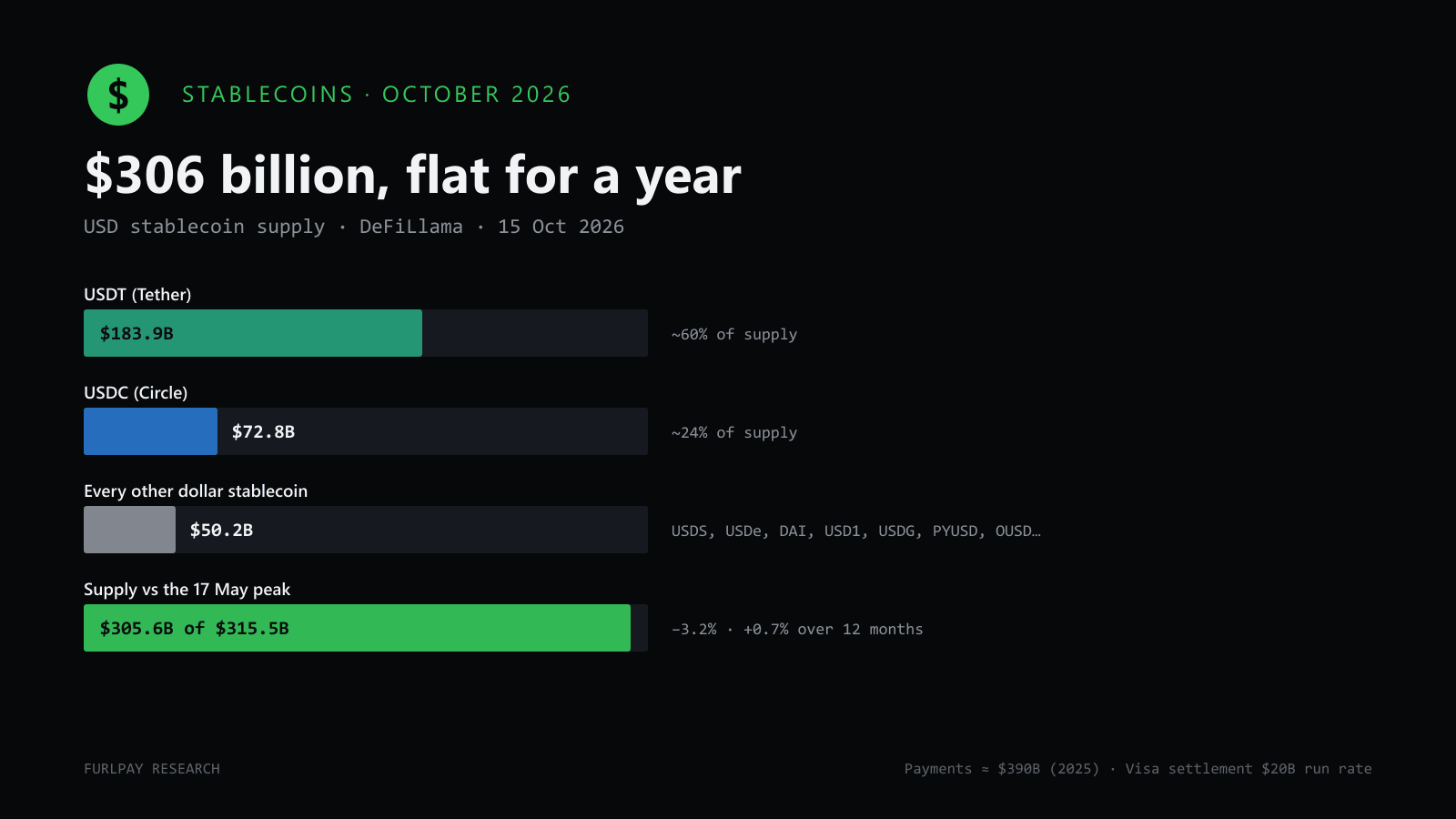
Stablecoins in October 2026: $306 Billion, Flat Supply, and the Networks Moving In
Dollar stablecoins total about $306 billion, almost exactly where they were a year ago, while the companies that run payments have stopped watching and started issuing. Here is the supply, issuer and chain picture measured on 15 October 2026, what is payments and what is not, and the rules that changed in the last month.
October 15, 2026 · 14 min read
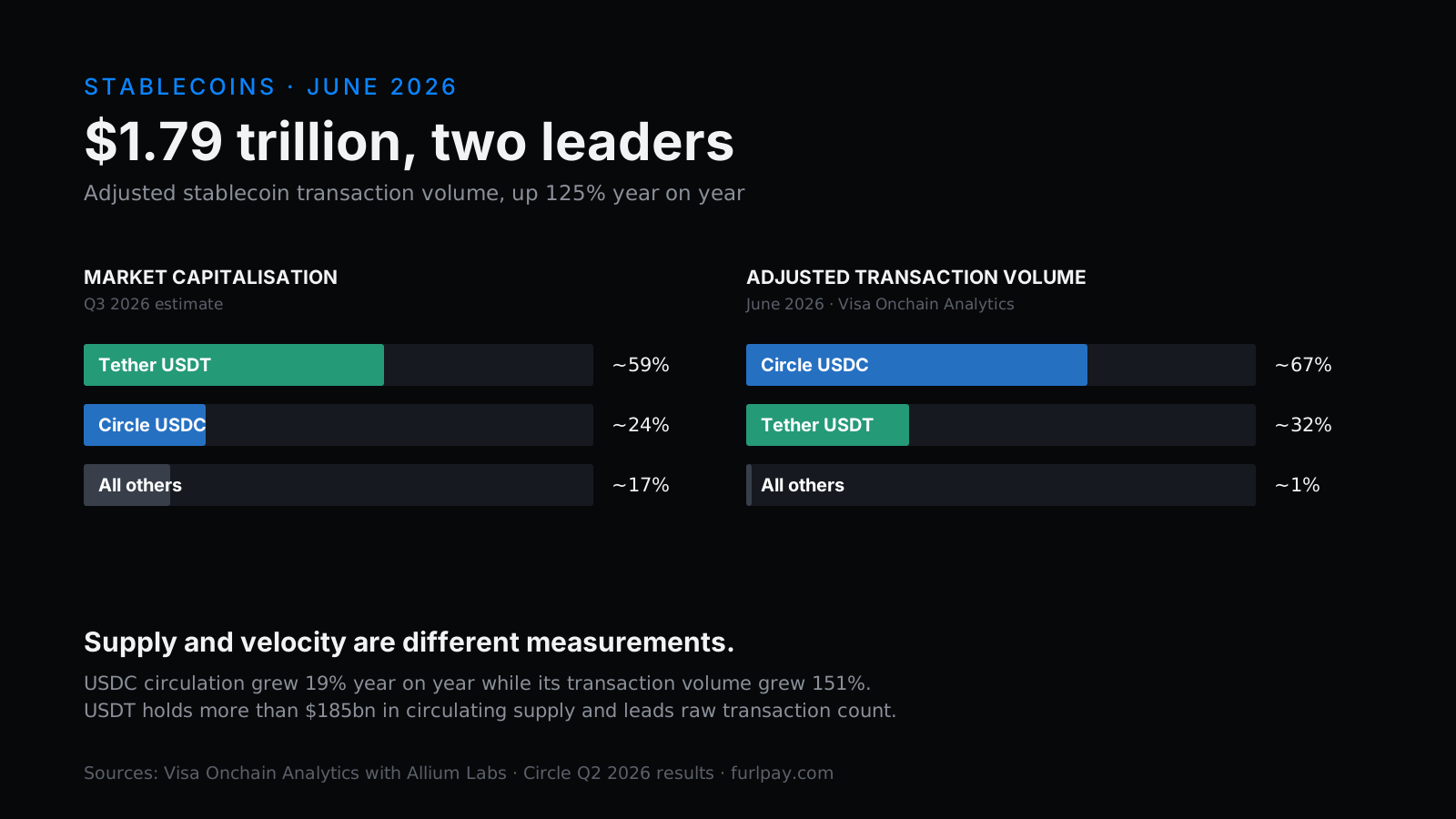
Stablecoin Transaction Volume in 2026: Circle, Tether and the Race to Build the Payment Rail
Stablecoins settled $1.79 trillion in adjusted transaction volume in June 2026, up 125% year on year. USDC accounted for approximately 67% of that volume; USDT remains the largest stablecoin by market capitalisation at more than $185 billion. An analysis of what each metric measures, where Circle and Tether actually stand, and what Visa, Mastercard, Stripe, PayPal and Coinbase are building around them.
September 7, 2026 · 15 min read

Stablecoins Quietly Overtook Crypto for Cross-Border Payments — Here Is the Data
In 2025 stablecoins settled about $33 trillion on-chain, more than Visa and Mastercard combined, while Bitcoin and Ethereum's share of cross-border flows kept shrinking. The GENIUS Act, Stripe's $1.1B Bridge deal and Mastercard's $1.8B BVNK deal all landed in the same window. Here is what actually happened, with the figures checked against primary sources — and where a middleware layer like FurlPay fits.
July 18, 2026 · 12 min read