Stablecoins in October 2026: $306 Billion, Flat Supply, and the Networks Moving In
By Ashutosh Kumar Singh · October 15, 2026 · 14 min read
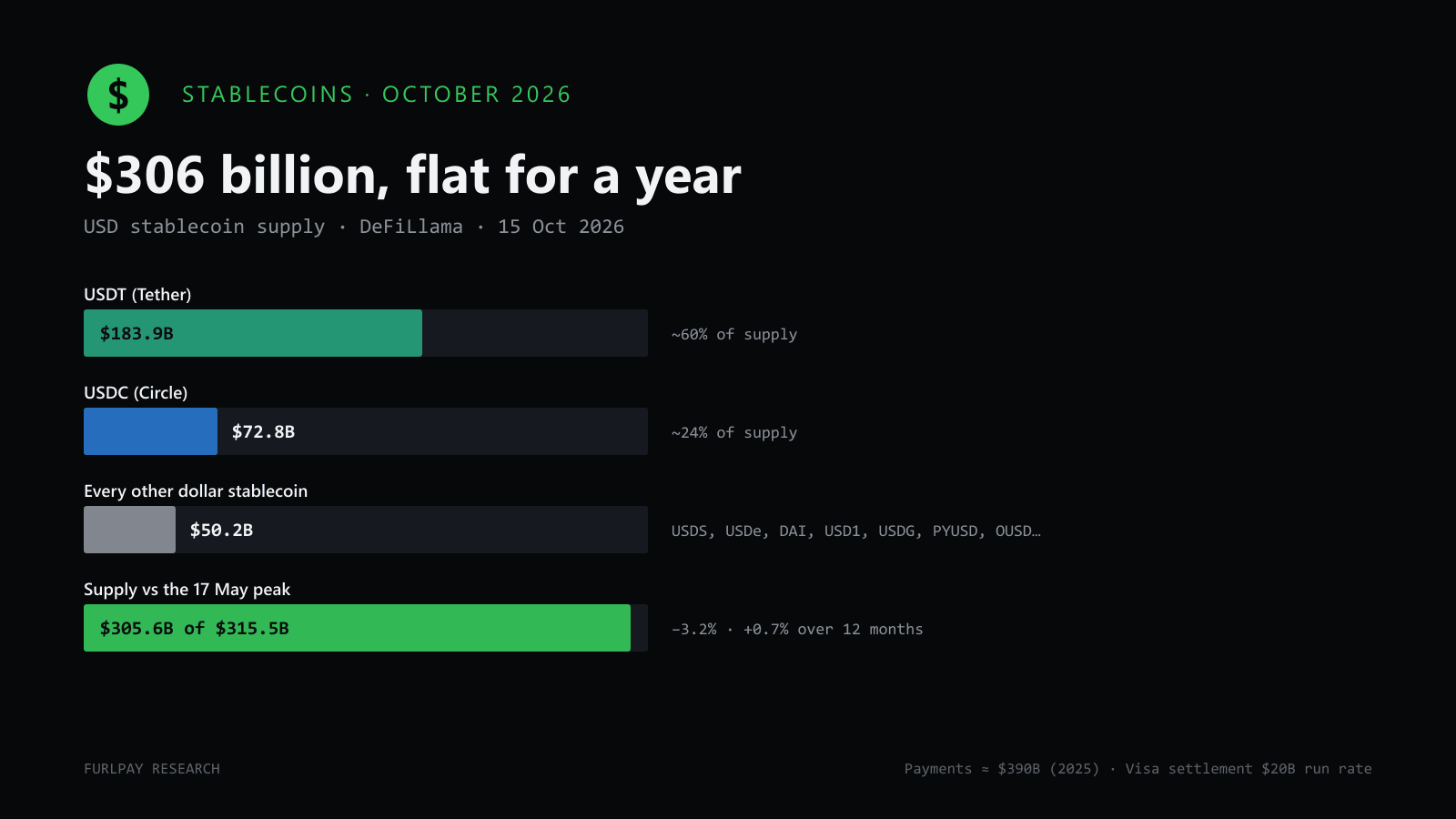
Two stories run through stablecoins in October 2026, and they point in different directions. The first is supply. Dollar stablecoins total about $306 billion, roughly what they were a year ago and about 3% below their May peak. The second is who is involved. In the last eight weeks Mastercard closed a stablecoin acquisition, Circle launched its own blockchain, a coin co-owned by Visa, Mastercard, Stripe, Coinbase and Shopify went live, and the US Treasury issued its first binding rule under the GENIUS Act.
This is the companion to our Bitcoin, Solana and Ethereum updates. The supply figures were pulled from DeFiLlama's public data on 15 October rather than copied from reports. Everything else is sourced and dated. Where a figure in circulation, including in our own earlier research, turned out stale or wrong, we say so.
The snapshot
| Metric | Value | As of / source |
|---|---|---|
| USD stablecoin supply | ~$306 billion | 15 Oct 2026, DeFiLlama |
| Peak supply | $315.5 billion | 17 May 2026, DeFiLlama |
| Change over 12 months | +0.7% | DeFiLlama series (computed) |
| USDT | $183.9 billion (~60%) | 15 Oct 2026, DeFiLlama |
| USDC | $72.8 billion (~24%) | 15 Oct 2026, DeFiLlama |
| Largest chains | Ethereum $144.2B; Tron $94.6B | 15 Oct 2026, DeFiLlama |
| Euro stablecoins | ~EUR 830 million | 15 Oct 2026, DeFiLlama |
| Real-economy stablecoin payments | ~$390 billion (2025) | McKinsey and Artemis |
| Cross-border stablecoin transfers | $220.3 billion (+77.5%) | Jul 2025-Jun 2026, Chainalysis |
| Visa stablecoin settlement | $20 billion annualised | September 2026 |
| Crypto card spend | $759 million a month | July 2026, a16z crypto |
Supply: a year of standing still
On DeFiLlama's series, dollar stablecoin supply was $305.6 billion on 15 October 2026, against $303.5 billion a year earlier and a peak of $315.5 billion on 17 May. Supply has gone nowhere in twelve months. The rest of crypto, meanwhile, lost about half its value: Chainalysis estimates roughly $2.1 trillion was erased in its 2026 measurement period. Stablecoins did not grow through the downturn, but they did not shrink with it either. By June 2026 they made up 22.5% of all measured on-chain balances, largely because everything around them fell.
Trackers disagree on the level. Our own research dated 1 October used a different tracker that read $300.9 billion, with a $322.4 billion peak. The gap comes from which assets each one counts. DeFiLlama, for example, includes BlackRock's BUIDL, a tokenised money-market fund, and Ethena's USDe, a synthetic dollar. To read a trend, compare points from the same tracker. To state a level, give a range.
Issuers: two giants and a crowded third tier
| Stablecoin | Supply (15 Oct 2026) | What it is |
|---|---|---|
| USDT (Tether) | $183.9B | Offshore liquidity; emerging-market retail; heaviest on Tron |
| USDC (Circle) | $72.8B | US-regulated issuer; card-network and bank settlement |
| USDS (Sky) | $7.1B | Upgraded DAI, issued by Sky (formerly MakerDAO) |
| USDe (Ethena) | $4.8B | Synthetic dollar hedged with derivatives; not fiat-reserved |
| DAI (Sky) | $4.8B | Crypto-collateralised |
| USD1 (World Liberty) | $4.2B | Fiat-reserved |
| USDG (Paxos / Global Dollar Network) | $3.0B | Reserve income shared with distribution partners |
| PYUSD (Paxos for PayPal) | $2.9B | PayPal and Venmo distribution |
| RLUSD (Ripple) | $2.4B | Institutional and cross-border |
| OUSD (Open Standard) | $0.8B | Live since 30 September; co-owned by payment networks |
USDT and USDC together hold about 84% of supply. They are not substitutes. Tether's market is offshore exchange liquidity and emerging-market savings. Circle's is regulated settlement. Tether reported a $1.5 billion net operating profit for Q2 2026, while its excess reserves, the buffer above what it owes holders, fell from $8.23 billion to $4.11 billion over the quarter. Its Q3 report had not been published when we checked.
Circle's Q2 2026 results showed $73.3 billion of USDC at quarter end and $701 million of revenue and reserve income, up 7%. On-chain USDC volume was $14.8 trillion in the quarter, up 151%. The reserve return rate fell 66 basis points to 3.48%, which offset most of the growth in average circulation. A stablecoin issuer is a bet on interest rates as much as on adoption. USDC supply has since drifted down: Circle's weekly data showed $73.0 billion on 8 October, after $9.7 billion of minting and $10.5 billion of redemptions in a single week. A figure of $74.6 billion from late September is still being quoted. It is out of date.
Where stablecoins live
Ethereum holds $144.2 billion of stablecoins and Tron $94.6 billion. Together that is about 78% of all supply. Solana ($15.7 billion), BNB Chain ($13.1 billion), Hyperliquid ($7.1 billion), Base ($5.2 billion), Arbitrum ($3.6 billion) and Polygon ($2.9 billion) make up most of the rest. Supply is not the same thing as payments. Tron is overwhelmingly USDT and carries a large share of emerging-market transfers.
Volume is not payments
Stablecoin "volume" figures run from hundreds of billions to tens of trillions of dollars, and they are all correct for what they count. Raw on-chain transfer volume, put at $33-35 trillion for 2025, includes exchange wallets shuffling funds, DeFi loops and bots. Adjusted measures remove some of that. Identified payments, meaning a business paying a supplier, a worker sending money home or a platform paying out, are about 1% of the raw number.
The best estimate of that payments layer comes from McKinsey and Artemis: about $390 billion in 2025, roughly 0.02% of global payments. Business-to-business payments were $226 billion of it, person-to-person $77 billion, consumer-to-business $76 billion and business-to-consumer $11 billion. It is small next to card and bank rails, but it is growing fast. Chainalysis measured cross-border stablecoin transfers up 77.5% to $220.3 billion in the year to June 2026, with monthly flows doubling from $11 billion to $24 billion and an average transfer of about $3,000. Domestic wallet-to-wallet transfers rose 302.9% to $228.7 billion, and 96% of that value was in stablecoins.
On Chainalysis's redesigned adoption index of 117 countries, Brazil ranked first, followed by the United States, Nigeria, Japan, South Korea, India, Ukraine, Thailand, South Africa and Canada.
The networks stopped watching
Visa's stablecoin settlement, where banks settle card obligations with Visa in stablecoins instead of wires, passed a $20 billion annualised run rate in September 2026. It was $3.5 billion in November 2025 and $7 billion in April. More than 160 stablecoin-linked card programmes run on Visa. That is settlement between institutions, not consumers paying in stablecoins.
Mastercard completed its acquisition of BVNK on 3 August 2026, months ahead of schedule. The price was about $1.5 billion up front, with up to $300 million more depending on performance. BVNK processes around $30 billion a year in stablecoin payments for businesses.
Then came Open USD. OUSD went live on 30 September 2026 on Ethereum, Solana, Base and Stripe's Tempo chain. Coinbase, Mastercard, Shopify, Stripe and Visa are its five founding equity holders, and they committed $1 billion of liquidity between them. Bridge, Stripe's stablecoin company, issues it, and the reserves are held at BlackRock, BNY and Lead Bank. Businesses mint and redeem at par with no fees, and reserve income is shared with the partners that distribute the coin rather than kept by the issuer. Two weeks after launch it had about $0.8 billion in circulation. One correction to our own coverage: our 4 July post described OUSD as launching in early July. That was the announcement, with about 140 partners. The token itself went live on 30 September.
Circle answered with infrastructure. Arc, its own layer 1 blockchain, opened its public mainnet on 16 September 2026. It uses USDC as its gas token, and its validator set is permissioned: Circle plus 11 institutions including BlackRock, DTCC, Mastercard and Visa. Anyone can deploy contracts on it.
The pattern behind all of this is that issuers increasingly compete on distribution economics rather than on the coin itself. USDG and OUSD pass reserve income to their distributors. Circle already shares a large part of its USDC reserve income with Coinbase. Visa and Mastercard both already settle in USDC. They now also co-own a coin that competes with it.
Cards and agents: real, and small
Crypto-funded card spending reached $759 million in July 2026, about 2.5 times a year earlier, across nearly 9 million purchases averaging about $86. USDC funded 58% of that spend, up from 48%, and USDT 26%. The user swipes a normal Visa or Mastercard card, and the merchant receives ordinary currency. The stablecoin is out of sight, behind the issuer.
Payments by AI agents get the most attention and carry the least money. The x402 protocol handled about 75.4 million transactions worth $24.2 million in one 30-day window, averaging roughly 32 cents each. Analysis of the same data found that about half the activity was wash trading, and that genuine daily volume was closer to $28,000. The standard is real and governed by a Linux Foundation body, but the money moving through it is still tiny.
The rules that changed
- United States. On 30 September the Treasury issued the first binding rule under the GENIUS Act, an interim final rule effective on publication. Issuers with $10 billion or less outstanding may stay under a state regime that a federal committee certifies as "substantially similar". Larger issuers must move to federal oversight within 360 days. Comments are open until 30 November. The Act takes effect no later than 18 January 2027. The CLARITY Act, the broader market-structure bill, failed a Senate cloture vote 49-50 on 15 September.
- European Union. MiCA's transition period ended on 1 July 2026. Crypto-asset service providers without authorisation had to stop serving EU clients. ESMA's register listed 244 authorised providers at the deadline, about 280 after its first July update. Euro stablecoins total about EUR 830 million, roughly 0.3% of the dollar supply.
- Brazil. Resolution BCB 561 took effect on 1 October 2026. Regulated electronic FX providers may no longer settle the offshore leg of a cross-border payment in stablecoins or any crypto asset. Only traditional FX or non-resident real accounts are allowed. Individuals can still buy and hold. The country that tops the adoption index has closed its main institutional stablecoin rail.
What this means for payments
The evidence supports stablecoins as settlement infrastructure: card-network settlement, B2B transfers and payouts, treasury moves and card programmes. In all of these the end user never handles the coin. It does not yet support them as a mass consumer payment method, or as the default rail for emerging-market remittances, which runs overwhelmingly on USDT and increasingly depends on local rules such as Brazil's. For a business, the practical questions are where its counterparties already hold dollars, which coin its card or banking partner settles in, and whether the off-ramp in the destination country is licensed. The chain and the brand of the coin come after that. We covered the cross-border side of this in more depth in Stablecoins overtook crypto for cross-border payments.
How these numbers were checked
- Supply by asset, by chain and over time came from DeFiLlama's public stablecoin API on 15 October 2026. Shares and changes are computed by us.
- Issuer, network, regulatory and research figures link to the filing, release or report they come from, and each is dated.
- This post draws on our internal research report dated 2 October 2026. Every figure taken from it was re-checked. Where a figure had moved since (USDC supply, OUSD's partner count, Arc's validator count, MiCA's authorised providers) or left out context (x402 wash trading), the current or fuller figure is used.
- Nothing here is investment, legal or tax advice.

Founder & CEO, FurlPay · Software Engineer at Skyhigh Security · NeurIPS 2026 author · Google DeepMind contributor · ex-Quantiphi
Ashutosh is a Software Engineer at Skyhigh Security (previously Quantiphi), working across ML systems and cloud infrastructure. He is a contributor to Google DeepMind and a NeurIPS 2026 author. He is building Furlpay: stablecoin payments, travel booking, and investing in one client — settled on Arbitrum. Pay in USDC, book 2.2M+ stays and flights, and let AI agents pay per-request via x402. Phishing-resistant. Compliance-aware. Zero gas.
Don't miss the next one
Stay ahead of the curve
Get product updates, engineering deep-dives, and security bulletins. No spam — just the signal.
More in Legal & Compliance
The CLARITY Act Is Not Dead. It Is Running Out of Calendar.
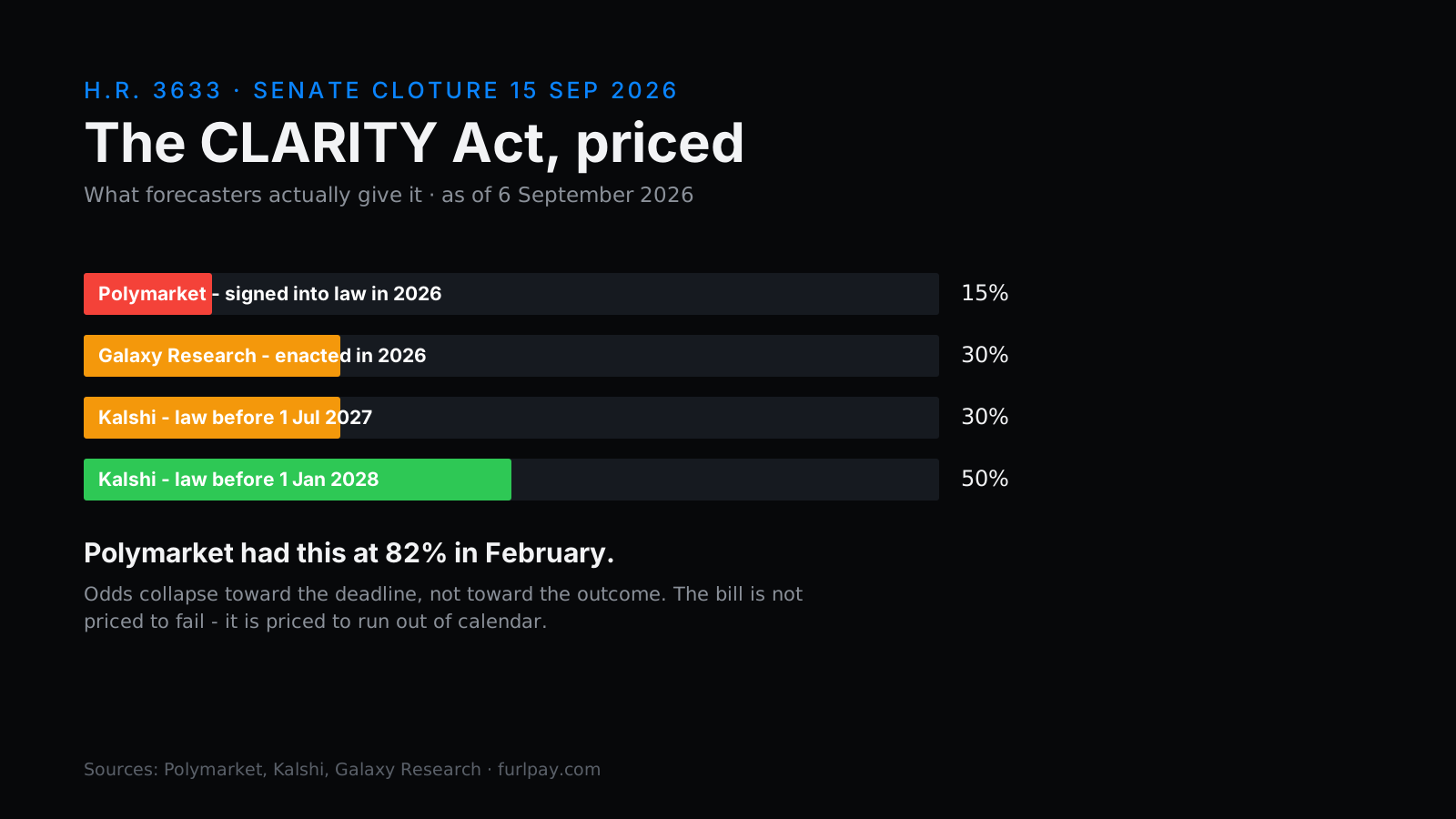
Updated 12 October: the 15 September cloture vote failed 49–50. Before it, prediction markets gave the CLARITY Act a 15% chance of becoming law in 2026 — and 50% by January 2028. The bill is late, not dead. Meanwhile JPMorgan settles more than $7bn a day in tokenized deposits without waiting for it. What the 15 September Senate vote decided, what atomic settlement does and does not fix, and why the strongest objections come from the people who understand market structure best.
September 7, 2026 · 23 min read
Stablecoin Transaction Volume in 2026: Circle, Tether and the Race to Build the Payment Rail
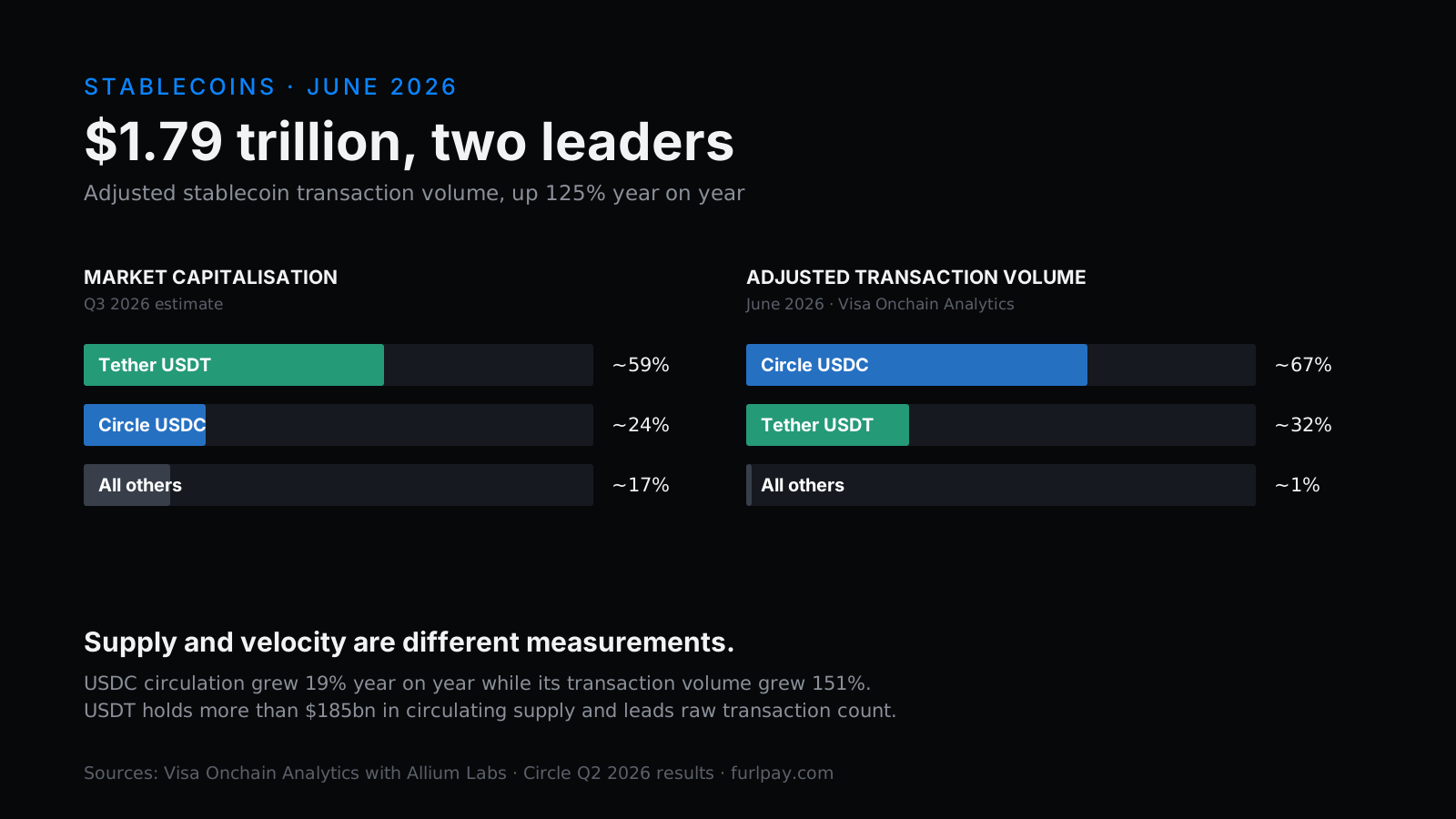
Stablecoins settled $1.79 trillion in adjusted transaction volume in June 2026, up 125% year on year. USDC accounted for approximately 67% of that volume; USDT remains the largest stablecoin by market capitalisation at more than $185 billion. An analysis of what each metric measures, where Circle and Tether actually stand, and what Visa, Mastercard, Stripe, PayPal and Coinbase are building around them.
September 7, 2026 · 15 min read

Stablecoins Quietly Overtook Crypto for Cross-Border Payments — Here Is the Data
In 2025 stablecoins settled about $33 trillion on-chain, more than Visa and Mastercard combined, while Bitcoin and Ethereum's share of cross-border flows kept shrinking. The GENIUS Act, Stripe's $1.1B Bridge deal and Mastercard's $1.8B BVNK deal all landed in the same window. Here is what actually happened, with the figures checked against primary sources — and where a middleware layer like FurlPay fits.
July 18, 2026 · 12 min read