JPMorgan 13F Q2 2026: What the SEC Filing Actually Shows
By Ashutosh Kumar Singh · September 2, 2026 · 18 min read
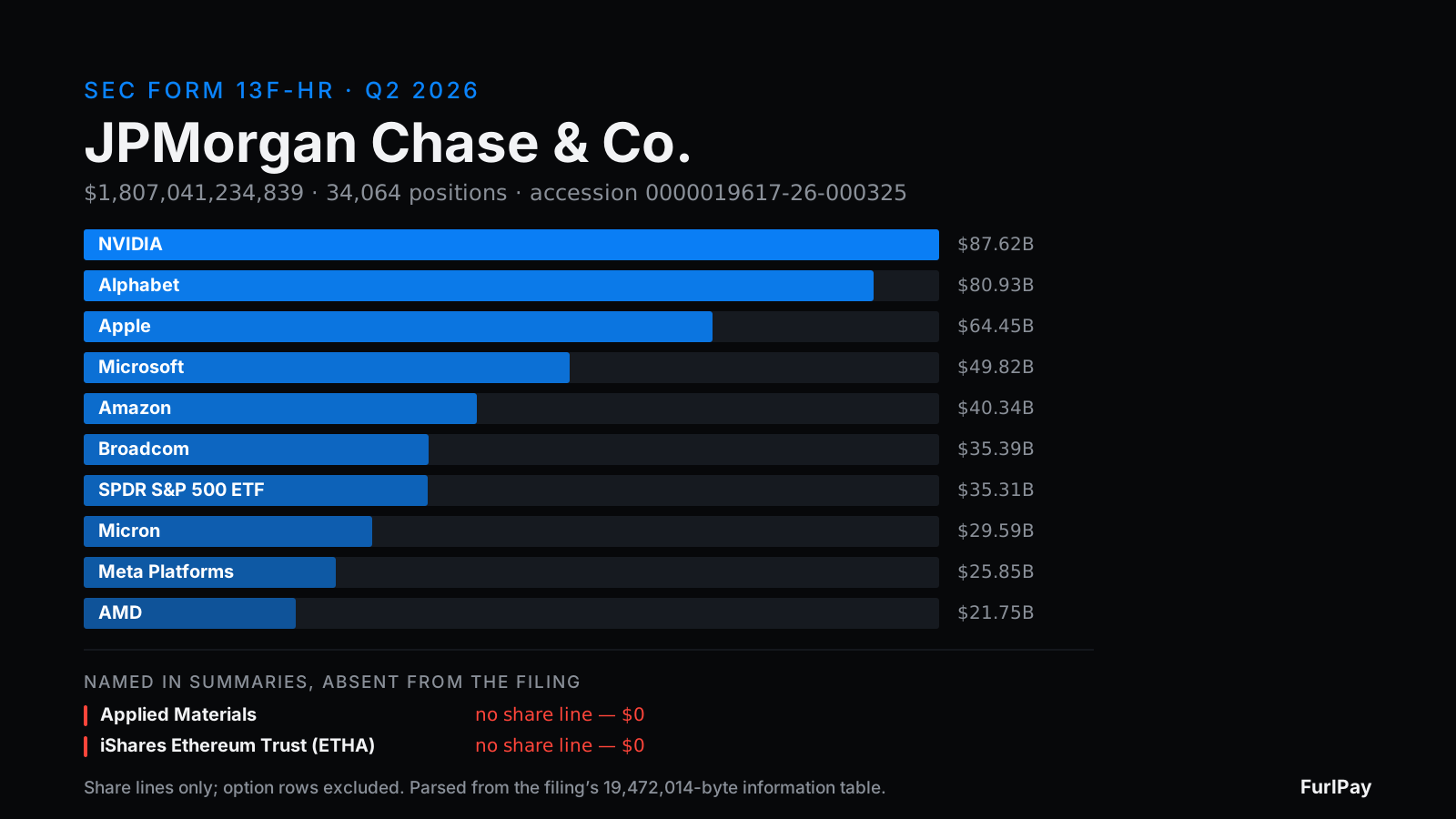
On 12 August 2026, JPMorgan Chase & Co. filed its Form 13F-HR for the quarter ended 30 June. The information table runs to 19,472,014 bytes and 34,064 rows, and reports securities worth $1,807,041,234,839. It is a public document, and the numbers in it are not in dispute.
What is in dispute is what those numbers mean. Depending on how the rows are counted, the same filing contains 34,064 positions, or 7,720, or 4,737. Depending on how one field is read, JPMorgan holds 3.8 million shares of Strategy Inc or 630,709. Depending on whether you match securities by name or by identifier, one bitcoin miner in the filing has no position at all. Every one of those readings is arithmetically defensible and only one of each pair is correct.
This is what the filing reports, parsed from the original XML rather than from a summary of it, with the aggregation choices stated wherever they change an answer.
The primary document
| Field | Value |
|---|---|
| Filer | JPMORGAN CHASE & CO |
| CIK | 0000019617 |
| Form | 13F-HR |
| Filed | 12 August 2026 |
| Period of report | 30 June 2026 |
| Accession | 0000019617-26-000325 |
| Information table | Information_Table_06.30.2026.xml, 19,472,014 bytes |
| Entries reported by filer | 34,064 |
| Entries we parsed | 34,064 |
| Value reported by filer | $1,807,041,234,839 |
| Value we summed | $1,807,041,234,839 |
| Confidential omissions | None (isConfidentialOmitted false) |
| Other included managers | 17 |
The parse reconciles exactly — same entry count, same total to the dollar. We then discarded that parser and did it again with a streaming XML parser rather than pattern matching, written independently. It returned the same 34,064 rows, the same $1,807,041,234,839, and the same distinct-CUSIP counts. Reconciliation against the filer's own stated totals is the minimum bar before quoting anything from a filing, and it is the step most summaries skip.
# The whole filing. No key, no vendor. The SEC requires a real
# User-Agent with a contact address and refuses anonymous traffic.
BASE=https://www.sec.gov/Archives/edgar/data/19617/000001961726000325
curl -H "User-Agent: your-name your@email" $BASE/primary_doc.xml
curl -H "User-Agent: your-name your@email" \
     -o infotable.xml "$BASE/Information_Table_06.30.2026.xml"
34,064 entries is not 34,064 positions
A Form 13F information table is a list of rows, not a list of holdings. The SEC requires separate reporting by investment discretion and by other included managers, so one position held across several mandates appears as several rows. Counting the same filing six ways gives six answers, and all six are reproducible from the document:
| What you count | Count |
|---|---|
| Raw information-table rows (the filer's own entry total) | 34,064 |
| Distinct CUSIPs | 7,720 |
| Distinct CUSIPs appearing on ordinary share rows | 6,818 |
| Distinct issuer-name strings | 6,474 |
| Distinct issuer name + title of class | 7,251 |
| Distinct issuers by six-character CUSIP prefix | 4,737 |
Databases that describe this filing as roughly 7,720 positions are counting distinct CUSIPs. That is a reasonable definition. So is 4,737, which folds an issuer's option CUSIPs onto the security they are written on. So is 34,064. "How many positions does JPMorgan report?" has no answer until someone says which of these they mean.
Different aggregation methodologies are not competing claims about reality. They become misleading only when the methodology is not stated — which is nearly always.
How the filing reports options
This is the single easiest place to misread a 13F, in either direction. The SEC's Form 13F FAQ, answering what belongs in Column 5, is explicit: most of the column entries for an option "refer to the underlying security, rather than to the option itself", covering Columns 1 through 5 and 7 through 8. The option is identified by the PUT or CALL designation alone. The value, the amount and the class all describe the underlying.
Two fields settle it before any arithmetic. Option rows carry titleOfClass "OPTION" and a distinct CUSIP — the iShares Ethereum Trust's shares are 46438R105 while its calls and puts are 46438R905 and 46438R955 — and they carry sshPrnamtType "SH". The type field on an option row says shares.
The arithmetic agrees. Divide reported value by reported amount on a share row, then on the same issuer's option rows. If option rows were denominated in contracts the two would differ by a factor of about 100. They do not differ at all:
| Issuer | Share rows: value / amount | Call rows | Put rows |
|---|---|---|---|
| NVIDIA | $194.97 | $194.97 | $194.97 |
| Apple | $281.74 | $281.74 | $281.74 |
| Invesco QQQ Trust | $724.08 | $724.08 | $724.08 |
| iShares Bitcoin Trust | $34.18 | $34.18 | $34.18 |
| iShares Ethereum Trust | $12.24 | $12.24 | $12.24 |
Across the filing, 869 issuers carry both share rows and option rows. In 729 the implied prices agree within two percent, and in none of them — zero out of 869 — is the ratio anywhere near 100. So an option row reads: this manager held options over this many shares of this security, and those shares were worth this much at quarter end. It is not a count of contracts, not a statement of what the options cost, and not a share position.
For scale, 466 call rows carry $37,970,606,604 and 473 put rows carry $56,739,111,688, together about 5.2 percent of the filing's reported value. Two constraints from the SEC's guidance matter for anyone tempted to net them: written options are not reportable at all, so every option row is a long position, and short equity positions never appear either. A 13F cannot show a net book, and no arithmetic on it will produce one.
A third row type that is neither stock nor options
Splitting rows into shares and options is still not enough, because the information table also carries convertible debt. The field that distinguishes it is sshPrnamtType: SH for a share count, PRN for a principal amount in dollars. A bond row is not an option, so any test that asks only "is this an option?" passes it into the share bucket, where a principal amount is added to a count of shares.
This filing carries 447 such rows worth $1,724,173,261 — convertible debt of Western Digital, Alibaba, Microchip, On Semiconductor and others. It is the difference between two totals that look interchangeable: non-option rows total $1,712,331,516,547, while genuine share rows total $1,710,607,343,286.
Classified properly, every row in the filing falls into exactly one of four buckets, and the four sum to the filer's own stated total:
| Bucket | Rows | Reported value |
|---|---|---|
| Ordinary shares (SH, non-option) | 32,678 | $1,710,607,343,286 |
| Convertible debt (PRN) | 447 | $1,724,173,261 |
| Calls, over underlying shares | 466 | $37,970,606,604 |
| Puts, over underlying shares | 473 | $56,739,111,688 |
| Total | 34,064 | $1,807,041,234,839 |
The largest lines, counted two ways
Ranked by ordinary share value, aggregating each issuer by its six-character CUSIP prefix:
| # | Security | Ordinary shares | Reported value | % of share total |
|---|---|---|---|---|
| 1 | NVIDIA | 449,404,578 | $87.62B | 5.12% |
| 2 | Alphabet (all classes) | 230,990,188 | $80.93B | 4.73% |
| 3 | Apple | 228,762,008 | $64.45B | 3.76% |
| 4 | JPM Diversified Return US MC Equity | 726,063,576 | $53.35B | 3.12% |
| 5 | Microsoft | 135,173,516 | $49.82B | 2.91% |
| 6 | iShares S&P Small-Cap 600 Growth | 286,317,285 | $48.55B | 2.84% |
| 7 | Amazon | 167,979,147 | $40.34B | 2.36% |
| 8 | Broadcom | 95,016,148 | $35.39B | 2.07% |
| 9 | SPDR S&P 500 ETF | 47,650,227 | $35.31B | 2.06% |
| 10 | Micron Technology | 25,836,011 | $29.59B | 1.73% |
Four of those ten are funds rather than operating companies, and one is JPMorgan's own product. Restricting to operating companies gives a different list: NVIDIA, Alphabet, Apple, Microsoft, Amazon, Broadcom, Micron, then Meta at $25.85 billion, AMD at $21.75 billion and Lam Research at $18.62 billion. Neither ranking is more correct — they answer different questions, and publishing one while implying the other is how "largest holding" claims go wrong.
Alphabet is aggregated across share classes here. Splitting Class A from Class C would move it down the table. We state the choice rather than leave a reader to discover it by disagreeing with a different site.
The iShares Ethereum Trust position
A widely circulated figure put JPMorgan at roughly 1.17 million shares of the iShares Ethereum Trust, worth about $14.3 million, up around fourfold on the quarter. The filing supports all three parts of that.
| Row type | Amount | Reported value |
|---|---|---|
| Ordinary shares (three rows: 156 + 1,167,975 + 1,300) | 1,169,431 | $14,313,835 |
| Call, over underlying shares | 600,000 | $7,344,000 |
| Put, over underlying shares | 600,000 | $7,344,000 |
The three share rows are split by investment discretion — one OTR row of 156 shares and two DFND rows — which is why they appear separately rather than as one line. JPMorgan's Q1 2026 filing, accession 0000019617-26-000225 for the period ended 31 March, reports 266,734 ordinary shares worth $4,073,028. The increase to 1,169,431 shares is 902,697 shares, or 338 percent.
One detail from those rows is worth keeping. The share rows name the issuer "ISHARES ETHEREUM TRUST ETF"; the option rows name it "ISHARES ETHEREUM TR". The same security, two spellings, in the same filing. Anything matching on issuer name rather than identifier splits the position without reporting an error.
What the filing does not establish is why the position grew. It shows a reported position increasing. It does not identify that position as proprietary, as client facilitation, as a hedge or as a directional view, and nothing in the document distinguishes between them. The same restraint applies to the equal call and put lines: 600,000 underlying shares on each side is consistent with a hedged or non-directional structure, and consistent with several other things too.
The iShares Bitcoin Trust position
| iShares Bitcoin Trust | Q1 2026 (31 Mar) | Q2 2026 (30 Jun) | Change |
|---|---|---|---|
| Ordinary shares | 8,302,691 | 10,407,635 | +2,104,944 (+25.4%) |
| Reported value of shares | $312,845,416 | $355,732,983 | +13.7% |
| Calls, underlying shares | 3,775,000 | 3,945,000 | +170,000 |
| Puts, underlying shares | 4,756,400 | 3,495,800 | −1,260,600 |
The ordinary share count rose about 25 percent quarter over quarter and the put line fell by more than a quarter. Both are computed from two filings and both are facts about what was reported. The reported value rose less than the share count did because the ETF's quarter-end price fell — a reminder that a change in reported value mixes a change in position with a change in price.
The 33-share Solana position
A circulating claim put JPMorgan at roughly 47,500 shares of the Bitwise Solana Staking ETF. The Q2 filing reports 33 shares, worth $340. The prior quarter explains the gap: at 31 March the filing reports 47,460 shares, worth $523,484. The claim was not invented. It was a quarter out of date, which is the most common failure in filing-derived data and looks identical to fabrication from the outside.
The ticker in that claim is a separate problem. The fund trades as BSOL. "SOL" is not a US equity ticker at all — it is the token the fund tracks.
Strategy Inc: why three numbers are not one position
| Strategy Inc (MSTR) | Q1 2026 | Q2 2026 |
|---|---|---|
| Common and preferred shares | 567,804 | 630,709 |
| Reported value of those shares | $68,740,805 | $58,244,442 |
| Convertible debt, principal | $6,543,000 | $3,200,000 |
| Reported value of that debt | $6,565,367 | $2,817,868 |
| Calls, underlying shares | 90,000 | 338,000 |
| Puts, underlying shares | 207,100 | 715,700 |
Nineteen rows sit under the CUSIP prefix 594972: eleven of common stock, two of a convertible preferred series, four of convertible notes, and one each of calls and puts. The equity rows total 630,709 shares — 624,387 of common under CUSIP 594972408 plus 6,322 of preferred. The note rows are a principal amount of $3,200,000. Adding the two gives 3,830,709, a figure that is not a share count of anything, and it is the number that has circulated most widely.
Read by row type, the equity position rose over the quarter while the convertible principal roughly halved. A summary reporting a single "MSTR position" has to choose one of these to be the number, and whichever it chooses will be wrong for some readers.
The crypto-linked names, ordinary share rows only
| Security | Ordinary shares | Reported value |
|---|---|---|
| Robinhood Markets | 15,803,996 | $1,609,321,182 |
| iShares Bitcoin Trust | 10,407,635 | $355,732,983 |
| Coinbase Global | 11,148,552 | $220,486,248 |
| IREN Limited (common, CUSIP Q4982L109) | 2,699,785 | $123,947,214 |
| Strategy Inc (common and preferred) | 630,709 | $58,244,442 |
| Riot Platforms | 1,557,533 | $36,938,390 |
| MARA Holdings | 3,495,920 | $36,077,799 |
| CleanSpark | 1,973,744 | $26,127,126 |
| Cipher Digital | 692,770 | $17,583,910 |
| iShares Ethereum Trust | 1,169,431 | $14,313,835 |
| Grayscale Bitcoin Mini Trust | 145,717 | $3,889,201 |
| Fidelity Wise Origin Bitcoin | 4,079 | $214,266 |
| Grayscale Bitcoin Trust | 448 | $20,952 |
| Bitwise Solana Staking ETF | 33 | $340 |
Robinhood is the largest of these by a wide margin. Grayscale's original Bitcoin Trust, the fund whose outflows are written about constantly, is a 448-share line worth $20,952 — a rounding error inside a $1.8 trillion filing.
Why a ticker is not a security identity
IREN is the sharpest illustration in this filing. Searching the issuer name for "IREN" returns 19 rows across three different companies and three instrument types. The miner's common stock is 12 rows under CUSIP Q4982L109 — 2,699,785 shares, $123,947,214. Its options are two rows under Q4982L909 and Q4982L959, over 788,100 underlying shares. Three further rows are convertible bonds under two entirely different CUSIPs, 46270CAB5 and 46270CAD1, carrying $4,080,452 of value over $1,294,000 of principal. The remaining rows belong to IRENIC ACQUISITION CORP and YIREN DIGITAL LTD, which are unrelated companies.
IREN also marks the limit of the method used here. Grouping by the first six CUSIP characters folds an issuer's options onto its stock, but IREN's shares carry a CINS beginning Q4982L — the identifier range for foreign issuers — while its US-registered notes begin 46270C. Same company, two unrelated prefixes, so this aggregation reports them separately. That is a defensible choice and a visible one; it is not a complete answer to corporate identity, and it is better to say where a method stops than to imply it does not.
Cipher makes the same point from the other direction. The company usually called Cipher Mining is filed as CIPHER DIGITAL INC. A search for "CIPHER MINING" returns nothing and produces a confident false negative on a $17,583,910 position sitting under CUSIP 17253J106.
Where circulating summaries fail against the filing
The semiconductor figure. A widely repeated claim is that Taiwan Semiconductor, AMD, Qualcomm and Applied Materials together account for "$240+ billion". Ordinary share rows in the filing: AMD $21,746,429,376, Taiwan Semiconductor $10,844,709,209, Qualcomm $1,560,803,624 — $34,151,942,209 in total. Applied Materials does not appear in the filing at all, under any CUSIP or name variant. Adding every option row for the three that are present raises the total only to about $37.4 billion.
The Berkshire ranking. Berkshire Hathaway appears at $6.50 billion of ordinary shares and is not the largest non-technology line by any reading. Johnson & Johnson at $15.07 billion, Mastercard at $14.39 billion and AbbVie at $12.17 billion are all larger operating companies, and several fund vehicles are larger still.
What the $1.807 trillion is, and is not
It is not JPMorgan's portfolio in the sense a reader naturally imports. The cover page lists 17 other included managers, which under the SEC's definitions makes this a combination report — a sum across a structure of affiliated managers, not one desk's book. The filing reports securities over which those managers exercised investment discretion. It does not distinguish proprietary capital from client assets, and it does not say why any position exists.
Nor is it a complete picture of anything. Section 13(f) securities are principally US exchange-traded equities and ETFs, with certain convertible debt, options and warrants; short positions, cash, most debt and non-US listings fall outside the report. Written options are excluded by rule. The document describes holdings as of 30 June 2026 and was filed on 12 August, generally within the 45 days managers are given. The SEC does not verify these filings, so the correct phrasing downstream is "the filing reports", never "the SEC confirms".
JPMorgan's own stock, measured separately
These figures are market data and a share count from a 10-Q, not part of the 13F, and they carry their own timestamps.
| Metric | Measured | Basis |
|---|---|---|
| Shares outstanding | 2,658,186,195 | dei tag, 10-Q for the quarter ended 30 Jun 2026, filed 6 Aug 2026 |
| Close, 1 Sep 2026 | $354.95 | consolidated tape |
| Market capitalisation | $943.5B | computed: close × shares outstanding |
| Highest intraday, trailing 2y | $366.50 on 13 Aug 2026 | daily bars |
| Highest close, trailing 2y | $365.18 on 12 Aug 2026 | daily bars |
| 3-month return | +17.94% | computed from 2 Jun 2026 close of $300.96 |
| 1-year return | +17.76% | computed from 29 Aug 2025 close of $301.42 |
Return figures depend entirely on the start date, which is why the basis is printed beside them. A summary quoting +20.6% and +19.2% is not necessarily wrong; it may be measuring from different days. Without the basis, neither number can be checked.
Reported, computed, normalized, inferred
The discipline that prevents most filing-derived errors is labelling which kind of statement a number is.
- REPORTED — present in the filing. The filing reports 1,169,431 ordinary shares of the iShares Ethereum Trust.
- COMPUTED — arithmetic over reported values, with the inputs named. That is 338% above the 266,734 shares in the prior quarter's filing.
- NORMALIZED — the result of an aggregation choice. Alphabet at $80.93B combines share classes under one CUSIP prefix; splitting them gives a different table.
- INFERRED — an interpretation the filing permits but does not establish. Equal call and put lines are consistent with a hedged structure.
- NOT ESTABLISHED — what the document cannot support. The filing does not show whether any position is proprietary, facilitation, hedging or a directional view.
Almost every wrong headline about a 13F is a claim that moved from the last category into the first without anyone noticing. It does not require bad faith, only an unlabelled number.
How to audit a 13F yourself
- Fetch data.sec.gov/submissions/CIK##########.json for the filing index. No API key; a descriptive User-Agent with a contact address is required.
- Take the 13F-HR, not the 13F-NT — a notice means another manager reports the holdings and carries no information table.
- Check whether a later 13F-HR/A exists, and read its amendment type. A restatement replaces the filing; an amendment adding new holdings contains only the added rows.
- Parse with a namespace-tolerant reader. Filers use ns1, n1 or no prefix, and a parser that assumes one shape returns zero rows for the others.
- Reconcile your row count and your sum against the filer's own tableEntryTotal and tableValueTotal before quoting anything.
- Classify on sshPrnamtType as well as putCall, so convertible debt reported as a principal amount never reaches a share count.
- Remember that an option row's amount and value describe the underlying security, and that written options are not reported at all.
- Aggregate on CUSIP, not on issuer name, and state which aggregation your counts use.
- Compare against the prior quarter before calling a number new, missing or wrong.
What this changed in our own systems
Our 13F parser now labels option rows as underlying shares rather than contracts, and the field names changed with them. Convertible debt aggregates into its own principal and value fields and is excluded from share totals. Reconciliation against the filer's stated totals runs before any figure is served, with a tolerance of half a dollar per entry — the arithmetic bound on the filer's own rounding, tight enough to still fail a dropped row. A test asserts that the four buckets sum to the reported total, which is the check that catches a row miscounted from one bucket into another.
Securities are matched by CUSIP, never by issuer name, because issuer names are how "RIOT" matches MARRIOTT and "MARA" matches MARATHON PETROLEUM. Nothing in our catalog links a 13F row to a tradable symbol: a CUSIP-to-ticker map is something we do not have and will not approximate with string comparison.
The naming problem outlasts this filing. BTC is a real, tradable US ticker — the Grayscale Bitcoin Mini Trust, which appears in this filing at 145,717 shares — and it is also what people mean when they type three letters into a payments app. XRP is both a token and an ETF. Our catalog resolves a bare ticker towards the listed security, a rule added after STX resolved to Stacks rather than Seagate. But that map is what the order endpoint books against, so cataloguing the Grayscale fund under BTC would have quietly redefined what "buy BTC" executes. Both were left out, and a test fails if anyone adds the row.
// The tripwire, not the comment, is what protects this.
it("BTC still resolves to the coin, not an ETF", () => {
  expect(bySymbol.get("BTC")?.kind).toBe("crypto");
  expect(byKindSymbol.has("etf:BTC")).toBe(false);
});
Editor's note and corrections
This article was substantially revised on 2 September 2026. An earlier version, published the same day under a different headline, reported several figures incorrectly. None of the errors came from the filing or from extracting it — the row count and total reconciled to the dollar on the first parse. All of them came from how correctly extracted rows were then classified. The corrections are listed here rather than quietly amended.
It stated that JPMorgan held no shares of the iShares Ethereum Trust, and that a circulating figure of about 1.17 million shares had been produced by reading option contracts as stock. The filing reports 1,169,431 ordinary shares worth $14,313,835. The circulating figure was correct and the error was ours.
It stated that the Invesco QQQ Trust had no share line. The filing contains eleven ordinary share rows totalling 2,912,061 shares and $2,108,565,901, alongside the option lines.
It described an option row's amount as a count of contracts. Per the SEC's Form 13F guidance and confirmed across 869 issuer comparisons in this filing, the amount and value on an option row describe the underlying security.
It reported Strategy Inc at 3,830,709 shares and dismissed a circulating claim of "624,387+ shares" as understating the position roughly sixfold. Both were wrong for the same reason: 3,830,709 is 630,709 shares of stock plus $3,200,000 of convertible note principal, and 624,387 is exactly the common-stock line. It also said the position had halved over the quarter; the equity rose, and it was the note principal that fell.
A revision reported IREN Limited at 3,993,785 shares and $128,027,666, again adding bond principal to a share count. The common stock is 2,699,785 shares worth $123,947,214, with the debt reported separately. The same revision described $1,712,331,516,547 as the total of ordinary share lines; that is the total of all non-option rows, and share rows alone total $1,710,607,343,286.
It published a "ten largest positions" table that omitted two fund vehicles ranking fourth and sixth, characterised a distinct-CUSIP count of about 7,720 as an error rather than a valid aggregation, and reported Cipher Mining as absent from the filing when the issuer is filed as CIPHER DIGITAL INC and holds $17,583,910.
The audit, claim by claim
| Claim | What the filing shows | Status |
|---|---|---|
| Total $1,807,041,234,839 | Matches, to the dollar (reported) | Confirmed |
| 34,064 entries | Matches the filer's own entry total (reported) | Confirmed |
| "7,712 positions" is wrong | 7,720 distinct CUSIPs — a valid count, not an error (normalized) | Corrected |
| Zero ETHA shares | 1,169,431 shares, $14,313,835 across three rows (reported) | False |
| ETHA quadrupled over the quarter | 266,734 → 1,169,431 shares, +338% (computed) | Confirmed |
| QQQ has no share line | 11 rows, 2,912,061 shares, $2,108,565,901 (reported) | False |
| Option amounts are contract counts | Underlying shares; class OPTION, type SH (reported) | False |
| BSOL ~47,500 shares | 33 shares at 30 Jun; 47,460 at 31 Mar (reported) | Stale, not invented |
| IBIT 10,407,635 shares / $355,732,983 | Matches (reported); +25.4% on the quarter (computed) | Confirmed |
| MSTR 3,830,709 shares | 630,709 shares / $58,244,442; rest was $3.2m of note principal | Corrected |
| MSTR share count halved on the quarter | Equity rose 567,804 → 630,709; the debt halved (computed) | Corrected |
| Circulating "624,387+ MSTR shares" understated | 624,387 is exactly the common-stock line (reported) | False |
| IREN 3,993,785 shares / $128,027,666 | 2,699,785 shares / $123,947,214; rest was bond principal | Corrected |
| Cipher Mining not in the filing | Filed as CIPHER DIGITAL INC, $17,583,910 (reported) | False |
| Semiconductor claim of $240B+ | $34,151,942,209 across AMD, TSMC, Qualcomm (computed) | Confirmed as overstated |
| Applied Materials held | No row under any CUSIP or name variant found | Confirmed absent |
| Berkshire is top non-tech holding | $6.50B; JNJ, Mastercard, AbbVie all larger (reported) | Confirmed as wrong |
| "Ten largest positions" table | Omitted two funds ranking 4th and 6th (normalized) | Corrected |
| Share lines total $1,712,331,516,547 | That is non-option rows; shares alone are $1,710,607,343,286 | Corrected |
Methodology
Source: JPMorgan Chase & Co, CIK 0000019617, Form 13F-HR, accession 0000019617-26-000325, period 30 June 2026, filed 12 August 2026. Prior-quarter comparisons use accession 0000019617-26-000225, period 31 March 2026 — a 13F-HR/A carrying 33,063 entries and $1,557,139,501,048, which is a restatement rather than a partial amendment.
The information table was parsed twice over all 34,064 rows: once with a namespace-tolerant pattern reader and once with a streaming XML parser, written independently. Both reconcile exactly to the filer's stated entry total and value total and agree on every derived count. Rows are classified on both putCall and sshPrnamtType, so an option row is never read as a share position and convertible debt reported as a principal amount is never counted as shares. Share and option values are never summed into a single exposure figure.
Issuer aggregation uses the six-character CUSIP prefix, which folds an issuer's option lines onto its share line and merges nothing else; where a company's equity and debt carry unrelated prefixes, as IREN's do, they are reported separately. Percentages are stated against either the ordinary-share total of $1,710,607,343,286 or the full reported total of $1,807,041,234,839, and the base is named each time.
Market prices, returns and market capitalisation are not from the 13F. Prices are daily closes from the consolidated tape as of 1 September 2026; the share count is JPMorgan's own cover-page tag from the 10-Q for the quarter ended 30 June 2026. Return windows name their start date.
Limitations: the filing is a quarter-end snapshot of Section 13(f) securities filed up to 45 days later, excludes short positions, cash, most debt, non-US listings and written options, and aggregates 17 other included managers. It does not establish the purpose of any position. The SEC does not verify these filings.
Bottom line
The filing is internally consistent and reconciles to the dollar. Every difficulty in reading it is a question of what each row represents: whether an amount is shares or principal, whether a row describes a security or an option over it, whether two rows naming similar issuers are the same company, and which of six defensible counts someone means by "positions".
That is where filing-derived data actually breaks, and the failure mode is never a number that looks obviously wrong. It is a number that looks entirely reasonable, reconciles against something, and means something other than what its label says.
None of this is investment advice. Everything above is checkable against accession 0000019617-26-000325. If you parse it and reach a different number, we would like to know, and we will correct this post and say plainly what changed — as we have here.

Founder & CEO, FurlPay · Software Engineer at Skyhigh Security · NeurIPS 2026 author · Google DeepMind contributor · ex-Quantiphi
Ashutosh is a Software Engineer at Skyhigh Security (previously Quantiphi), working across ML systems and cloud infrastructure. He is a contributor to Google DeepMind and a NeurIPS 2026 author. He is building Furlpay: stablecoin payments, travel booking, and investing in one client — settled on Arbitrum. Pay in USDC, book 2.2M+ stays and flights, and let AI agents pay per-request via x402. Phishing-resistant. Compliance-aware. Zero gas.
Don't miss the next one
Stay ahead of the curve
Get product updates, engineering deep-dives, and security bulletins. No spam — just the signal.
More in Engineering
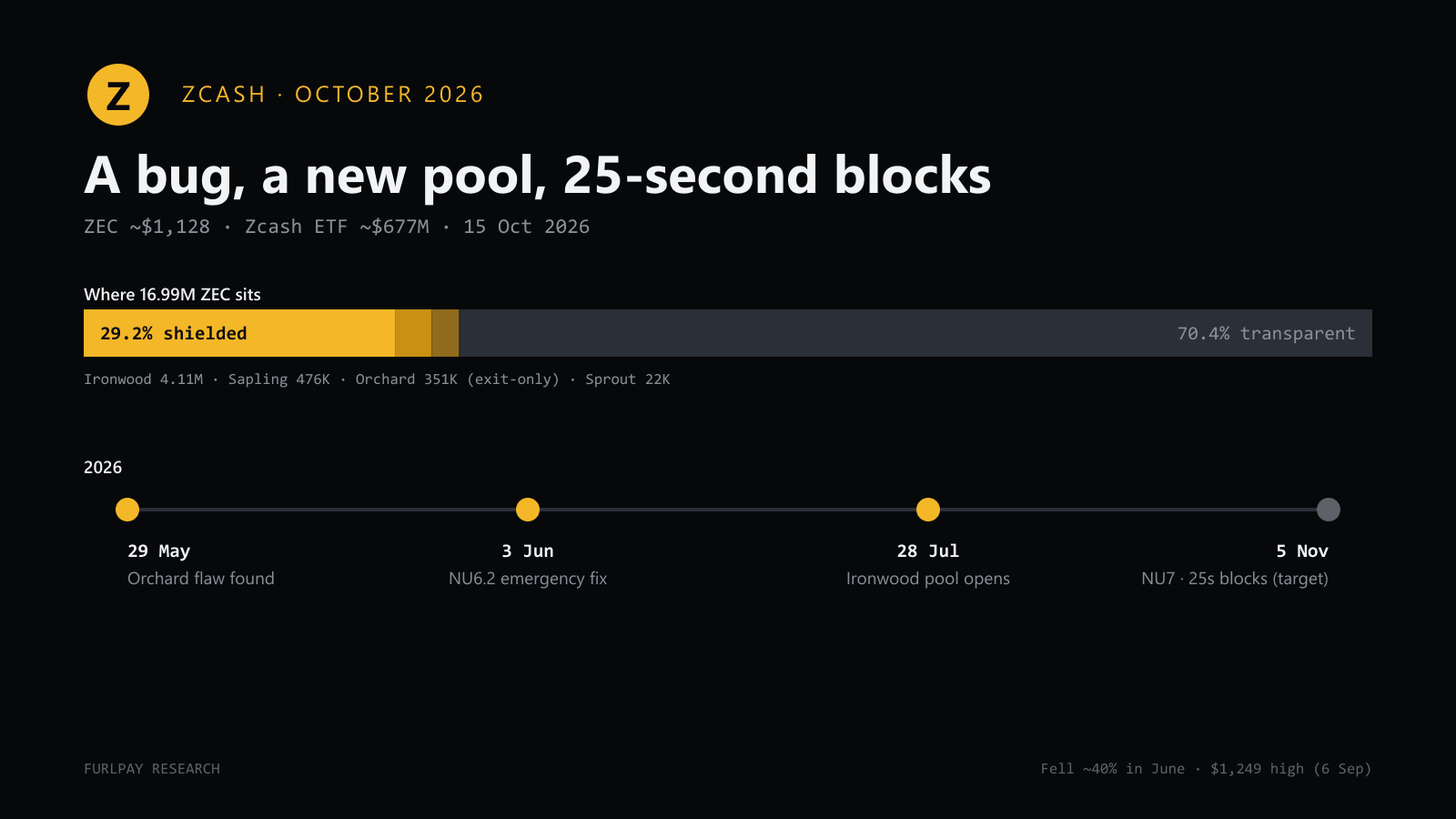
Zcash in October 2026: A Bug, a New Pool, an ETF and 25-Second Blocks
ZEC traded above $1,100 in mid-October 2026, months after a flaw that could have allowed undetectable counterfeiting forced Zcash to close its main shielded pool and open a new one. Here is the supply, the shielded share, the Orchard bug and Ironwood, NU7's 25-second blocks, the ETF and treasury buyers, and the EU rule that removes ZEC from regulated platforms in 2027.
October 15, 2026 · 14 min read
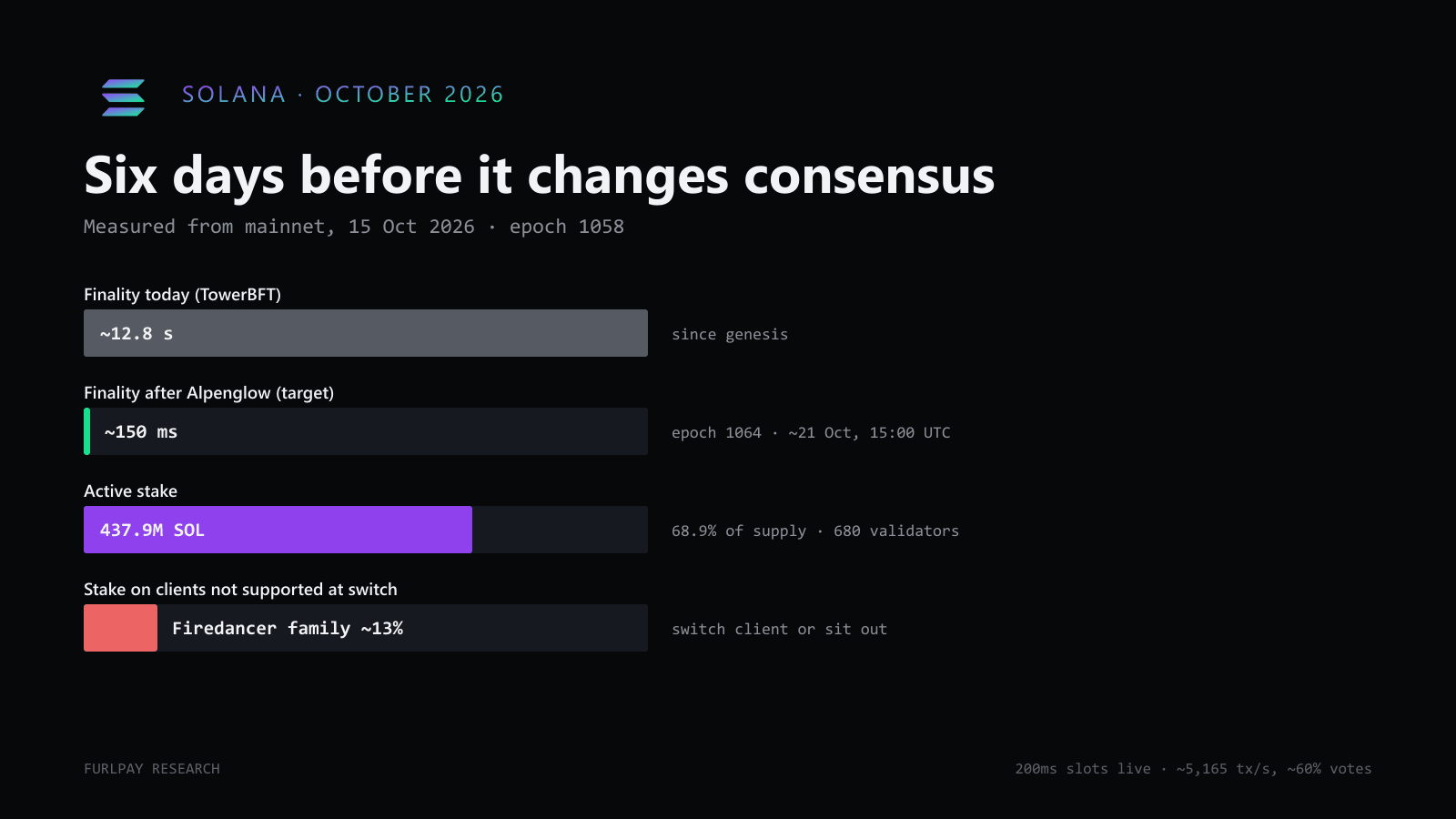
Solana in October 2026: Six Days Before It Changes Consensus
SOL traded near $106 in mid-October 2026, about 64% below its all-time high, while the network moved to 200ms slots and scheduled its largest consensus change since genesis for 21 October. Here is the supply, staking, validator, client, ETF and stablecoin picture as measured from mainnet, including where widely repeated figures are wrong.
October 15, 2026 · 12 min read
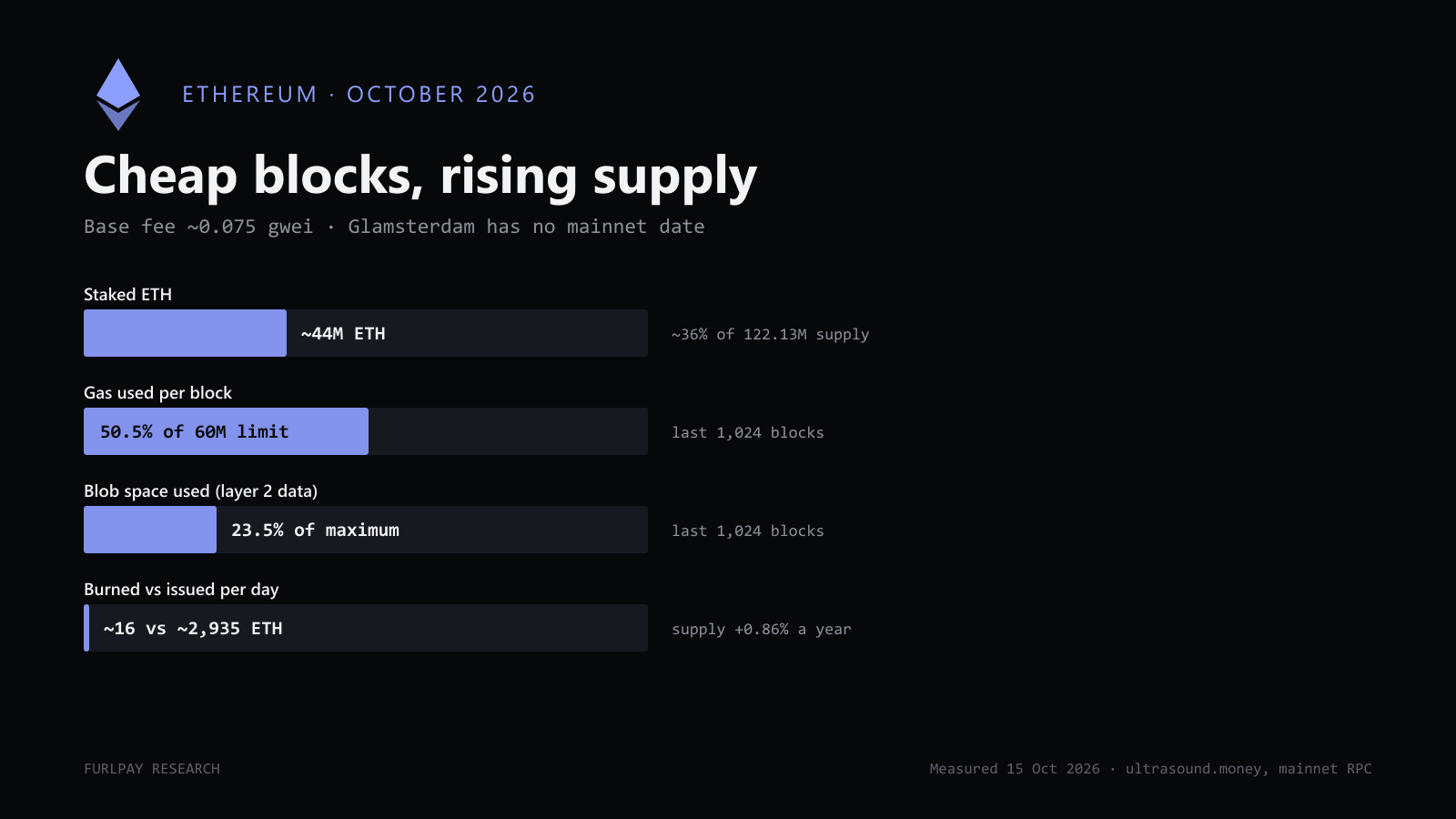
Ethereum in October 2026: Cheap Blocks, Rising Supply, No Glamsterdam Date
ETH traded near $2,450 in mid-October 2026, about half its August 2025 high. A mainnet transfer costs a fraction of a cent, supply is growing about 0.9% a year rather than shrinking, around 44 million ETH is staked, and Glamsterdam has passed its first testnet with no mainnet date. Every figure is measured or sourced and dated.
October 15, 2026 · 12 min read