JPMorgan and Morgan Stanley Took Opposite Roads Into Digital Money
By Ashutosh Kumar Singh · October 16, 2026 · 14 min read
Ask what America's two most influential investment banks are doing about digital money and you get two different answers. JPMorgan is building plumbing: a deposit token, a settlement network, tokenized money-market funds, and a shared bank network due in 2027. Morgan Stanley is building distribution: its own bitcoin, ether and solana funds, spot crypto trading for E*Trade's retail base, and a lab to test the rest before it reaches clients.
Both strategies are rational, and they say a great deal about who will own each layer of digital dollars. This post sets out what each bank has actually launched, what is only reported or planned, and what it means for a business choosing how to get paid. Every figure is dated and linked. Where sources disagree, we say so.
The snapshot
| JPMorgan | Morgan Stanley | |
|---|---|---|
| Core bet | Tokenized bank deposits for institutions | Crypto access for wealth and retail clients |
| Flagship product | JPM Coin (JPMD) deposit token on Base, Nov 2025 | E*Trade spot BTC, ETH and SOL trading, Jul 2026 |
| Own crypto ETFs | None | MSBT (Apr 2026); MSSE and MSOL (Jul 2026), 0.14% fee |
| Product for stablecoin issuers | JLTXX tokenized money-market fund (May 2026) | MSNXX Stablecoin Reserves Portfolio (Apr 2026) |
| Issues its own stablecoin | No current plan (Aug 2026) | No |
| In the 21-bank stablecoin consortium | No | No |
| Shared bank network | The Clearing House tokenized deposits, targeted H1 2027 | None announced |
| Public-chain footprint (16 Oct) | JPMD on Base: ~1.0M outstanding, no transfers since Feb. JLTXX: ~$741M outstanding | No Morgan Stanley-issued token found by name on Base or Ethereum |
| Next milestone | JPMD on Canton, phased through 2026 | Asset transfers on E*Trade, expected later in 2026 |
JPMorgan: make the deposit programmable, keep the deposit
JPMorgan's blockchain unit, Kinexys (formerly Onyx), has run bank settlement in production since 2020, when JPM Coin first went live inside the bank. On its own 2026 milestones page, dated 28 April, the bank says Kinexys has processed more than $3 trillion since inception and averages more than $5 billion a day. Secondary coverage has quoted higher figures, around $4 trillion cumulative and $7 billion a day, and our own September post on the CLARITY Act used the higher daily number. We use the bank's figure here. The same page names Oliver Harris, formerly of Goldman Sachs, as head of Kinexys.
The product that matters most is JPM Coin, ticker JPMD. It is a deposit token: a transferable claim on a dollar held at JPMorgan, not a separate reserve-backed coin. After a June 2025 pilot with B2C2, Coinbase and Mastercard, it opened to institutional clients on Base on 12 November 2025. Base is Coinbase's Ethereum layer 2, so this put bank deposits on a public network. Transfers settle around the clock, without the cut-off times of wire clearing. In January 2026 JPMorgan and Digital Asset announced plans to issue JPMD natively on the Canton Network in phases through 2026. Canton is a privacy-configurable chain backed by Goldman Sachs, BNP Paribas and others.
JPMorgan's asset-management arm has built the other half. MONY, a tokenized private money-market fund on Ethereum, launched on 15 December 2025. On 13 May 2026 it was followed by JLTXX, a registered government money-market fund, also on Ethereum. JLTXX is designed for stablecoin issuers that must hold reserves under the GENIUS Act. JPMorgan seeded it with $100 million, with Anchorage Digital also participating, and investors can subscribe or redeem in cash or stablecoins through Morgan Money.
What the blockchain shows
Announcements and on-chain activity are different things, so we queried both public contracts with Allium's indexed Base and Ethereum data on 16 October 2026. The results show how JPMorgan is actually using public chains.
| Contract | What the chain shows | Reading |
|---|---|---|
| JPMD on Base (0x7e0a...6b82, labelled Kinexys) | 48 transfers in total, the first on 20 June 2025 and the last on 20 February 2026; 12 receiving addresses; 3.50 million minted, 2.50 million burned, about 1.0 million outstanding | Test-sized. The public contract is a showcase, not where Kinexys's daily billions move |
| JLTXX on Ethereum (0x0986...7bD8) | 443 transfers from 8 May to 15 October 2026; 9 receiving addresses; 1.16 billion tokens minted, 0.42 billion redeemed, about 741 million outstanding | Real money. At a $1 share price that is about seven times the $100 million seed in five months |
The contrast is the story. JPMorgan's deposit token on a public chain has barely moved since its pilot. The more than $5 billion a day Kinexys reports runs on the bank's own permissioned ledger. Its tokenized fund for stablecoin reserves, by contrast, is growing on public Ethereum among a handful of institutional holders. On-chain activity confirms where JPMorgan expects public chains to matter first: holding the reserves behind other people's stablecoins, not moving its own deposits. Both tokens use two decimal places, like a bank ledger, while almost every imitation (see below) uses the 18 decimals common to ERC-20 tokens.
The imitations are the other finding. On Base alone, 503 token contracts use the ticker JPMD, and exactly one, the Kinexys contract, uses JPMorgan's two-decimal format. There are also 28 called JPME, the ticker JPMorgan has trademarked for a euro version, and 57 called MONY. Ethereum has 33 more JPMD tokens, 20 MONY tokens and a fake JLTXX created a day before JPMorgan announced the real one. Since June 2025, 269 of the fake JPMD tokens on Base have been swapped about 266,000 times by roughly 192,000 wallets. Allium prices that trading at $36.5 million, a figure that is probably inflated, because pricing illiquid tokens is unreliable. The real JPMD has never traded on a decentralized exchange, and it cannot be bought there: it is available only to JPMorgan's onboarded institutional clients. Any token sold as "JPM Coin" on a decentralized exchange is not JPMorgan's.
On stablecoins themselves JPMorgan has stayed careful. It told the Wall Street Journal on 26 August 2026 that it has no current plan to issue one but is evaluating the option. Its answer to stablecoins is collective instead: in June the Journal reported that JPMorgan, Citi, Bank of America and Wells Fargo plan a tokenized deposit network operated by The Clearing House for the first half of 2027. That network would let tokenized deposits move between banks, not only between JPMorgan clients.
One widely repeated claim needs a caveat. Bloomberg reported in October 2025 that JPMorgan planned to let institutional clients borrow against bitcoin and ether. Some 2026 coverage says the programme has launched, but we could not find a statement from the bank confirming it, so we treat it as planned.
Morgan Stanley: put crypto where the clients already are
Morgan Stanley's advantage is distribution. It runs one of the largest wealth-management businesses in the world, and E*Trade served 8.6 million households with about $1.56 trillion in client assets on 31 March 2026. Its strategy has been to bring crypto into those accounts instead of sending clients elsewhere.
The sequence was fast. Morgan Stanley opened crypto access to all wealth clients in October 2025. On 6 January 2026 it filed for its own bitcoin and solana trusts. The Morgan Stanley Bitcoin Trust (MSBT) began trading on 8 April at a 0.14% fee, below BlackRock's IBIT at 0.25%, and held about $381 million by mid-July. Ether (MSSE) and solana (MSOL) trusts followed on 28 July. Both stake their holdings and pass the rewards to the fund.
On 16 July E*Trade completed its rollout of spot crypto trading for eligible US clients: bitcoin, ether and solana, at a 0.50% commission, with custody and execution by Zero Hash. Those holdings are not covered by FDIC or SIPC protection. Moving coins on and off the platform is expected later in 2026, so for now it is a place to hold crypto, not to pay with it.
Morgan Stanley's institutional moves are slower and more deliberate. On 29 September Bloomberg reported a new Digital Asset Lab that tests stablecoins, tokenized deposits, tokenized money-market funds and DeFi vaults in a segregated environment. "It's where technology earns the right to scale at the firm," said Megan Brewer, who leads market innovation. Amy Oldenburg, head of the digital-asset team, said DeFi vaults had "a very reasonable path" but that "we cannot put the rest of the platform at risk." A tokenized-asset wallet for institutional and high-net-worth clients has been reported for the second half of 2026 but has not launched.
Where they converge: the reserve business
The most telling overlap is in a product few people see. In April 2026 Morgan Stanley Investment Management launched the Stablecoin Reserves Portfolio (MSNXX), a constant-$1 government money-market fund holding Treasury bills and repo, built for stablecoin issuers. Three weeks later JPMorgan launched JLTXX for the same buyers.
This is the part of the stablecoin business banks can win without issuing anything. The GENIUS Act requires payment-stablecoin issuers to back every token one-for-one with cash, short-dated Treasuries, repo and money-market funds invested in them. That is roughly $306 billion of dollar stablecoins today, on our 15 October measurement, most of it parked in exactly those instruments. Whoever issues the coin, both banks want to manage the reserves behind it.
Where they both stayed out
On 1 September 2026, 21 institutions including Bank of America, Citi, Goldman Sachs, Wells Fargo, UBS, Deutsche Bank, Santander and MUFG committed to form a company to issue a jointly owned dollar stablecoin in the first half of 2027. Neither JPMorgan nor Morgan Stanley is on the list. JPMorgan is backing its own deposit token and The Clearing House network. Morgan Stanley has not said why it stayed out. Its public moves so far favour distributing assets and managing reserves over issuing money.
Their research does not agree either
In July 2025 J.P. Morgan Research cut its forecast for the stablecoin market to about $500 billion by 2028. Its argument was that around 88% of demand came from crypto-native activity and only about 6% from payments. Morgan Stanley's published commentary cites estimates that the market could exceed $2 trillion by 2028, driven by remittances, e-commerce and B2B settlement. Fourteen months later supply sits around $306 billion and has been flat for a year, which so far fits the cautious view better.
What this means for a business that wants to get paid
- JPMD is not something most businesses can accept. It moves between JPMorgan institutional clients, and an open interbank version through The Clearing House is not due before 2027. If your customers and suppliers are not all JPMorgan clients, a deposit token does not reach them.
- E*Trade and the Morgan Stanley ETFs are investment products, not payment rails. They will bring many more people into owning crypto. They do not yet let anyone send it.
- Open, reserve-backed stablecoins such as USDC are the option that works between any two parties today, around the clock, with GENIUS Act reserve rules taking effect in January 2027. The banks' reserve funds make those reserves more institutional, not less.
- Expect the two models to meet. Tokenized deposits will dominate where both sides bank in the same network. Stablecoins will dominate where they do not. Payment software has to handle both.
For clarity about our own position: FurlPay settles payments in USDC on public networks. We are not a bank, we do not issue a stablecoin, and we have no relationship with JPMorgan or Morgan Stanley. We do not accept JPMD, which is not available outside JPMorgan's client network. Our deposit tokens versus stablecoins guide explains the difference in more detail.
What we will watch next
- JPMD's Canton phases, and whether JPMorgan names a third chain or launches the euro version.
- Whether JPMorgan changes its August position and issues a stablecoin.
- The Clearing House network's first live interbank transfers, targeted for the first half of 2027.
- Coin transfers on E*Trade, which turn a trading product into one that can move money.
- Morgan Stanley's tokenized-asset wallet and the first products out of its Digital Asset Lab.
- Asset growth in JLTXX and MSNXX as issuers prepare for the GENIUS Act's effective date of 18 January 2027.
How this was checked
- Product launches, dates, fees and fund details come from the banks' own releases or from the outlet that first reported them, linked in the text.
- Kinexys volumes use JPMorgan's published figures of 28 April 2026. Higher figures in circulation are noted, not used.
- On-chain figures come from Allium's indexed Base and Ethereum data, queried on 16 October 2026: ERC-20 transfer logs for the two contracts, the token registry for ticker imitations, and decentralized-exchange swaps for trading. The JLTXX address is from J.P. Morgan Asset Management's launch release, and the JPMD address is the one Basescan labels Kinexys. Outstanding supply is minted minus burned. Ticker counts include every contract with that exact symbol, so a few may be harmless tests rather than scams.
- Items that are reported but unconfirmed are labelled as such: the crypto-collateral programme and the Morgan Stanley wallet. One widely repeated October report of a JPMorgan stablecoin initiative could not be traced to its source and is left out.
- Stablecoin supply is from our 15 October 2026 DeFiLlama measurement.
- Nothing here is investment, legal or tax advice. Fund tickers are named for identification, not as recommendations.

Founder & CEO, FurlPay · Software Engineer at Skyhigh Security · NeurIPS 2026 author · Google DeepMind contributor · ex-Quantiphi
Ashutosh is a Software Engineer at Skyhigh Security (previously Quantiphi), working across ML systems and cloud infrastructure. He is a contributor to Google DeepMind and a NeurIPS 2026 author. He is building Furlpay: stablecoin payments, travel booking, and investing in one client — settled on Arbitrum. Pay in USDC, book 2.2M+ stays and flights, and let AI agents pay per-request via x402. Phishing-resistant. Compliance-aware. Zero gas.
Don't miss the next one
Stay ahead of the curve
Get product updates, engineering deep-dives, and security bulletins. No spam — just the signal.
More in Legal & Compliance
Deposit Tokens vs Stablecoins: What JPMD and USDC Mean for Your Business
A deposit token is your bank balance in programmable form. A stablecoin is a separate dollar token backed one-for-one by reserves. They settle the same way on a blockchain, but they differ on who can hold them, who they can reach and what stands behind them. Here is the plain comparison, with JPMorgan's JPMD and Circle's USDC as the worked examples.
October 16, 2026 · 8 min read
Stablecoins in October 2026: $306 Billion, Flat Supply, and the Networks Moving In
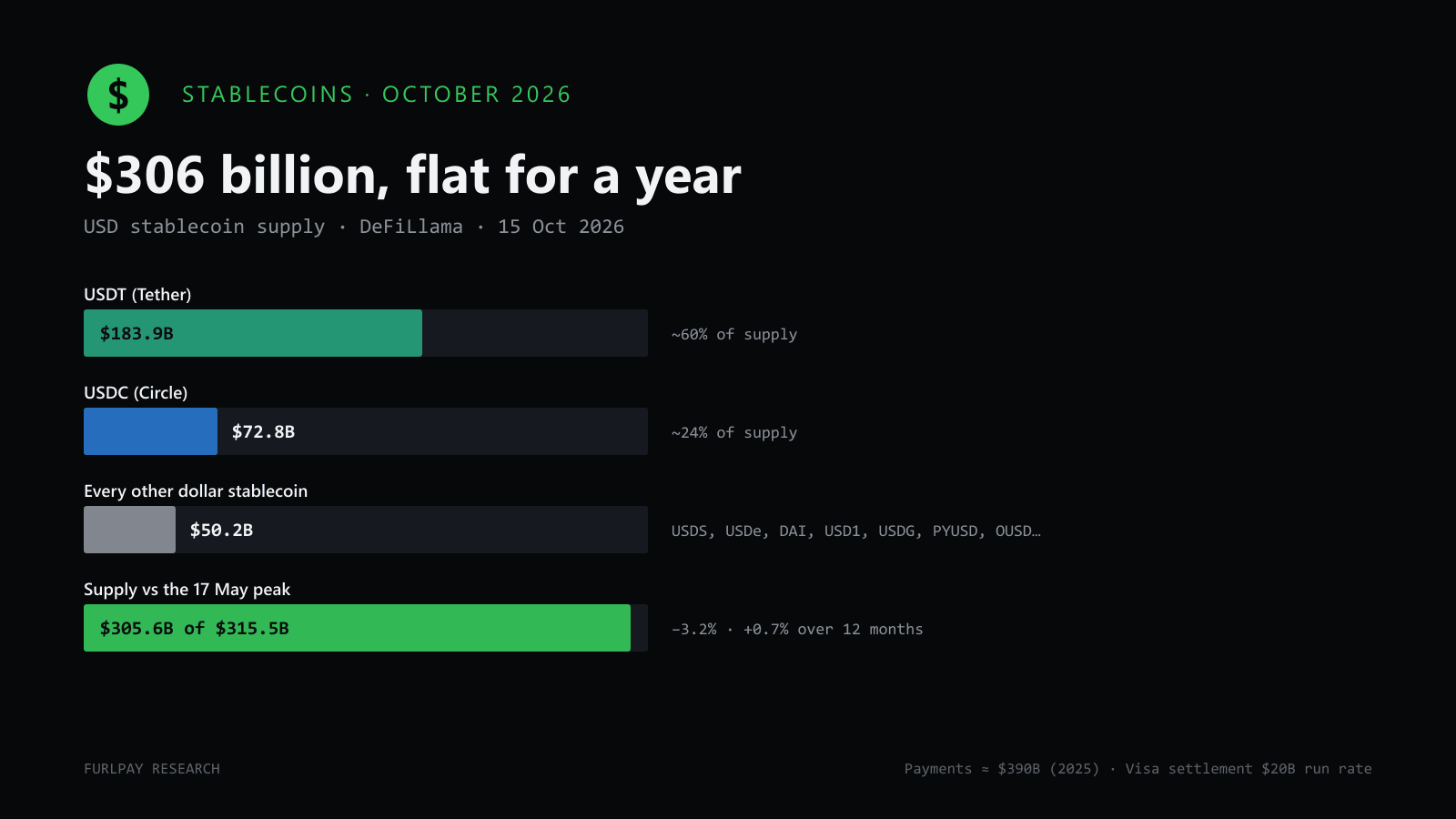
Dollar stablecoins total about $306 billion, almost exactly where they were a year ago, while the companies that run payments have stopped watching and started issuing. Here is the supply, issuer and chain picture measured on 15 October 2026, what is payments and what is not, and the rules that changed in the last month.
October 15, 2026 · 14 min read
The CLARITY Act Is Not Dead. It Is Running Out of Calendar.
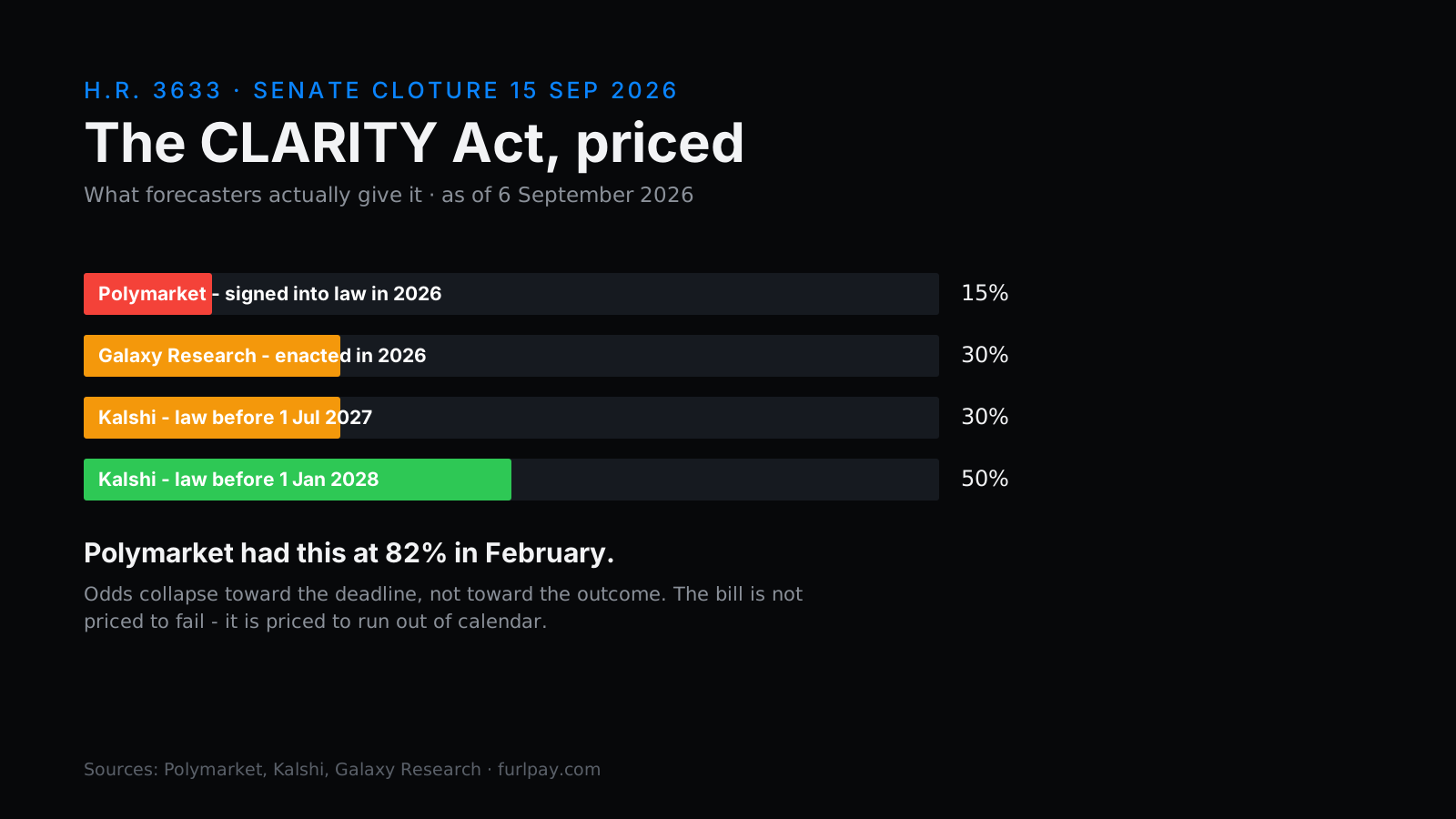
Updated 12 October: the 15 September cloture vote failed 49–50. Before it, prediction markets gave the CLARITY Act a 15% chance of becoming law in 2026 — and 50% by January 2028. The bill is late, not dead. Meanwhile JPMorgan settles more than $7bn a day in tokenized deposits without waiting for it. What the 15 September Senate vote decided, what atomic settlement does and does not fix, and why the strongest objections come from the people who understand market structure best.
September 7, 2026 · 23 min read