Deposit Tokens vs Stablecoins: What JPMD and USDC Mean for Your Business
By Ashutosh Kumar Singh · October 16, 2026 · 8 min read
Banks and payment companies now offer two kinds of digital dollar that look the same on a blockchain explorer and behave very differently in practice. A deposit token is a bank deposit that can move on a blockchain. A stablecoin is a token issued by a separate entity that holds reserves for every token outstanding. JPMorgan's JPM Coin (JPMD) is the best-known example of the first. Circle's USDC is the largest regulated example of the second.
If you run a business, the difference decides who you can get paid by. This guide covers what each one is, how they compare, and which to use when.
What is a deposit token?
A deposit token is a transferable record of money a customer holds at a specific bank. Holding one JPMD means holding one dollar on deposit at JPMorgan, the same legal claim as a balance in a JPMorgan account. The bank keeps the deposit on its balance sheet and can lend against it, as banks always have. The token adds programmability and 24/7 settlement. JPMD became available to JPMorgan's institutional clients on Base on 12 November 2025, and a Canton Network deployment is being rolled out in phases through 2026.
What is a stablecoin?
A payment stablecoin is a token issued by a company whose job is to hold safe, liquid reserves equal to every token outstanding and to redeem tokens for dollars. In the United States the GENIUS Act, signed on 18 July 2025, requires those reserves to be held one-for-one in cash, short-dated Treasury bills, repo and government money-market funds. It also forbids issuers from paying interest to holders. Its main provisions take effect by 18 January 2027 at the latest. Anyone with a compatible wallet can hold USDC, and it moves on public networks without either party needing an account at the issuer.
Side by side
| Deposit token (e.g. JPMD) | Stablecoin (e.g. USDC) | |
|---|---|---|
| What you hold | A deposit claim on one bank | A token redeemable from a reserve-holding issuer |
| What stands behind it | The bank's balance sheet and capital, under bank regulation | Segregated one-for-one reserves, under the GENIUS Act from 2027 |
| Who can hold it | The bank's onboarded clients, typically institutional | Anyone with a wallet, subject to issuer and exchange checks |
| Who you can pay | Other clients on the same bank network | Any wallet on a supported network |
| Settlement hours | 24/7 | 24/7 |
| Interest to holders | Depends on the bank's terms | Prohibited for the issuer under the GENIUS Act |
| Networks | Chosen by the bank (JPMD: Base, Canton) | Many public chains (USDC: Ethereum, Solana, Arbitrum, Base and others) |
| Main limitation | Reach ends at the bank's client network | Reserve and issuer risk sits outside the banking system |
Why banks prefer deposit tokens
Deposits are a bank's cheapest funding. When a client converts a deposit into a stablecoin, that money leaves the bank and ends up in Treasury bills held by the issuer. A deposit token keeps the money on the bank's balance sheet while giving the client most of what makes stablecoins useful: instant, round-the-clock, programmable transfers. That is why JPMorgan built JPMD, and why JPMorgan, Citi, Bank of America and Wells Fargo are planning a shared tokenized deposit network through The Clearing House for the first half of 2027.
Banks are not all betting the same way. On 1 September 2026, 21 other institutions, among them Citi, Goldman Sachs and UBS, committed to a jointly owned dollar stablecoin, also for 2027. Some banks are in both camps. Our comparison of JPMorgan and Morgan Stanley looks at how two of the largest are placing their bets.
The interoperability problem
A deposit token is only as useful as the network of people who can hold it. Today a JPMD transfer works when both sides are JPMorgan clients. Paying a supplier who banks elsewhere means leaving the token and using a conventional rail. Interbank networks like the planned Clearing House system are meant to fix this, but they are not yet live, and they will still connect banks rather than the open internet. A stablecoin solves reach by design and pays for it with a different risk: the holder relies on the issuer's reserves, not on a bank's balance sheet and supervision.
How to tell a real bank token from a fake one
Bank tokens attract imitators. On 16 October 2026 Base had 503 token contracts using the ticker JPMD, and only one of them was JPMorgan's. Fake JPMD tokens had been swapped about 266,000 times on decentralized exchanges. The real one has never traded there. A few checks catch nearly all of these:
- Get the contract address from the bank, not from a search result or a token list. JPMorgan Asset Management publishes JLTXX's address in its launch release.
- A deposit token you can buy on a decentralized exchange is not a bank deposit token. JPMD is available only to the bank's onboarded clients.
- Check the decimals. JPMorgan's JPMD and JLTXX use two decimal places, like a bank ledger, while most imitations use the ERC-20 default of 18.
- Check the history. The real JPMD on Base has 48 transfers in total. A "JPM Coin" with thousands of retail swaps is a copy.
Which one should a business use?
- Large corporates moving money between their own accounts, or with counterparties at the same bank, will often find a deposit token the simpler choice. It stays inside a familiar banking relationship.
- A business paid by many customers, platforms or AI agents it has never onboarded needs something any wallet can send. Today that means a regulated stablecoin.
- Cross-border payouts to people without accounts at a major US bank work with stablecoins now and with deposit tokens only through a local partner bank.
- Treasury teams should expect to hold both. The likely 2027 picture is deposit tokens inside bank networks, stablecoins between them, and software that converts at the edge.
FurlPay settles in USDC on public networks, because our users are paid by counterparties at any bank or none. We do not accept deposit tokens today, because none is yet open to parties outside its issuing bank's network. For the fee comparison against cards, see Crypto vs Card Fees: The Real Math, and for choosing between the two largest stablecoins, see USDC vs USDT for Payments.
Frequently asked questions
- Is JPM Coin a stablecoin? No. JPMorgan describes JPMD as a deposit token: a representation of a deposit at the bank, not a separately reserved coin.
- Can a small business accept JPMD? Not unless it is a JPMorgan client with access to the product, which has been offered to institutional clients.
- Does the GENIUS Act cover deposit tokens? The Act regulates payment-stablecoin issuers. Tokenized deposits remain bank deposits under existing banking rules.
- Are both available 24/7? Yes. Both settle on blockchains around the clock, unlike wires and ACH, which follow banking hours and cut-offs.
- Will they become interchangeable? Partly. Interbank tokenized-deposit networks and stablecoin on- and off-ramps are both converging on instant conversion between the two, but neither is seamless in October 2026.
How this was checked
- JPMD details come from JPMorgan's announcements and The Block's reporting on the November 2025 launch. The Canton rollout is from the January 2026 announcement by Digital Asset and Kinexys.
- GENIUS Act provisions are summarised from the enacted statute. Interest-prohibition and reserve rules apply to issuers. This is a summary, not legal advice.
- We make no claim about deposit insurance for deposit tokens. Check the terms with the issuing bank.

Founder & CEO, FurlPay · Software Engineer at Skyhigh Security · NeurIPS 2026 author · Google DeepMind contributor · ex-Quantiphi
Ashutosh is a Software Engineer at Skyhigh Security (previously Quantiphi), working across ML systems and cloud infrastructure. He is a contributor to Google DeepMind and a NeurIPS 2026 author. He is building Furlpay: stablecoin payments, travel booking, and investing in one client — settled on Arbitrum. Pay in USDC, book 2.2M+ stays and flights, and let AI agents pay per-request via x402. Phishing-resistant. Compliance-aware. Zero gas.
Don't miss the next one
Stay ahead of the curve
Get product updates, engineering deep-dives, and security bulletins. No spam — just the signal.
More in Legal & Compliance
JPMorgan and Morgan Stanley Took Opposite Roads Into Digital Money
JPMorgan is turning bank deposits into tokens and keeping them inside its own network. Morgan Stanley is selling bitcoin, ether and solana to 8.6 million E*Trade households and running the cheapest bank-issued crypto ETFs. Both now sell funds to stablecoin issuers, and neither joined the 21-bank stablecoin consortium. Here is where each stands in October 2026, from the filings and the banks' own announcements.
October 16, 2026 · 14 min read
Stablecoins in October 2026: $306 Billion, Flat Supply, and the Networks Moving In
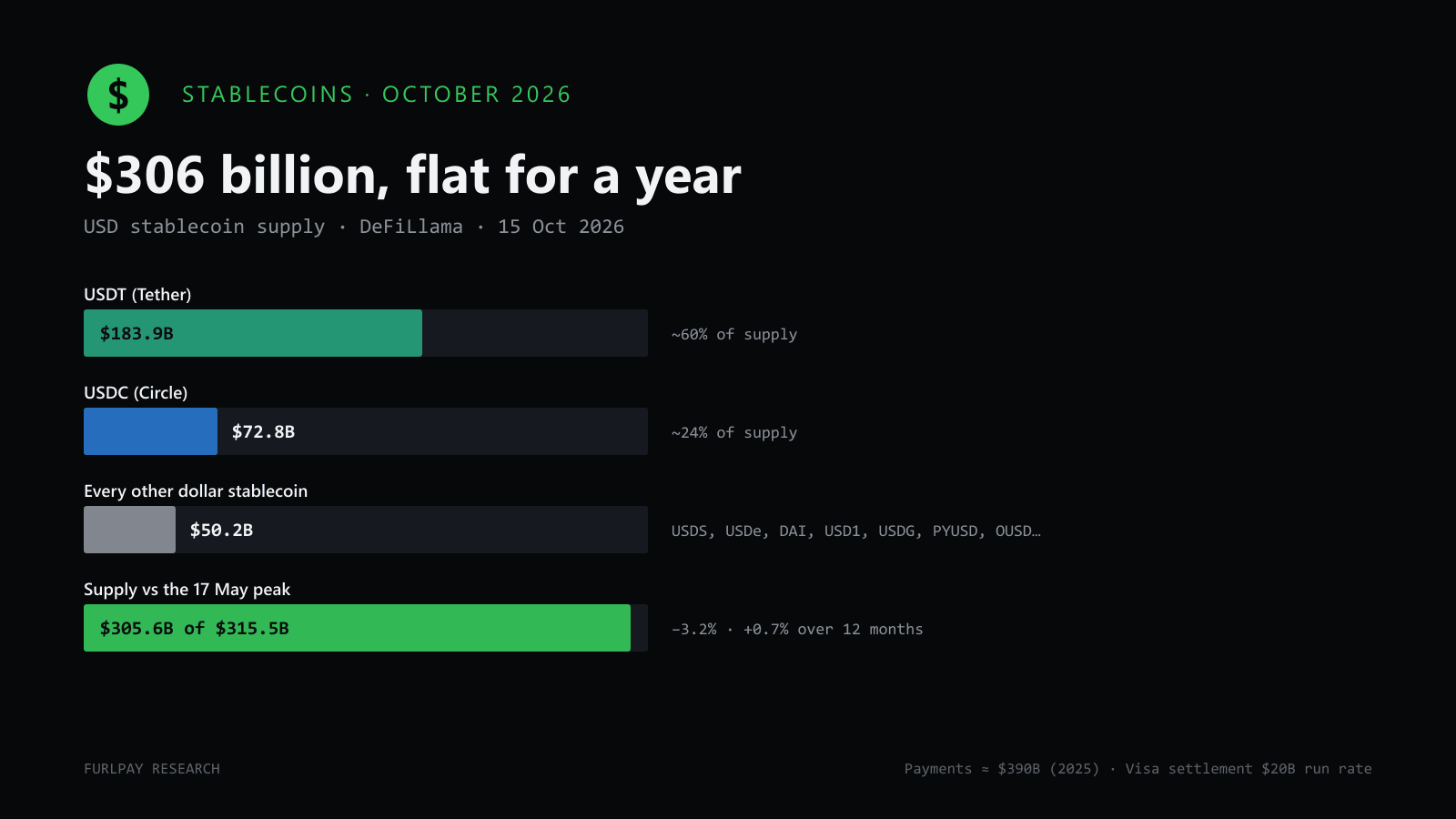
Dollar stablecoins total about $306 billion, almost exactly where they were a year ago, while the companies that run payments have stopped watching and started issuing. Here is the supply, issuer and chain picture measured on 15 October 2026, what is payments and what is not, and the rules that changed in the last month.
October 15, 2026 · 14 min read
The CLARITY Act Is Not Dead. It Is Running Out of Calendar.
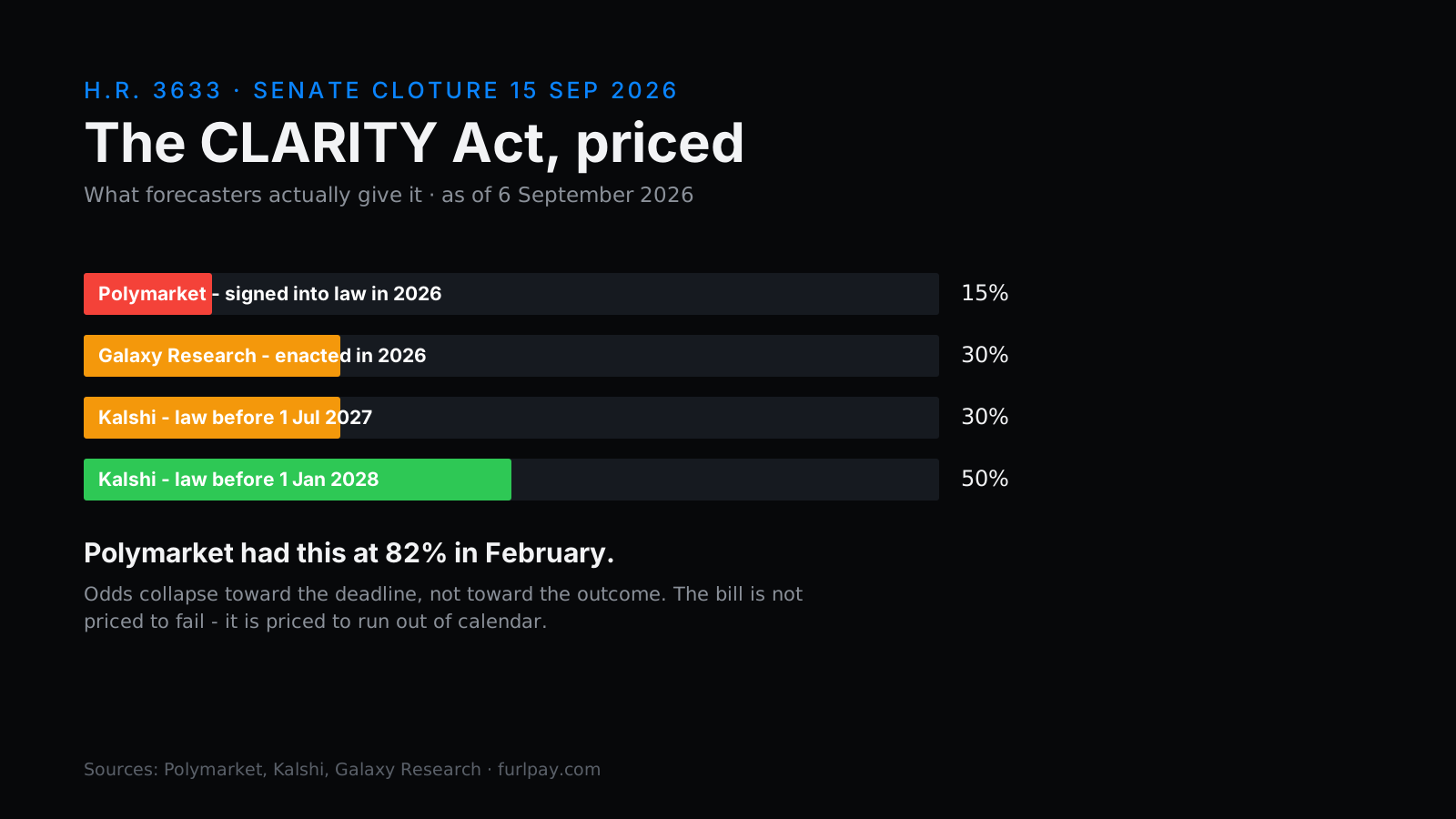
Updated 12 October: the 15 September cloture vote failed 49–50. Before it, prediction markets gave the CLARITY Act a 15% chance of becoming law in 2026 — and 50% by January 2028. The bill is late, not dead. Meanwhile JPMorgan settles more than $7bn a day in tokenized deposits without waiting for it. What the 15 September Senate vote decided, what atomic settlement does and does not fix, and why the strongest objections come from the people who understand market structure best.
September 7, 2026 · 23 min read